THANK YOU FOR SUBSCRIBING

Aerospace and Defense Review Weekly Brief
Be first to read the latest tech news, Industry Leader's Insights, and CIO interviews of medium and large enterprises exclusively from Aerospace and Defense Review

 James Grzella, Senior Advisor and Hwa Yu, CEO
Beneath this progress runs a complex current of export controls, procurement laws and contrasting organizational cultures that require seamless alignment across borders. Delta One was founded in 2020 to deliver the expertise that makes this happen.
A U.S.-based consultancy, Delta One specializes in industrial cooperation and offset programs. It is committed to making the collaboration between U.S. and South Korean aerospace and defense organizations compliant and commercially viable.
“Our role is to make trans-Pacific collaboration more attainable,” says Hwa Yu, CEO. “We understand the cultural expectations, the business languages and the constraints on both sides, and we use that insight to create alignment where most see friction.”
Delta One’s credibility is earned from experience on both sides of the U.S.-ROK alliance. Yu is a bilingual legal and trade specialist with years of experience navigating policy frameworks and contract negotiations with U.S. and Korean government agencies and industry players. Senior advisor James Grzella brings more than five decades of high-level private sector experience in senior roles at Raytheon, ATK (now part of Northrop Grumman); as a consultant/ contractor for Aerospace & Defense companies (Boeing, Lockheed Martin, Rockwell Collins, Mitsubishi Heavy Industries); and, as a U.S. Army Foreign Area Officer (FAO) and the Liaison Officer in the Joint U.S. Military Affairs Group in South Korea. Director Mirim Nam spent 20 years at the U.S. Embassy in Seoul as a Senior Economic Specialist and, based in Los Angeles, leads Delta One’s West Coast coverage.
Together, this team gives Delta One an edge that few advisory companies can claim—an insider’s understanding of the U.S. and South Korean defense business environments.
Delta One’s core work revolves around enabling the entry and growth of aerospace and defense companies in regulated U.S. and South Korean defense markets. The team advises on licensing, partnership structuring and compliance with U.S. International Traffic in Arms Regulations (ITAR) and South Korea’s Defense Acquisition Program Administration (DAPA) requirements.
It turns policy goals into partnerships that sustain long-term capabilities. With South Korea pushing to become the world’s fourth-largest defense exporter and the U.S. focused on reinforcing trusted supply chains, Delta One serves as a translator of intent.
Navigating Policy, Culture and Compliance
Defense transactions between the U.S. and South Korea are governed by a network of treaties, memoranda and industrial participation programs. Even a minor oversight can delay approvals or derail progress. Delta One minimizes risk through proactive coordination with both governments’ oversight agencies and by maintaining current insight into policy updates that affect technology transfer or co-production.
Cross-border defense collaboration depends as much on understanding policy as it does on managing people. Delta One operates at that intersection. Drawing on extensive experience in bilateral negotiations, export licensing and government relations, its consultants expertly guide clients through shifting policy environments.
-
We understand the cultural expectations, the business languages and the constraints on both sides, and we use that insight to create alignment where most see friction.
Defense transactions between the U.S. and South Korea are governed by a network of treaties, memoranda and industrial participation programs. Even a minor oversight can delay approvals or derail progress. Delta One minimizes risk through proactive coordination with both governments’ oversight agencies and by maintaining current insight into policy updates that affect technology transfer or co-production.
Equally important is its attention to cultural context. Business practices in Seoul and Washington differ in terms of pace, hierarchy and language of communication. Delta One’s bilingual consultants interpret these subtleties for clients, guaranteeing negotiations and proposals move forward seamlessly. This cultural intelligence often determines whether or not a promising opportunity turns into a sustainable partnership.
Strengthening Bilateral Market Access
Delta One’s strength lies in its ability to turn bilateral potential into tangible market access. It supports both South Korean and U.S. defense companies in identifying qualified partners, establishing compliant relationships and navigating multi-layered approval systems.
Each engagement begins with a detailed understanding of the client’s strategic goals through SWOT analysis, whether entering a new market, securing an offset contract or supporting a foreign military sales program. It then helps them decide between working directly with a U.S. or South Korean defense company or pursuing opportunities as a subcontractor to a local defense contractor. Once the business model is finalized, clients are matched with a reliable partner to collaborate with.
“Once we’ve identified a potential company, I spend about 40 hours researching and then assess if it is the right fit for the client,” says Grzella. “We go above and beyond to match our clients with the absolute best.”
Precision and accountability are key pillars of Delta One’s advisory approach. Instead of providing broad market overviews, it develops targeted strategies aligned with both nations’ procurement priorities. The team’s insights into DAPA in South Korea and the U.S. Department of Defense acquisition process allow clients to anticipate challenges before they arise. By bridging procedural and cultural differences, it ensures that partnerships are grounded in operational clarity and mutual gain.
Empowering Small and Medium Enterprises
Small and medium-sized enterprises (SME) face steep barriers when entering foreign defense markets. Delta One gives SMEs the same strategic and procedural support that larger firms enjoy. It structures teaming agreements, advises on export control documentation and ensures that all transactions comply with ITAR and DAPA requirements.
Delta One’s team simplifies regulatory complexity and builds confidence in leadership teams new to defense exports. By guiding clients through every phase, from initial opportunity assessment to long-term sustainment, it expands the circle of participants in the U.S.-Korea defense supply chain.
Supporting Strategic Growth for Allied Resilience
Evolving global defense supply chains are driving the U.S. and South Korea to strategically synchronize their production strengths for greater mutual advantage. South Korea’s growing export profile in systems like self-propelled howitzers, armored vehicles, navy vessels and fighter aircraft has reshaped the balance of capability in the Indo-Pacific. Delta One plays a key role in aligning that growth with the U.S.’s strategic priorities.
It assists clients in structuring programs that contribute to broader alliance resilience, whether through co-development, licensed production or joint maintenance initiatives. Each engagement is designed to meet commercial objectives while strengthening the interoperability and industrial depth of the alliance itself.
Building Credibility through Experience
Clients rely on Delta One not just for advisory support, but for judgment—when to pursue an opportunity, when to pause and how to maintain compliance throughout every stage of engagement. Its network across the U.S. and South Korean defense and aerospace industries provides a foundation for insights that extend beyond transactional advice.
Its consultants maintain ongoing relationships with key stakeholders, allowing clients to anticipate changes. This foresight has become especially valuable as export controls, security classifications and alliance priorities evolve.
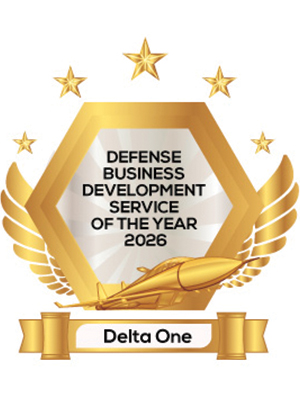
By translating regulations into opportunity and cultural nuance into collaboration, the company continues to strengthen the alliance that inspired its creation. In an industry defined by barriers, Delta One’s ability to open pathways that reflect the shared goals of two enduring partners has earned it the recognition of Defense Business Development Service of the Year 2026.
Embracing Change: Opportunities in Defense Business Development
Defense business development services play a pivotal role in connecting government defense needs with capable private-sector solutions. As defense ecosystems grow more complex, competitive, and technology-driven, organizations can no longer rely solely on technical excellence to secure contracts. Defense business development services help companies identify opportunities, position offerings, build strategic relationships, and navigate long sales cycles typical of defense markets.
The services act as a bridge between innovation and acquisition, ensuring that promising capabilities reach military and defense customers effectively. With rising security concerns, modernization programs, and multinational collaboration, the demand for specialized defense business development expertise continues to expand across global markets. The services enable strategic growth, portfolio diversification, and sustainable revenue streams. Companies gain clearer visibility into future demand and align research, hiring, and investment decisions accordingly.
Strategic Modernization in Defense: Opportunities for Business Development
Governments continuously invest in upgrading platforms, systems, and capabilities to address emerging threats and maintain strategic advantages. The modernization creates a steady pipeline of opportunities across land, air, sea, space, and cyber domains. Defense business development services help companies align their offerings with these priorities and articulate value in a way that resonates with defense decision-makers. Business development service providers step in to guide market entry, partner selection, and compliance, enabling new entrants to compete alongside established defense contractors.
Shifting alliances, regional conflicts, and evolving security strategies prompt governments to reassess defense capabilities and procurement strategies. The advisory role becomes valuable when companies expand into international defense markets with different regulations and acquisition cultures. Defense customers increasingly emphasize mission effectiveness, lifecycle support, and interoperability rather than standalone products. Business development services now focus on solution-based positioning, consortium building, and long-term sustainment strategies.
Defense acquisitions often rely on trust, credibility, and long-term engagement. Business development services emphasize stakeholder mapping, engagement planning, and consistent communication to build durable relationships across military, civilian, and industry networks. Digitalization shapes market trends. Defense organizations adopt digital procurement tools, data-driven evaluations, and collaborative platforms. Defense business development services increasingly incorporate digital intelligence, opportunity tracking, and competitive analysis tools to improve responsiveness and strategic planning.
Transforming Defense Business Development with AI
Technology implementation has transformed how defense business development services operate. The systems provide visibility into opportunity pipelines, engagement history, and decision timelines. Advanced analytics layered onto the platforms help teams prioritize efforts based on probability, strategic value, and resource alignment. AI and data analytics enhance opportunity identification and qualification.
Business development teams use these insights to engage early, shape requirements, and position solutions before formal solicitations appear. Knowledge management systems support proposal development and capture management. Defense business development services rely on institutional knowledge, past performance data, and competitive intelligence. Digital repositories enable faster access to lessons learned, win themes, and compliance templates, improving proposal quality and consistency.
Defense pursuits often involve cross-functional teams spanning engineering, legal, finance, and partners. Secure collaboration platforms enable coordinated planning, document sharing, and real-time communication, even across geographically distributed teams. Applications of defense business development services span the entire defense value chain. For established contractors, these services support strategic account management, pipeline development, and long-term customer engagement.
Public-private collaboration initiatives rely on business development expertise. As governments seek innovation through collaboration with industry and academia, business development services facilitate consortium formation, funding applications, and stakeholder coordination. Across all applications, technology-enhanced defense business development services improve speed, accuracy, and strategic focus, enabling organizations to compete more effectively in demanding defense markets.
Navigating Resource Constraints in Defense Business Development
Defense business development services mitigate this risk by embedding compliance expertise into opportunity planning and partner selection. Defense customers may limit information sharing due to security concerns, making it challenging to assess requirements and competitive landscapes. Business development professionals rely on relationship networks, domain expertise, and strategic intelligence to interpret limited signals and inform decision-making.
Resource constraints further complicate defense business development efforts. Smaller firms may lack dedicated teams or the budget to pursue multiple opportunities. Cultural differences between commercial and defense environments can hinder success. Defense customers prioritize reliability, accountability, and mission alignment over speed or novelty. Business development services help translate commercial innovation into defense-relevant value propositions that emphasize risk reduction and long-term support.
The need for defense business development services continues to grow as defense environments become more dynamic and interconnected. Governments demand faster innovation, stronger partnerships, and better value for money. Companies must respond with agility while maintaining compliance and credibility. Defense business development services provide the strategic guidance, market intelligence, and relationship management required to succeed under these conditions.
Future solutions will likely integrate deeper analytics, scenario planning, and digital engagement tools. The human elements of trust, judgment, and strategic insight will remain central. Driven by modernization, geopolitical change, and innovation, this market continues to expand in scope and importance. Through advanced technology, structured processes, and deep domain expertise, these services help organizations overcome regulatory, competitive, and operational challenges. Their impact reaches beyond individual companies, strengthening defense ecosystems and supporting mission readiness.
...Read more
| Share this Article: |
Company
Delta One
Management
James Grzella, Senior Advisor and Hwa Yu, CEO
Description
Delta One is a Virginia–based advisory company specializing in U.S.–South Korea defense collaboration. It guides companies through export rules, compliance demands and cultural differences to form stronger partnerships, enter new markets and grow sustainably across both nations’ aerospace and defense sectors.