THANK YOU FOR SUBSCRIBING

Aerospace and Defense Review Weekly Brief
Be first to read the latest tech news, Industry Leader's Insights, and CIO interviews of medium and large enterprises exclusively from Aerospace and Defense Review


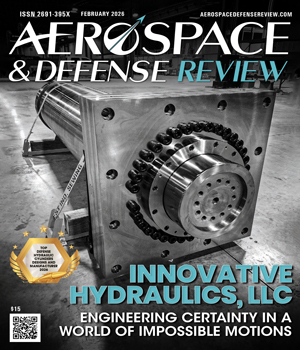
Engineers in defense and aerospace often face a problem that looks deceptively simple on paper: they need something to move from Point A to Point B under load, without fail. A cylinder must push, pull, lift, or position a mass and behave predictably across temperatures, pressures, velocities, and alignments that no textbook can fully capture. These systems sit at the heart of launch infrastructure, missile elevation platforms, mobile bridging equipment, naval mechanisms, industrial press machines, and civil structures. Yet the actuators that drive them are rarely as straightforward as their linear motion implies. Behind every stroke lies a volatile combination of physics, safety, and environmental exposure that makes the act of “going in and out” a far more sophisticated engineering challenge.
From the outset, the company positioned itself at the intersection of engineering rigor, manufacturing discipline, and environmental resilience. Its work ranges across aerospace, defense, industrial presses, heavy mobile equipment, and civil engineering, yet every project they accept carries a similar DNA: unusual size, unusual load, unusual environment, or unusual precision. These are the cylinders that cannot fail.
 For decades, defense contractors and aerospace integrators have struggled to find cylinder manufacturers willing or able to engineer around these realities. Off-the-shelf units rarely survive the loads. Commodity suppliers lack the testing capacity. High-production manufacturers cannot adapt their processes to the slow, iterative work needed for custom, mission-critical actuation.
The result is a quiet but persistent bottleneck: programs stall, launch hardware underperforms, mobile military systems degrade faster than expected, and engineering teams search for suppliers who can design not just a component but a solution.
Innovative Hydraulics, LLC was built for this problem.
Rather than compete in the crowded space of standard catalog cylinders, the company defined itself around a single conviction: complex motion deserves complex engineering. Where other manufacturers seek volume, Innovative Hydraulics seeks difficulty. Where others deliver a part, the company delivers a piece of an engineered system. And where many suppliers hope customer requirements conform to their production capabilities, Innovative Hydraulics reshapes its processes to meet those requirements head-on.
We will take on any challenge that a customer has and, if it is within the laws of physics, we will come up with a solution.
Designing for the Real Problem
The company’s value becomes clearer when examining how most hydraulic challenges actually behave. A cylinder rarely experiences a single static load. Instead, it moves through a curve, lifting an object from horizontal to vertical, steering a platform across uneven ground, raising a launch vehicle from its cradle, or controlling the elevation of a missile guidance assembly. Forces increase, decrease, shift laterally, or spike unexpectedly. Many manufacturers design for the maximum value on the spec sheet. Innovative Hydraulics designs for the entire journey.
This philosophy forms the core of their engineering approach. Instead of treating a cylinder as a standalone object, the firm treats it as a dynamic structural participant whose weakest point must be identified and reinforced. Engineers map load curves, model positional stresses, analyze environmental conditions, and develop materials and seals that survive both violent motion and long idle periods.
 Such attention to detail solves real problems customers struggle with. Defense applications require zero-leak precision under shock loads. Aerospace systems may sit dormant for years and then transition instantly into motion. Heavy mining clients run their equipment continuously in abrasive, freezing, or heat-intensive environments. Civil installations must survive decades underwater. Each condition demands a different material strategy, plating option, seal geometry, or thermal tolerance. This emphasis on problem-solving is also what distinguishes the company culturally.
“We will take on any challenge that a customer has and, if it is within the laws of physics, we will come up with a solution. This mindset of equal parts confidence and discipline has guided us into some of the most unique actuator programs in the country,” says Jim Tobul, President.
A Narrative Written in Difficult Projects
To understand why engineers seek out Innovative Hydraulics, it helps to follow the arc of a few representative challenges.
NASA’s crawler transporter, for example, is a machine many Americans have seen but few appreciate in detail. It carries launch vehicles from the assembly building to the pad over a trek of miles, but its steering system must perform with perfect smoothness despite the vehicle’s enormous mass. When NASA chose to modernize the crawler ahead of new missions, they presented Innovative Hydraulics with drawings originally marked for the Saturn V era. The legacy design worked, but materials science and seal technology had advanced significantly.
Innovative Hydraulics re-engineered the cylinders with updated alloys, improved plating, and seals built for a duty cycle NASA had never originally imagined. The agency’s expectations were exacting: no chatter, no leakage, perfect positional control. The cylinders met those standards, and when NASA later expanded its Artemis program, the agency returned to Innovative Hydraulics for additional upgrades, an endorsement no marketing department could equal.
Another story, known internally as a “quiet milestone,” involved a 65-foot-stroke cylinder designed for a defense-related manufacturing process. The length alone introduced significant engineering risks. Alignment tolerances that are trivial on a one-foot cylinder become unforgiving at more than sixty feet. The piston and rod must remain parallel, the seals must behave uniformly across the entire stroke, and machining must hold a perfect geometry. Innovative delivered the unit successfully. Months later, the customer ordered another.
There are also the telescoping cylinders, one of the company’s signature competencies. As rockets grew taller and heavier, aerospace clients needed cylinders that could pack compactly while producing long, stable extension strokes reaching up to ninety feet. Innovative designed multi-stage telescopes capable of lifting launch vehicles from horizontal to vertical positions, each stage sized to handle precise load transitions without compromising structural integrity.
Such projects demonstrate not just technical prowess but a deliberate rejection of simplification. Many manufacturers excel in high-volume, cost-efficient cylinders. Innovative Hydraulics excels where that model fails, in low-volume, highly specialized, deeply engineered solutions.
-
We strive to keep everything in-house so we control the quality of the product and the workmanship.
Such projects demonstrate not just technical prowess but a deliberate rejection of simplification. Many manufacturers excel in high-volume, cost-efficient cylinders. Innovative Hydraulics excels where that model fails, in low-volume, highly specialized, deeply engineered solutions.
Manufacturing Rigor as Competitive Advantage
Engineering alone cannot solve the industry’s actuator problem; production discipline must match it. Innovative Hydraulics built its reputation by insisting that design and manufacture remain tightly integrated. The company keeps nearly all critical processes in-house: machining, welding, threading, assembly, finishing, and testing. This choice trades some economies of scale for absolute control over tolerances, metallurgy, cleanliness, alignment, heat treatment, and weld quality.
 The welding capability inside the facility rivals that of specialized aerospace shops. Thick-wall high-pressure cylinders sometimes require welds that take more than sixteen hours to apply and finish, followed by radiographic inspection to catch even microscopic porosity. Materials range from carbon steels to stainless steel, to aerospace alloys, to titanium. Every weld procedure is documented and every heat cycle is verified.
Equally important is the company’s machining capability. As cylinder lengths increase, the demands on parallelism and concentricity escalate dramatically. A tool deviation that would be irrelevant on a short cylinder can cause catastrophic wear on a long stroke. The shop uses newer CNC systems that hold tolerances across lengths that most manufacturers avoid.
Surface finishing provides another layer of differentiation. Laser cladding, advanced coatings, underwater-rated paints, and hard chrome plating are applied according to environmental demands. Rod finishes must not only resist corrosion but also maintain low friction under dynamic loads. Every decision is rooted in environment-specific logic.
Testing is where Innovative Hydraulics eliminates any remaining uncertainty. The company runs static pressure tests and dynamic load tests, but some customers require far more. Life-cycle testing with hundreds of thousands of strokes is not uncommon; the company simulates load while pressurizing the cylinder to recreate real operating conditions. Its fixtures can apply millions of pounds of force. Engineers observe leakage rates, heat buildup, deformation, and seal fatigue. When the cylinder reaches the customer, it is already proven, not just predicted.
Engineering as a Competitive Identity
If there is a single thread connecting all of Innovative Hydraulics’ project stories, it is a very particular view of what engineering should accomplish. For many competitors, a hydraulic cylinder is a commodity defined by bore, rod, stroke, and pressure. For Innovative Hydraulics, it is a moving structure embedded in a larger system, shaped by forces that change second by second. The company designs accordingly.
 This explains its appeal to defense customers, who operate in environments where motion must be precise, repeatable, and dependable under stress. Missiles require elevation systems that allow no drift. Portable military bridges must deploy flawlessly under the weight of armored vehicles. Equipment exposed to extreme weather must avoid frost-locking or seal hydroplaning. Actuators in deep-water or sub-ice conditions need coatings and geometries that withstand decades of service.
Innovative Hydraulics does not simplify these problems; it absorbs them.
The company’s staff culture reinforces that identity. Many engineers and technicians have worked together for fifteen to twenty years, and newer employees are trained under a mentorship model that preserves institutional knowledge. This continuity allows the company to approach each new challenge with layered expertise in design, materials, welding, seals, testing, and field behavior.
Growth through Deeper Expertise, Not Broader Volume
As demand for its engineered solutions increases, Innovative Hydraulics is expanding its facility footprint, machining length capacity, and technical staff. New long-bed machining centers representing multimillion-dollar investments allow the company to internalize work once subcontracted. The company has also increased its manufacturing space, added to its engineering team, and grown its buyer and sales groups. The goal is not to chase commodity markets but to deepen its capacity for the kind of work that built its reputation.
Tobul’s view of the future is pragmatic. “We are not afraid of most any challenge,” he notes, and the remark reflects the company’s willingness to take on applications that defy easy categorization. But he also clarifies that the goal is not uncontrolled expansion; it is meaningful expansion into more programs that require the kind of precise, high-performance cylinders the company specializes in.
Defense remains a major opportunity. Many government program offices still do not know that a firm capable of highly engineered cylinders, tested, documented, and validated to mission standards, exists within domestic manufacturing. Innovative Hydraulics hopes this visibility changes that.
In a sector where motion must be perfect and failure is not an option, Innovative Hydraulics stands not as a commodity supplier but as a problem-solving partner. It is a company that makes the difficult possible, the complex manageable, and the uncertain measurable. For the engineers who rely on them, that difference defines everything.
“We strive to keep everything in-house so we control the quality of the product and the workmanship,” concludes Tobul.
Designing Defense-Grade Hydraulic Cylinders Under Exacting Demands
Defense programs depend on hydraulic cylinders that perform reliably over long service lives, irregular duty cycles, and extreme physical conditions. Procurement leaders responsible for these systems face a narrow margin for error. Failure rarely comes from basic actuation, but from subtle misalignment between design assumptions and real-world loading, storage or environmental exposure. Cylinders may sit idle for extended periods, shift abruptly from static to dynamic states or operate under variable loads that change continuously during motion. In this environment, reliability is not a function of volume manufacturing or catalog specifications, but of disciplined engineering choices made for a specific use case.
A defining challenge in defense cylinder acquisition lies in load variability. Applications such as mobile missile systems, armored vehicle bridge deployment or precision elevation mechanisms impose changing forces as mass shifts through an arc of motion. Cylinders built around peak force alone risk accelerated wear or instability when operating through intermediate positions. Designs that account for load progression across the full movement profile tend to maintain positioning accuracy and service life more consistently. That capability depends on analytical modeling rather than standard sizing rules.
Sealing behavior introduces another layer of risk. Defense systems often require zero drift over long dwell periods, followed by precise movement under command. Leakage that might be tolerable in industrial settings becomes unacceptable when positioning accuracy or readiness is at stake. Seal selection must balance static retention, dynamic response and compatibility with pressure, temperature and environmental exposure. High-speed actuation, underwater deployment, cold-weather operation or elevated heat each impose different constraints, making generalized solutions unreliable.
Dimensional scale further complicates execution. Longstroke or large-bore cylinders magnify the consequences of minor deviations in machining or assembly. Parallelism and perpendicularity between the piston, rod and bore must be maintained across substantial lengths to prevent early wear from the first cycle onward. Manufacturing capability, not just design intent, determines whether these tolerances can be held consistently.
Programs in this sector also tend to emphasize validation over iteration. Prototyping is often impractical due to cost and size, placing greater weight on first-article testing. Static load verification, hydrostatic pressure testing and extended cycle testing under applied load are commonly required to demonstrate compliance before deployment. Suppliers must be able to replicate service conditions during testing, not merely confirm pressure containment.
Innovative Hydraulics aligns closely with these realities. Its work in defense applications reflects an emphasis on custom-engineered welded cylinders designed around specific load behavior rather than standardized formats. The company concentrates on larger bore sizes, multi-stage telescoping designs and extended strokes that many manufacturers cannot support internally. Its engineering approach incorporates load-curve analysis to ensure performance across changing force conditions, a requirement common in elevation and deployment systems. Manufacturing remains largely in-house, allowing tighter control over machining, welding and assembly tolerances. Testing infrastructure supports combined pressure and load validation, enabling first-article qualification for demanding defense and aerospace programs. These capabilities have been exercised in applications ranging from mobile bridge systems to precision-guided platform actuation, where leakage control, positional accuracy and longevity are decisive.
For those evaluating hydraulic cylinder partners, alignment between analytical design, manufacturing discipline and validation capability should guide selection more than production scale or unit cost. In that context, Innovative Hydraulics represents a disciplined choice for programs that demand engineered solutions built to application-specific requirements rather than adapted from general-purpose designs.
...Read more
| Share this Article: |
Company
Innovative Hydraulics, LLC
Management
Jim Tobul, President
Description
Innovative Hydraulics designs and manufactures high-precision, custom hydraulic solutions for aerospace, heavy equipment, defense, and civil engineering. Renowned for problem-solving and engineering rigor, the company transforms complex challenges into reliable, high-performance systems, delivering cylinders that meet extreme pressures, precise tolerances, and specialized requirements where off-the-shelf products fall short.