THANK YOU FOR SUBSCRIBING

Aerospace and Defense Review Weekly Brief
Be first to read the latest tech news, Industry Leader's Insights, and CIO interviews of medium and large enterprises exclusively from Aerospace and Defense Review


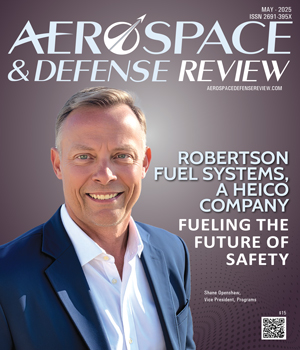
 Shane Openshaw, Vice President, Programs
Robertson Fuel Systems was started by Dr. S. Harry Robertson, a man who dedicated his life to researching, developing, and manufacturing safer fuel systems for military and commercial aviation. His work included conducting rigorous crash tests and drop tower experiments to understand human survivability in aircraft crashes. The crashworthy fuel system is the outcome of that research, which forms the backbone of the company’s current offerings. Its fuel tanks also incorporate self-sealing capabilities designed to withstand extreme ballistic threats, optimizing the safety and survivability of the aircraft and its crew.
Even more impressive, Robertson can develop and have fuel systems flying within just 12 months, where similar programs typically take three to five years. What sets Robertson apart is its ability to rapidly develop and deploy products which meet stringent government and military survivability standards.
“We provide mission commanders more than just reliable fuel solutions—we deliver fuel tanks that enhance both safety and operational success,” says Shane Openshaw, Vice President, Programs. “Our tanks are designed to ensure that even in the event of a crash, fuel remains safely contained to prevent post-incident fires.”
Robertson’s fuel system solutions offer ballistic self-sealing capability ranging from 7.62mm to 23mm threats, offering a lifeline in high-risk situations. In earlier designs, a highly flammable fuel system posed a risk in the case of survivable crashes or enemy fire, but Robertson’s fuel tanks have reduced those dangers, contributing to the preservation of lives. This commitment to survivability and mission success has established the company as a trusted partner in the most demanding environments, providing clients with the safest and most dependable fuel systems.
Next-level Fuel Systems
Robertson offers primary and auxiliary aviation fuel systems, ground vehicle fuel systems, crashworthy fuel cells and aviation support equipment with over 60 unique system variations. These solutions are on multiple military platforms worldwide, including the AH-64 Apache, H-60 Black Hawk, H-47 Chinook, V-22 Osprey, and UH-1Y Venom. In many cases, more than one product is available for each platform, including both internal and external auxiliary fuel tank options.
The aim is to provide mission commanders with maximum flexibility. For example, the Apache helicopter can carry one or two crashworthy, externally mounted auxiliary fuel tanks, each holding 125 gallons of fuel, the Combo-Pak, carrying 100 gallons of usable fuel along with some firepower, or both.
The Combo-Pak is one of Robertson’s most notable innovations, with an interesting backstory. Thanks to advancements in weapon accuracy, Apaches in combat were not consuming a full 1200 round magazine of 30mm ammunition during a typical mission, and often would return to base with ammunition remaining. It was clear additional fuel on board would enable the Apaches to stay in the fight longer and further extend the battle to the enemy. Recognizing this opportunity, the company designed, developed and built a 300-round magazine integrated with a 100-gallon fuel tank which can replace the original magazine. The balance between ammunition and additional fuel was a perfect “combination,” hence the name, “Combo-Pak.” The Combo-Pak can be swapped with the full-sized ammo magazine in less than 20 minutes, enabling rapid reconfiguration. The idea was implausible at first, but the company executed ingeniously and the Combo-Pak is now a standard addition to the Apache. This technology is a proven game changer in U.S. military operations, especially in Iraq and Afghanistan. The Combo-Pak has demonstrated its endurance during critical times by extending the Apache’s range by up to an hour, a distinct operational advantage in the field that the U.S. Army values highly.
From Concept to Combat
Robertson’s low non-recurring engineering (NRE) costs allow clients to be involved in developing and launching these kinds of new products. Whereas NRE costs are usually high in the defense sector, the company invests its own development funds. Products are delivered quickly to meet clients’ needs with fast approval and operational deployment. As a non-traditional defense contractor, Robertson can deliver products with more speed and at less cost, schedule, and development risk to the customer.
-
Not a single service member has perished in a post-crash fire when our product is on the aircraft. They survive the crash, our fuel tank holds up, and they N make it home to their families
This distinct approach has proven effective in enabling the company to respond rapidly to urgent operational needs from both U.S. and foreign military forces. In one example, the UK Ministry of Defence had an urgent operational requirement for a reduced size crashworthy external fuel system for their WAH-64. The system was developed and flying in less than 6 months. The US Army Bradley Fuel Cell Survivability (BFCS) Kit was also a rapid response to an urgent U.S. Army need. Robertson designed and fully qualified the system in less than 18 months, and delivered over 4,000 BFCS kits.
Beyond designing and manufacturing innovative fuel systems, Robertson conducts qualification testing. The U.S. military requires extensive testing for fuel systems, including slosh and vibration, drop, and gunfire resistance. Whereas other manufacturers, including large aircraft OEMs, often rely on independent laboratories for these tests, Robertson has everything in-house, saving time and reducing costs.
The company offers training programs for maintainers, instructing them how to properly maintain their tanks. Military units and intermediate-level maintenance teams receive all necessary technical publications to maintain their tanks. For more complex issues, Robertson handles repairs and overhauls, either onsite or at its facility. This model empowers maintainers to perform maintenance at the lowest level and keeps systems in the field operational.
Robertson has continually evolved its manufacturing capabilities and material technologies, and more efficiently than ever before making fuel solutions. The company stays at the forefront of innovation, delivering uncompromised safety performance in crashworthy fuel systems that bring our Servicemen and Servicewomen home safely.
As Openshaw puts it, “Not a single service member has perished in a post-crash fire when our product is on the aircraft. They survive the crash, our fuel tank holds up, and they make it home to their families.”
Selecting Survivable Fuel Systems for Mission Aircraft
Aviation fuel containment has now become a critical factor in acquiring a defense aircraft, as range, survivability, and platform availability are considered together. Additional capacity at a tank poses risks if it increases fire susceptibility, exacerbates maintainability issues, or alters the platform configuration. Commanders require additional range without loss in survivability. Acquisition managers desire a system that takes them from requirements to fielding in order without additional cost or disruption.
The basic criteria that a fuel system must meet are the environmental conditions expected in a mission. For Rotary-wing and Tactical aircraft this is defined by impact loads from a crash, ballistics, limited space for installation, and a continuous search for improved fuel, payload, and weapon tradeoffs. It would need to minimize fire post crash, retain fuel after a crash and resist threat fire. Such a requirement is restricting, as safety cannot be viewed as an addition to be "added on", but the aspect that is designed in.
Mission flexibility matters just as much. Defense buyers need fuel options that let crews configure an aircraft for the sortie ahead rather than accept a fixed compromise. A system should extend range or endurance while preserving useful payload, cockpit awareness and the ability to refuel, transfer or remove fuel equipment without turning a mission decision into a maintenance event. This is especially important for helicopter fleets that shift between combat, transport, reconnaissance and support roles. The best solution gives commanders more choices without asking them to change the aircraft’s basic purpose.
The procurement team must also consider how rapidly a supplier will be able to qualify and sustain the equipment. The fuel systems are an integral part of ensuring safety, airworthiness, and operability; hence, a purchaser will be needing proof of internal design control, test facilities, documentation, maintenance training, and repair services. Reliance on external facilities may entail additional cost and time delay considerations. The supplier who has all the necessary capabilities for designing, testing, manufacturing, training, and repairing in one program is more desirable since it gives a purchaser a straight forward line to go from requirement to fleet adoption.
An ideal purchase must strike a balance between protection, durability, and utility of the entire lifecycle, and not emphasize one attribute to the extent that it alone becomes sufficient. Extra fuel serves little purpose if it limits weapon carrying capacity or adds to maintenance costs. Crashing resistance serves little purpose if it cannot be sustained by field mechanics. Qualification serves little purpose if it hinges on a cumbersome and expensive development process. An ideal selection will ensure that aircrafts remain flexible, pilots remain safe, and systems are sustained with minimal hassle.
For organizations evaluating survivable aircraft fuel systems, Robertson Fuel Systems is a strong fit. Its portfolio aligns closely with the needs that matter most: crashworthy and self-sealing fuel containment, ballistic tolerance, range extension and mission configuration. Its defense products include crashworthy primary and auxiliary fuel cells, the Reduced Size Crashworthy External Fuel System for the AH-64 Apache and the Combo-Pak internal auxiliary fuel system, which combines usable fuel with ammunition carriage and cockpit-controlled fuel transfer. Robertson’s long focus on survivable fuel systems, in-house testing and sustainment support makes it especially well-suited for buyers who need protection, endurance and field practicality in a single integrated decision.
...Read more
| Share this Article: |
Company
Robertson Fuel Systems, A Heico Company
Management
Shane Openshaw, Vice President, Programs
Description
Robertson Fuel Systems specializes in life-saving fuel containment solutions for military and commercial aircraft and vehicles. Its fuel tanks are not just self-sealing; they are designed to withstand extreme conditions, ensuring the safety and survivability of both the aircraft and its crew.