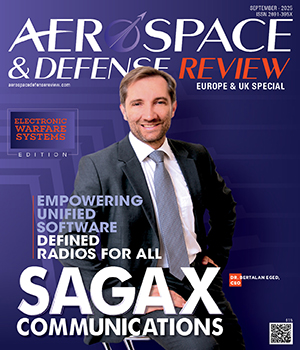
 Dr. Bertalan Eged, CEO
Today, Dr Eged is the CEO of Sagax Communications, the research and development division of Sagax Ltd., established to provide high-performance signal processing and data communication solutions in the embedded system market. In his current role, Dr Eged leads a dedicated community of professional engineers who seek continuous innovation, each of whom works tirelessly to invent and create affordable, cutting-edge radio electronics equipment and systems. The team has been working with SDR technology since the early 2000 years and has built a competitive product set based on that technology. All of their early prototypes and systems have been deployed and tested on the most dangerous battlefields over the last two decades and improved based on continual customer feedback. With decades of hands-on experience under their belt, Dr Eged and his team create military-grade SDR solutions based on internationally recognised SDR research and development that clients can leverage in the most demanding electronic warfare missions and environments, particularly in the defence sector.
Highly Configurable, Infinitely Variable
Complex military missions require highly sophisticated communication systems accompanied by high-end radio devices, requiring application-specific hardware and software components. At the beginning of the SDR era the US Army employed up to 25-30 radio families, working co-operatively with Navy and Air force systems but forgreater interoperability across mission-critical applications the SDR concept was introduced. Sagax Communications has developed a proprietary SDR with software running on programmable and reconfigurable hardware devices. Sagax’s offering is referred to as the “radio platform,” while the different software layers are called “the application framework.” This scheme provides universal and reusable components, which saves costs and can be upgraded. The SDR covers different hardware and software components, which can also be used as stand-alone products to build SDR based solutions.
Thus, Sagax’s solution set is ever-evolving and customisable, which is the reason for its current focus on developing radio frequency (RF) sensor-based integrated systems that can be tuned according to various customer workflow requirements. Sagax’s RF sensors provide smoother integration into the customer-specific data aggregation and processing workflow. The result is the ability to convert RF data coming from the sensor, aggregate and process it according to the workflow, and deliver high-end data. Sagax Communications’ thus provides receiver systems for SIGINT/COMINT electronic warfare and ITU compliant spectrum monitoring. The systems range from man-portable receivers to integrated site units with direction finding and record playback capabilities. Both civil and defence clients currently utilise them for a variety of applications, such as multimillion direction and position finding of in-field assets, spectrum monitoring, signal analysis and real-time electromagnetic scenario recording system for the HF, VHF and UHF and upper frequency bands.
Continued Innovation to Meet Ever-Evolving Needs
Sagax was most recently funded by the NRDI, Hungary, to develop SDR technology for non-cooperative drone detection and started to adjust their technology for this new challenging need. The project’s objective was to strengthen the domesticR&D potential in the field of radio communication equipment and application development requiring high skills, qualifications and experience, thus increasing the competitiveness of our domestic industry, effectively contributing to the creation of a knowledge-based economy. Sagax had to set up and create a knowledge base, a research and development workshop that Hungary can rely on to strengthen its presence in international (especially European) research and development co-operations. The practical and economical utilisation of successful development results can open up further R&D projects to create radio directional measuring instruments, which would answer real market demands, and prompt the preparation/marketing/sales of small series production.
As a result, Sagax built validation systems and began conducting field trials to increase their internal first-hand experience in counter drone warfare and sent one of their engineers to train as a licensed drone pilot. Trials began, and Sagax noted that counter-drone operations required specialised apparatus for processing time, frequency, and spatially agile signals, since most unhostile drones are high elevation, fast-moving targets. Subsequently, an advanced antenna array and processing platform were developed, and most of the processing work was handed over to the more real-time components such as Field Programmable Gate Arrays (FPGAs), making the system more resilient against e.g. drone swarm attacks. The capability results from the functional hardware elements present in the SDR, which are connected through open interfaces and predefined firmware procedures.

Continued Growth and the Thirst for Widespread Application
The company has always pushed the envelope on advancing the role of its technology in the field, which is on the edge of commercialisation, i.e., becoming a part of everyday life. Sagax developed its first software-defined radio more than 22 years ago, which was a very new technology. They were one of the first companies to have already developed the direct digital architecture for HF. Sagax was fortunate enough to have capable technological suppliers who could augment their internal research capability and provide the components necessary to develop such solutions. Be it 5G or electronic warfare, the company is always looking for quality partners to help them further their cause. As Eged puts it, “We have developed components and tools, but is it enough? Should we develop a niche product? Who do we choose as our partners moving forward? As a small company trying to enter the market, these are the questions we ask ourselves.”
-
We have developed components and tools, but is it enough? Should we develop a niche product? Who do we choose as our partners moving forward? As a small company trying to enter the market, these are the questions we ask ourselves
The company takes pride in its interdisciplinary approach, honing expertise in both radio frequency electronics and digital electronics. This complements its plans to advance into real-time FPGA signal processing capability. Additionally, Sagax Communications is preparing to venture into the aerospace sector and expand its preferences by capitalising on some of the contracts it has with the European Space Agency (ESA). One of the notable examples is developing a man-portable EW system for drone detection in a militarised scenario. Such futuristic concepts substantiate the adage, “The sky is the limit.”
| Share this Article: |
Company
Sagax Communications
Management
Dr. Bertalan Eged, CEO
Description
Sagax Communications deliver advanced radio-electronic solutions with mature mainstream commercial technology.