


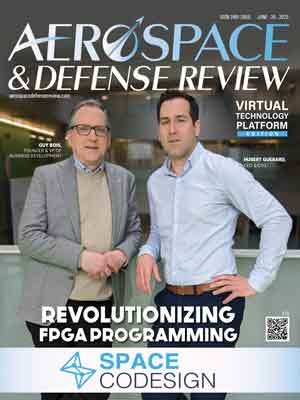
 Hubert Guerard, CEO & CTO & Guy Bois, Founder & VP of Business Development
To address this challenge, Professor Guy Bois, renowned for his expertise in hardware and software codesign, founded Space Codesign Systems. His goal was to simplify FPGA programming based on virtual platforms, making it more accessible to businesses and enabling the validation of applications in a streamlined manner. SpaceStudio, the company's flagship product, was born. It is a cutting-edge development environment that revolutionized the paradigm of FPGA programming.
A Vendor-Agnostic and Versatile Platform for Application-Driven Workflows
Bois, founder and VP of business development at Space Codesign Systems, describes SpaceStudio not merely as a dynamic virtual platform but as an application-driven workflow.

SpaceStudio’s functionalities are rooted in a unique methodology called codesign, which merges hardware acceleration on FPGAs with software running on processors. Hardware elements are designed and implemented on FPGAs to address specific tasks or algorithms, while processors handle general-purpose computing tasks. This system-centric, codesign environment allows for the simultaneous development of software and hardware, fostering improved collaboration and ensuring consistent and rigorous validation throughout projects.
One of SpaceStudio’s key differentiators is its ability to enable hardware implementation after application optimization. The platform executes the applications in a virtual environment, identifying optimized systems that can then be implemented on an FPGA board for final execution. This two-step development process begins with a system-level optimization process where the application and architecture are improved by creating different components, and by using simulation feedback to satisfy the requirements. The platform optimizes the combination of functions and re-generates the virtual platform based on the mapping of software and hardware functions. The resulting systems are then processed through a full system compiler, which generates a fully functional and deployable system for any FPGA board. SpaceStudio automates the downstream flow, invoking high-level synthesis (HLS) tools to generate register transfer level (RTL) IP for hardware-mapped functions, cross-compiling software-mapped functions for the target processor, and utilizing synthesis and place-and-route tools to generate the bitstream. At the end of the workflow, the resultant systems are executed on real hardware, enabling SpaceStudio to seamlessly interact with all three paradigms–hardware implementation, application development, and virtual platform.
A vendor-agnostic and versatile platform, SpaceStudio supports multiple FPGA vendors, including AMD/Xilinx, Intel/Altera, and NanoXplore. It also integrates with various HLS tools such as Vitis HLS, Intel HLS Compiler and with Siemens Catapult, it aims to penetrate the ASIC market, offering a cost-effective and seamless transitions from FPGA to ASIC environments. These diverse integrations allow developers to work with their preferred vendor tools, optimizing workflow and accelerating time-to-market while ensuring the designs meet their standards. SpaceStudio utilizes FPGA tools and provides an abstract view in C/C++, the preferred language of software and system designers.
In a rare feat in the industry, it seamlessly adapts its virtual platform to accommodate changes in system specifications during the development cycle. This agility allows for changes during the architectural exploration phase and provides a smooth transition from modeling to FPGA implementation. In essence, SpaceStudio is a dynamic virtual playground where developers can freely experiment, optimize, and bring innovative FPGA-based products to life.
Eliminating Non-Conformity and Fostering Collaboration
By integrating SpaceStudio into their design flow, businesses can eliminate the operational bottleneck that has long plagued FPGA design environments—the presence of non-conformities.
“SpaceStudio allows users to use the same environment for specification, development, and validation, increasing validation points and detecting issues early on,” says Hubert Guerard, CEO and CTO of Space Codesign.

With a top-down approach to development processes, SpaceStudio enables modifications at any point by any team, automatically incorporating them and ensuring consistency across different processes handled by various development teams. The platform abstracts FPGA complexities, bridging the gap between software and hardware components.
Spacestudio Is A Tool, Agnostic Of The Target, That Uses A Common Environment For Design Space Exploration, Interface Prototyping, Development And Functional Validation. This Allows For Continuous Validation And Early Detection Of Issues
To further align with client needs, Space Codesign offers supplementary services in virtual platform development and implementation, including modeling specific IPs for virtual platforms and low-level IP development using RTL code and HLS tools.
The product’s application and user-centric approach have streamlined FPGA environments for numerous businesses.
“SpaceStudio is a tool, agnostic of the target, which uses a common environment for design space exploration, interface prototyping, development, and functional validation. This allows for continuous validation and early detection of issues,” states Jérôme Lachaize, an HW/SW expert at Airbus Defence and Space.
M3 Systems, a company specializing in reliable and accurate geolocation, also benefited from adopting SpaceStudio. By putting their VHDL codes and low-level details into it, they could generate an abstract view, reducing the learning curve for their employees and facilitating the onboarding process for new systems.

“Its methodology, driven by the system-level optimization and full system compiler, simplifies algorithm development and implementation for a variety of FPGA, ensuring smoother lab integration. The adoption of SpaceStudio opens the way to innovative GNSS receivers’ architecture,” says Marc Pollina, CEO of M3 Systems.
Pioneering Innovation: A Visionary Approach
Space Codesign's ability to simplify FPGA programming is nothing short of remarkable. Success is attributed to its team of industry experts, comprising engineers from Polytechnique Montréal's innovation lab, where Bois developed the technology behind SpaceStudio. The lab continues to play a pivotal role in ongoing advanced research, serving as a source of top-tier talent. The engineers, mentored by industry stalwarts, possess deep knowledge and skills in hardware, software, and codesign environments, making them valuable assets to the company. Apart from that, Space Codesign's transition to remote working demonstrates the trust it places in its staff.
-
Spacestudio Allows Users To Use The Same Environment For Specification, Development, And Validation, Increasing Validation Points And Detecting Issues Early On
With a team comprising young and enthusiastic engineers, Space Codesign provides on-site support for clients located in different regions. The company's dedication to staying at the forefront of technological advancements has led to many strong alliances with industry titans.
In a recent milestone, it joined the Siemens Digital Industries Software Solution Partner Program as a software and technology partner. This collaboration allows the company to leverage cutting-edge technology, enhancing the platform's functionalities and improving system integrations in complex embedded systems. With access to tools like Catapult HLS, Space Codesign empowers customers to explore emerging technologies such as machine learning and machine vision.
Having built a substantial clientele in Europe, it has set its sights on expanding its footprint in the U.S., particularly in the aerospace industry. SpaceStudio enables rapid prototyping phases in the FPGA/ASIC design process, further solidifying Space Codesign's position as a pioneering force in the industry.
True to its name, Space Codesign provides a collaborative space for software and hardware development teams to codesign FPGA-based systems and bring innovative products to the market. As advanced algorithms continue to shape the landscape of technological advancements, it remains committed to blazing a trail and empowering enterprises to enhance their competitive stature.
| Share this Article: |

Company
Space Codesign
Management
Hubert Guerard, CEO & CTO & Guy Bois, Founder & VP of Business Development
Description
Space Codesign offers its cutting-edge flagship product SpaceStudio, a development environment that streamlines FPGA design flow algorithms, provides system-level optimization, and generates the entire system to be executed on a physical board.
Space Codesign News
Space Codesign Systems Participates in the Development of an Advanced OpenMP Framework for Enhanced Efficiency and Resilience in Spaceborne Systems

MONTREAL, -- Space Codesign Systems, a leading provider of end-to-end solutions for embedded systems design, is pleased to announce its participation in a collaborative project backed by the European Space Agency (ESA) to develop an advanced OpenMP framework for enhanced efficiency and resilience in spaceborne systems. This project is funded under the ESA's Open Space Innovation Platform initiative.
The growing complexity and diversity of embedded FPGA SoCs (System on Chip) in modern satellites pose significant challenges for software developers. Optimizing software deployment, ensuring compliance with safety and availability constraints, and maximizing development productivity are crucial for successful space missions.
Addressing Challenges in Parallel Programming for Space with the ESA
Traditional programming languages used in critical real-time systems struggle to handle the extreme parallelism offered by modern platforms. OpenMP, a widely adopted standard for parallel programming in high-performance computing, is emerging as a viable solution for exploiting parallelism within the SoCs used in critical domains.
While OpenMP offers a comprehensive set of functionalities and supports various CPU and accelerator devices, its application in space systems requires further development. This ESA-backed project addresses these challenges by proposing a novel OpenMP framework that integrates an enhanced parallel programming model with a customized compiler and runtime system.
Benefits of the New OpenMP Framework
This innovative framework offers a two-pronged approach:
• Resilience: Leverages the parallel and heterogeneous capabilities of SoCs to implement software fault-tolerance techniques such as replication, N-version programming, and advanced monitoring
• Efficiency: Provides tools for design space exploration, enabling optimal deployment configurations across CPUs, GPUs, and FPGAs within modern space SoCs
"Developing space applications requires uncompromising performance and reliability," said Hubert Guerard, CEO of Space Codesign. "By collaborating with the ESA and other leading organizations, this project will allow us to achieve resilient FPGA acceleration, ensuring critical space missions can operate effectively, even in harsh environments."
Project Consortium Expertise
The project leverages the expertise of a consortium of leading organizations:
• Barcelona Supercomputing Center: Specializes in adapting OpenMP for critical real-time systems, focusing on efficiency, productivity, resilience, and functional correctness. They will extend the compilation toolchain for code analysis and transformation.
• IRT Saint Exupéry and Space Codesign Systems: Offers expertise in FPGA deployment and design space exploration. They will contribute the TOAST and SpaceStudio technologies, with SpaceStudio serving as the integration and evaluation framework.
• Airbus Defence and Space: Provides crucial insights into spaceborne systems requirements, including performance and resilience needs. Airbus Defence and Space will also contribute the use case applications for evaluating the framework.
By combining the strengths of OpenMP with a next-generation framework, this project has the potential to revolutionize software development for spaceborne systems, leading to more efficient, robust, and reliable missions.