THANK YOU FOR SUBSCRIBING

Aerospace and Defense Review Weekly Brief
Be first to read the latest tech news, Industry Leader's Insights, and CIO interviews of medium and large enterprises exclusively from Aerospace and Defense Review


 Charles Sleeper, President and CEO
Achieving that level of combat readiness requires training technology that can accurately replicate enemy tactics to keep trainees on their toes. Here, precision radar-simulating antennas—like those engineered by UBC Inc—become mission-critical.
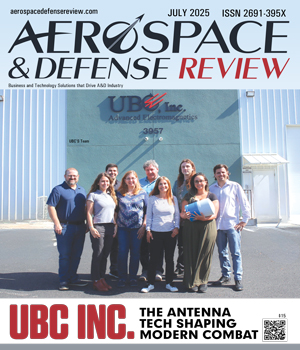
Founded in 1980 by Pat and Rebecca Crane, this Florida-based, Hispanic-woman-owned company has become an indispensable supplier for the U.S. military, preparing warfighters to detect, respond to and outmaneuver today’s increasingly sophisticated threats.
UBC’s signature innovation is its Cassegrain twist reflector antenna, a highly agile, lightweight system that allows for wide-angle scanning at extremely high speeds.
“Our solution allows us to provide a scanning antenna without some of the cumbersome and expensive electromagnetic pieces like a rotary joint that would go along with a standard Cassegrain antenna,” says Charles Sleeper, president and CEO.
In fact, very few companies around the world have mastered the technology behind UBC’s Cassegrain twist reflector antenna. The system features a Cassegrain reflector at the antenna’s front, which reflects the transmitted electromagnetic waveform onto a specially designed twist plate. This plate induces a phase shift that aligns, or co-polarizes, the signal with the main reflector, enabling efficient transmission into free space.
Its innovative design achieves beam steering solely by adjusting the lightweight twist plate. The plate’s low inertia helps the system scan rapidly and with high positional accuracy without relying on heavier, slower mechanical components. UBC’s antennas can now deliver fast, precise performance that is ideal for simulating complex radar threats in dynamic environments.
-
Our solution allows us to provide a scanning antenna without some of the cumbersome and expensive electromagnetic pieces like a rotary joint that would go along with a standard Cassegrain antenna
These antennas also address key challenges in radar threat simulation, maximizing time-on-target and integrating tracking technology. This enables accurate signal replication across frequencies, even from moving drones, ensuring receiver systems can reliably detect and interpret simulated threats during electronic warfare training.
Such capabilities have made UBC a trusted supplier to the U.S. Department of Defense. Its antennas have been used on legacy target drones like the QF-4, as well as on naval platforms including the BQM-74 and BQM-34, all of which play essential roles in weapons testing and pilot readiness programs. UBC carefully balances performance with cost—engineering antennas that are both highly threat-representative and reasonably priced. This combination makes UBC’s solutions especially well-suited for large-scale, repeatable training scenarios where realism and affordability are equally critical.
Recently, UBC has collaborated with the University of Oklahoma on a radar system designed as a GPS backup system for the U.S. Navy. The company also holds an indefinite delivery/indefinite quantity (IDIQ) contract with the Navy for nine variants of its antennas, ensuring a stable pipeline of government work for years to come.
Despite the technical complexity, the heart of UBC’s value lies in its human-centric approach. Over the years, the company has avoided the typical growth-at-all-costs model, instead choosing to focus on enduring excellence in a specialized, high-stakes domain. It still operates as a lean, focused operation with nine to ten employees generating three to four million dollars in annual revenue. The company prides itself on exceptionally low turnover, with some employees having worked there for nearly 30 years—longer than Mr. Sleeper’s own tenure of 20 years.
The team is already planning a new product cycle to build the next generation of antennas that will meet emerging defense requirements over the coming decade. As long as pilots need to practice against the radar emissions of tomorrow’s enemies, UBC’s twist-reflector devices will keep turning.
Advancing Threat Simulation Through Precision Antenna Engineering
Modern aerospace and defense testing programs depend on radar simulation environments that can mirror real-world threat behavior without introducing unnecessary cost, weight or system complexity. Training systems, autonomous target drones and weapons validation platforms now require antenna technologies capable of replicating diverse radar signatures across broad frequency ranges while maintaining rapid beam steering and signal fidelity. Procurement leaders evaluating aerospace antenna development providers increasingly focus on whether a solution can sustain simulation accuracy under dynamic flight conditions while remaining adaptable to evolving mission requirements.
Programs tied to pilot training and missile testing place unusual pressure on antenna developers because the systems involved must support both realism and repeatability. A narrow-purpose antenna may perform well in a controlled environment yet struggle when tasked with emulating multiple threat profiles across changing scenarios. Broad-spectrum simulation demands flexible architectures that can scale across frequencies without sacrificing responsiveness. Speed of beam positioning has become equally important because airborne simulation platforms often operate in fast-moving environments where delay or drift can compromise data quality and training realism.
Another challenge stems from balancing capability against lifecycle cost. Defense organizations continue to modernize testing infrastructure while managing finite procurement budgets. Antenna assemblies integrated into expendable or semi-expendable drone platforms cannot rely on excessively complex mechanical systems that increase maintenance burdens or replacement costs. Buyers therefore place greater value on antenna developers capable of simplifying system architecture while preserving tracking precision, signal consistency and electromagnetic performance.
The strongest engineering groups in this segment also demonstrate an ability to adapt existing platforms into semi-custom solutions rather than forcing customers into rigid product configurations. Radar simulation programs rarely follow a uniform template. Frequency coverage, scan behavior, tracking requirements and integration constraints differ across naval aviation programs, electronic warfare exercises and target drone deployments. Development teams that can tailor antenna geometry, beam control characteristics and tracking behavior around customer requirements often deliver greater long-term utility than providers focused only on standardized hardware production.
Beam steering efficiency has also emerged as a major differentiator. Traditional scanning approaches can introduce additional weight, inertia and mechanical limitations that reduce responsiveness in airborne environments. Lightweight steering mechanisms capable of maintaining accurate positioning while minimizing hardware complexity support better target illumination and stronger simulation continuity during flight operations. These characteristics become particularly important when testing systems must identify or classify signals under constrained power conditions.
UBC stands out in this environment because its engineering work is closely tied to airborne threat simulation and defense testing applications. The company has spent decades supporting target drone and pilot training programs through semi-custom antenna systems built around its Cassegrain twist reflector technology. Its antennas are designed to simulate hostile and friendly radar threats while supporting rapid scan rates and accurate beam positioning. The company’s optical and electromagnetic approach allows beam steering without relying on conventional rotary-joint configurations, reducing mechanical burden while improving response speed. UBC has also developed tracking capabilities that maximize time on target during simulation exercises, improving signal recognition for systems under test. Long-term Defense Department relationships, ongoing Navy contract work and continued next-generation antenna development reinforce its position as a credible choice for aerospace and defense organizations requiring specialized radar simulation support.
...Read more
| Share this Article: |

Company
UBC Inc.
Management
Charles Sleeper, President and CEO
Description
UBC Inc. is a Florida-based, Hispanic woman-owned company specializing in advanced radar-simulating antennas for defense training. UBC supports U.S. military readiness with high-speed, cost-effective systems like its signature Cassegrain twist reflector antenna, enabling realistic, repeatable electronic warfare simulations in an increasingly complex global threat environment.