THANK YOU FOR SUBSCRIBING

Aerospace and Defense Review Weekly Brief
Be first to read the latest tech news, Industry Leader's Insights, and CIO interviews of medium and large enterprises exclusively from Aerospace and Defense Review


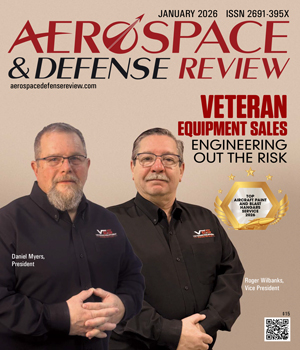
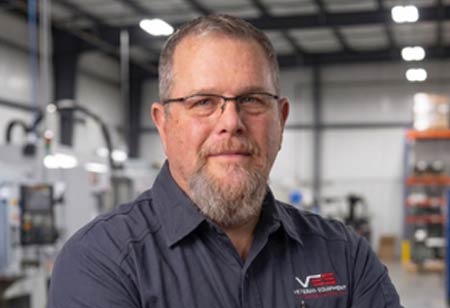
 Daniel Myers, President and Roger Wilbanks, Vice President
That belief was forged over decades in aircraft sustainment, from his early service in the United States Air Force to his later role at a major aircraft depot facility. There, every strip, blast, and repaint demanded absolute precision, yet the environments supporting that work often lagged far behind the hazards involved.
Throughout his career, Myers repeatedly saw technicians performing high-risk corrosion control tasks in outdated facilities with poor airflow, improperly sealed equipment, and a lack of knowledge on hexavalent chromium, exposing them to toxic dust and long-term health consequences. Safety was treated as an individual responsibility rather than an engineered condition. Watching skilled operators shoulder risks that engineering progress should have already eliminated shaped his conviction that protection must be designed into the environment, not delegated to behavior.

VES, an SBA-certified Service Disabled Veteran Owned Small Business based in Idaho, now carries that conviction forward. The company designs and manufactures integrated corrosion control environments for aerospace, defense, mining, and other industrial sectors. Its systems combine controlled spaces, engineered airflow, and operator protection into a single, unified solution built around one principle. People come before products.
“Our primary goal is that the operator can safely do the mission with the right protection in place,” says Myers.
When Exposure Becomes Structural
The dedication to operator safety at VES comes from real-world experiences. Myers witnessed the long-term consequences of exposure firsthand. He saw retired depot workers develop cancers years after leaving service. In one case, a former technician died of cancer suspectedly linked to hexavalent chromium exposure. As told to Myers, later, his spouse’s home and car tested positive for hexavalent chromium contamination, most likely traced back to dust unknowingly carried home by the employee on his clothing and shoes.
We understand our customers and their needs, and look to design and develop solutions that meet those needs.
Hexavalent chromium is not a marginal risk. The Erin Brockovich case drew attention to the chemical, which Myers characterizes as far more carcinogenic than asbestos. Yet in many facilities, primary controls still depend on respirators, housekeeping routines, and signage. VES was founded on the belief that real protection only exists when systems assume procedures will break down and are engineered to help prevent exposure regardless.
People Before Products, Engineered into Practice
VES operates on a clear philosophy. PPE and policy are necessary, but they cannot be the final safeguard. Engineering must be the last line of defense.
That philosophy shaped the company from the beginning. Myers launched VES in 2015, and after a planned acquisition fell apart, he moved into manufacturing advanced equipment in 2019. Free from legacy assumptions, the company was built around one core belief; protection should never be optional or retrofitted. It must be built into the environment surrounding every technician.
This approach reframes change management. Instead of relying on training refreshers or compliance enforcement, VES embeds safer behavior directly into how work is performed. Engineering decisions replace procedural dependence, reducing variability and risk over time.
Unifying Critical Systems with Governance Built In
In an industry where customers often juggle separate vendors for blast booths, air systems, and clean rooms, VES stands out as a full-support integrator.
Competitors typically deliver only one component of the corrosion control ecosystem, leaving customers to coordinate multiple contractors and assume the integration risk. VES eliminates that burden by delivering complete, end-to-end environments. These include blast and paint hangars, clean rooms, air showers, compressed air systems, and small parts paint and blast booths. When external components such as compressors are required, they are engineered into the workflow from the start.
Governance and procurement are treated with the same discipline. Many VES products carry National Stock Numbers, allowing government agencies to acquire equipment through established channels without extended competitive cycles. NSN listing is not a marketing credential; it signifies compliance, repeatability, and earned trust.
-
Our primary goal is that the operator can safely do the mission with the right protection in place.
Governance and procurement are treated with the same discipline. Many VES products carry National Stock Numbers, allowing government agencies to acquire equipment through established channels without extended competitive cycles. NSN listing is not a marketing credential; it signifies compliance, repeatability, and earned trust.
“The government trusts that the product does what it says it does and is competitively priced,” says Myers.
This trust is reinforced by operational consistency. At many military installations, Myers saw too many systems arrive that failed to perform as promised, driving post-installation modifications that pushed budgets 30 to 40 percent over plan. VES designs every system to operate exactly as specified, without downstream correction or costly change orders.
“We understand our customers and their needs, and look to design and develop solutions that meet those needs,” says Vice President Roger Wilbanks.
That mindset drives long-term relationships. In one early project, a customer purchased a blast system configured for plastic media. When a more aggressive media was used, it damaged the equipment. VES built, shipped and installed replacements parts at its own expense to ensure the customer needs were fully supported, even though the original equipment was delivered as ordered.
“We will work out the minutia in the end, but we want you long term,” Myers says.
To protect customers operationally, VES uses commercial off-the-shelf components for controls and internal systems. If the company were ever unavailable, customers could still maintain equipment locally. Proprietary lock-in has no place in mission-critical environments.
Delivering Measurable Results at Scale
VES systems are already delivering tangible improvements in readiness, safety, and cost control.
In Tucson, blast capability upgrades were stalled by funding and procurement delays. VES collaborated with an 8(a) firm to create a viable contracting pathway and aligned technical specifications directly with mission needs. The facility is now under modification, equipment has been delivered, and installation is scheduled for early 2026. What could have taken years is being executed in months.
At Osan Air Base in South Korea, a newly constructed corrosion control facility entered service with severe ventilation and operational flaws. VES was engaged to assess the site. Its findings led the government to halt the original project and initiate a redesign with a leading architectural and engineering team. The contractor specifically requested VES to provide compliant airflow solutions and integrated advanced equipment, avoiding a potential multimillion-dollar teardown.
VES also provides abatement through its Hex Buster™ technology, a “green” solution that permanently converts hexavalent chromium into trivalent chromium, a harmless nutritional mineral. The conversion is irreversible. Facilities that would otherwise close for months can reopen in days or weeks, shifting costs from millions to tens or hundreds of thousands while returning operators to mission work quickly.
Continuous Improvement, Not Complacency
Product and equipment evolution at VES is continuous. The Raptor cabinet line, first delivered in 2020, has undergone multiple design iterations focused on ergonomics, sealing, dust control, and durability. When improvements enhance safety, usability, or longevity, VES implements them and absorbs the development cost.
That same approach led to a recent breakthrough in the form of a rotating heavy hose support system, a challenge that had resisted successful engineering for years. This system supports operations in blast rooms and hangar environments. An example is available at https://www.vessystems.com/ blast-booth-accessories.
Purpose remains constant. Myers and Wilbanks do not frame success in terms of market share. They measure it in protected operators, reliable systems, and sustained readiness. Many at VES have military backgrounds and view every deployment as a responsibility to the mission.
Community involvement reflects the same values. VES supports local food banks, law enforcement, and programs assisting women and children escaping domestic violence. One visible example was a bright pink, double-width Raptor cabinet delivered to Dover Air Force Base in support of Breast Cancer Awareness Month.
Beyond aerospace, VES has expanded into mining, oil and gas, and silica-intensive environments where operator exposure carries similar risks. A key growth driver is the company’s NIOSH-compliant air shower, capable of removing up to 85 percent of surface dust in 18 seconds while maintaining negative pressure and HEPA filtration. Currently, only VES offers this level of protection in hazardous particulate applications.
“We are going to stay at the tip of the spear,” Myers says. “There is always more. We are never satisfied.”
That dissatisfaction with the status quo defines VES. Safer operators deliver higher performance. Better engineering eliminates costly overruns. Reliable systems accelerate readiness. Customer satisfaction means exactly what it says. VES continues to raise expectations for how corrosion control environments should operate, one engineered solution at a time.
Setting the Standard for Aircraft Paint and Blast Hangar Systems
Executives responsible for acquiring aircraft paint and blast hangar services operate in an environment shaped by regulatory pressure, workforce safety obligations and mission continuity requirements. Aerospace and industrial coating facilities are no longer judged solely on throughput or footprint. They are assessed on how effectively they control hazardous byproducts, integrate complex workflows and sustain long-term reliability in demanding service conditions. As fleets age and environmental scrutiny increases, shortcomings in hangar design or blast systems can halt operations, expose organizations to liability and erode confidence across maintenance teams.
The most persistent challenge in this category is hazard containment. Aircraft paint stripping and blasting processes generate toxic dusts and residues that cannot be treated as routine housekeeping issues. Facilities that rely on generalized ventilation or operator-dependent cleanup practices face elevated health risks and inconsistent compliance outcomes. Decision-makers are increasingly focused on systems that embed contaminant control directly into the hangar and booth architecture rather than treating safety as an add-on. Effective solutions demonstrate an understanding of how harmful materials behave within enclosed spaces and how engineering controls can reduce cumulative exposure over years of use.
A second pressure point is system integration. Paint and blast hangars do not function in isolation. They depend on coordinated airflow, material handling, compressed air, clean rooms and transition zones that protect personnel as they move between processes. Fragmented sourcing often leads to mismatched specifications, rework and costly change orders after installation. Buyers now favor providers that can design cohesive environments where blasting, painting, stripping and support systems are engineered to work together within the constraints of existing facilities and regulatory frameworks.
Execution discipline forms the third critical lens for evaluation. Aerospace maintenance environments leave little tolerance for equipment that underperforms once installed. Delays driven by redesigns, unclear specifications or post-award corrections disrupt schedules and inflate total program cost. Buyers look for partners that invest heavily upfront in understanding workflow, spatial constraints and end-user behavior, translating those insights into designs that function as intended from day one. Reliability is measured not by promises but by the absence of downstream surprises.
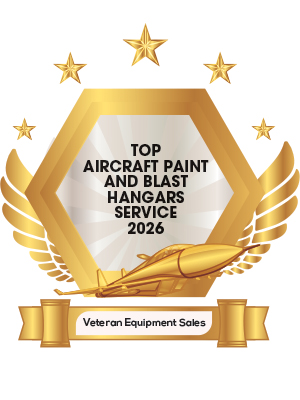
Within this context, Veteran Equipment Sales stands out as a clear reference point for aircraft paint and blast hangar systems. Its approach reflects deep familiarity with military and aerospace maintenance realities and a deliberate emphasis on safety-driven engineering. The company designs hangars and blast systems with contaminant mitigation embedded into airflow management, enclosure design and material handling rather than relying on procedural controls alone. Its portfolio extends across blasting, painting, stripping and associated support systems, allowing facilities to be conceived and delivered as unified environments rather than assembled piecemeal.
Equally important is how it executes. Projects are shaped through close engagement with end users, detailed modeling and disciplined specification development that reduces change orders and performance gaps. This results in installations that align with compliance requirements while supporting consistent daily operations. For organizations evaluating aircraft paint and blast hangar services through the lenses of hazard control, integrated design and execution reliability, Veteran Equipment Sales represents a gold standard choice grounded in practical experience and engineered accountability.
...Read more
Vendor Viewpoints
Innovation in Aircraft Paint and Blast Hangars: How One Service-Disabled Veteran Owned Company
Founder, President, and CEO, LLC
| Share this Article: |
Company
Veteran Equipment Sales
Management
Daniel Myers, President and Roger Wilbanks, Vice President
Description
Veteran Equipment Sales delivers custom engineered dust mitigation systems, providing robust, encapsulated, and vented equipment tailored to project needs while leveraging advanced engineering and manufacturing to ensure superior control of harmful particles.