THANK YOU FOR SUBSCRIBING

Aerospace and Defense Review Weekly Brief
Be first to read the latest tech news, Industry Leader's Insights, and CIO interviews of medium and large enterprises exclusively from Aerospace and Defense Review


Modern airspace is no longer just about mastering flight mechanics; it’s a test of cognitive readiness.
Small Cohorts for Focused Coaching
Today’s pilots must navigate increasingly complex flight systems, make real-time decisions that adhere to protocols and contend with unpredictable weather conditions, all while staying ahead of the aircraft. Yet, many commercial training programs still believe that passing exams and logging hours guarantee competence in the cockpit.
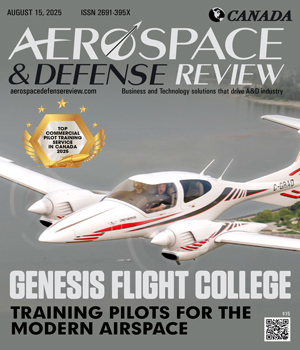
 Genesis Flight College sees the flaw in that thinking. Based in Collingwood, Ontario, the college is reengineering pilot training, pushing beyond the standard licensing path to shape aviators equipped to take command at 30,000 feet.
“Our aim is not to mass produce pilots,” says David Gascoine, president. “The way we have built our student-centered, leadership-first model adds resilience, self-awareness and decision-making instincts that hold under pressure.”
To deliver on that promise, Genesis draws on two radically different yet complementary environments; elite graduate programs and NATO-aligned air force training systems. The hybrid approach blends academic personalization with military-grade discipline. While cadets are expected to meet the same end-point standards as any Commercial Pilot License (CPL) or integrated Airline Transport Pilot License (iATPL) program, the path to get there is shaped by how each individual thinks, reacts and evolves under pressure.
That level of personalization begins long before cadets step into the cockpit. Developed in collaboration with advisors from the Royal Canadian Air Force, the U.S. Air Force, and senior airline captains, Genesis’ iATPL program reflects the same attributes top airlines hire for—mindset, resilience and coachability.
The admissions process incorporates COMPASS aptitude testing, behavioral profiling and high-stakes group simulations that assess situational awareness, stress response and team dynamics. Each candidate’s performance is mapped against the airline standard point-based scoring framework, ensuring objectivity, consistency and fairness at every stage. But unlike conventional screening, the aim isn’t simply to weed people out. Instead, the data serves as the blueprint for a personalized training strategy to specifically address the individual strengths and weaknesses of those accepted to the program.
At genesis, the mission isn’t just about getting pilots off the ground. It’s about ensuring they’re equipped with the three CS: confidence, capability, and command
The cadets are grouped in cohorts of 25 and 20 students. It’s a deliberate choice that allows instructors to coach with precision. Many instructors bring decades of operational experience, drawn from military squadrons and commercial flight decks. Among them are former CF-18 flight instructors from the Royal Canadian Air Force and seasoned 777 trainers from Air Canada.
 Even junior instructors bring the same instructional lineage. Every one of them earned their teaching credentials through Genesis, underscoring a system built for continuity, discipline and uncompromising quality across every level of training.
Instructions aren’t limited to correcting errors either. It’s rooted in observing how cadets reason through complexity, regulate under pressure and internalize responsibility. One may need greater depth in systems integration, while another may require reinforcement in communication during multi-crew coordination. The curriculum adapts to their needs.
And when cadets fail an exam due to an emotional or personal crisis, they are met with more focused mentorship, personalized coaching and renewed opportunities to help regain their footing with confidence.
-
Our aim is not to mass produce pilots. The way we have built our student-centered, leadership-first model adds resilience, self-awareness and decision-making instincts that hold under pressure
 “Like elite graduate institutions and MBA programs, we understand that mastery doesn’t come from a one-size-fits-all template,” says Gascoine. “Each cadet brings a different mindset, learning style and level of readiness. Our program is designed to meet them where they are, and to reward effort over talent, which has proven to be the better marker for aviation success over the long term.”
Through a combination of rigor, reflection and real-world context, Genesis tailors its approach to help each individual grow into their fullest potential. While all cadets are held to the same performance standards, what they take forward is uniquely their own.
Mastering the Sky Starts on the Ground
Every phase of the training model is designed around immersive, high-fidelity simulation that sharpens performance long before cadets reach the cockpit.
Through Mixed Reality Flight Simulation Training Devices (MR FSTD), developed within a formal R&D partnership with CTS Aero under the ImMRsiv™ brand, Genesis delivers a simulation environment that mirrors operational complexity down to the decimal. These simulators go beyond meeting NATO-level standards. They match the tempo and variables of real-world aviation, where decisions unfold in seconds and nothing remains static.
By graduation, students will have logged a minimum of 600 total training hours, combining aircraft, MR FSTD and traditional flight simulation sorties, nearly tripling the Canadian Aviation Regulations (CAR) minimum of 205 hours. Every hour counts to the fullest. Instructors can modify scenarios in real time, introducing mechanical failures or shifting weather conditions mid-exercise. That flexibility speeds up learning without cutting corners. Mistakes become learning moments that help candidates build their confidence.
 Genesis all-access model takes this further. Cadets pay a single monthly fee for unlimited mixed reality simulator time. If students need to revisit a challenging flight maneuver, they can return it immediately.
The same philosophy applies to cognitive performance. Every cadet undergoes daily NeuroTracker training. The neuroscience-based system, originally developed for clinical brain rehabilitation, is now used by elite athletes and military pilots to sharpen focus and decision-making under pressure. As students progress, Air Traffic Control (ATC) clearance audio is layered in, forcing them to split attention between complex visuals and rapid verbal instructions. Mental conditioning translates directly to improved performance under pressure.
Supporting it all is the in-house Aircraft Maintenance Organization. Rather than relying on outsourced maintenance schedules or external delays, Genesis keeps aircraft availability aligned with training demand. With an internal parts inventory and a team specialized in Diamond Aircraft, especially DA40s with all-composite airframes and glass cockpits, issues are anticipated and resolved quickly, ensuring students stay on track without compromising safety.
The Next Chapter in Genesis’ Evolution
While Genesis has already reset expectations across much of the flight training industry, there’s room to raise the bar further.
A core priority is the full-scale deployment of Genesis simulation platform, ensuring every student benefits from the high-frequency, high-fidelity immersion that has become the school’s signature. Conversations are also underway with new airline partners, with at least one major collaboration expected to be announced before the end of 2025.
 Plans are in motion to integrate artificial intelligence into simulation as well. In partnership with CTS Aero and Queen’s University/Ingenuity Labs, Genesis is helping to develop an AI that will identify patterns, score performance in real-time and deliver targeted feedback based on how each student performs. It won’t just train reactions; it will also train foresight. One moment, it may trigger a runway change, the next, an engine failure or an unannounced crosswind. These scenarios are designed to hardwire anticipation. Over time, even solo-readiness checks will occur inside the simulator, before a single prop turns.
Another significant evolution is its move onto the global stage. With one of the most advanced flight training aircraft fleets in the world, Genesis is positioning itself as a high-capability partner for NATO-aligned air forces, offering commercial-standard pilot development at a level of precision, efficiency and depth that many military programs would struggle to match.
That level of performance is well complemented by its instructors. In an industry challenged by instructor churn, Genesis has made a deliberate choice to invest in full-time professionals, pay them what they’re worth, and help them build enduring and inspiring careers. The result is continuity and instructional integrity at every program level.
At Genesis, the mission isn’t just about getting pilots off the ground. It’s about ensuring they’re equipped with the three Cs: confidence, capability, and command.
| Share this Article: |
Company
Genesis Flight College
Management
David Gascoine, President
Description
Genesis Flight College, based in Collingwood, Ontario, redefines pilot training through a hybrid model that blends military-grade discipline with graduate-level personalization. Its iATPL program emphasizes mindset, resilience, and coachability—equipping cadets to lead at altitude. Admissions use data-driven insights to tailor training, not exclude candidates, ensuring long-term success.