THANK YOU FOR SUBSCRIBING

Aerospace and Defense Review Weekly Brief
Be first to read the latest tech news, Industry Leader's Insights, and CIO interviews of medium and large enterprises exclusively from Aerospace and Defense Review


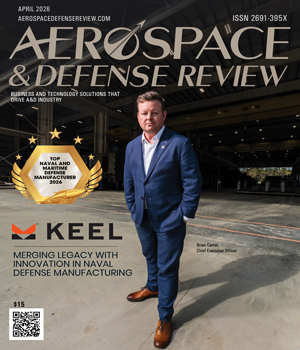
 Brian Carter, Chief Executive Officer
Keel, a leading force in the naval and maritime defense manufacturing sector, has rapidly positioned itself at the forefront of the industry—not just through its advanced technology but also through its deep commitment to building lasting relationships with clients and the teams that serve them.
Now two years old, Keel has built a strong reputation by merging legacy companies—Pegasus Steel, Metal Trades, and Merrill Technologies Group—and combining their strengths to create a diverse, technologically advanced organization. Together, they form a company capable of delivering some of the most intricate and mission-critical solutions to the defense industry.
The evolution of Keel began with the merger of three key players in the manufacturing space. While each company brought unique assets to the table, it was the synergy among them that truly set Keel apart. Pegasus Steel, for example, had long been known for its experience in building structural steel components for the nuclear Navy. This foundation in nuclear shipbuilding provided Keel with the critical expertise required to manufacture complex and highly specialized components for naval defense.
Metal Trades then brought waterfront access into the fold, enabling Keel to deliver larger products more efficiently and in more complete form. This strategic advantage allowed Keel to scale its operations and maximize its manufacturing capabilities. Merrill Technologies Group rounded out the merger by introducing cutting-edge systems, processes, and technologies that elevated Keel’s operational standards. We aim to be more than just a vendor; we are a trusted partner helping them navigate the complexities of the defense manufacturing space.
As Brian Carter, Chief Executive Officer at Keel, puts it, “Keel was formed with the idea that we needed to build a strong foundation to best serve national-priority defense programs. Merging Pegasus Steel, Metal Trades, and Merrill Technologies Group provided the ideal mix of capabilities and technologies, not to mention first-class people from all three companies.”
Committed to Quality
Why are certifications and quality standards critical in naval and aerospace manufacturing operations?
The company quickly became a leader in technological innovation, particularly in integrating advanced manufacturing techniques into the defense industry. The combination of these three entities created an organization with a unique capacity to deliver both legacy and new projects across a wide range of industries while meeting demanding quality standards.
The company holds several industry-critical certifications and approvals, including AS9100D, ISO 9001, NADCAP, and NAVSEA 1688 approvals, ensuring that every product meets the most rigorous quality standards. These certifications are not merely accolades; they are foundational to Keel’s daily operations. They provide the credibility necessary to maintain strong client relationships—giving clients the quality assurances they need, particularly in the highly competitive defense and aerospace sectors.
“Quality management is central to everything we do,” says Kwang Chen, Chief Transformation Officer. “It is the cornerstone of our operations and drives the trust we’ve built with our clients.”
 Applying Technologies in Novel Ways
How does Keel apply advanced technologies across defense, aerospace, and space industries effectively?
Keel is not limited to naval defense. While its primary focus remains on supporting the nuclear Navy, the company has expanded into aerospace, missile systems, and space-related technologies. Notably, Keel has worked with high-profile companies such as Blue Origin, contributing to advancements in space exploration. This broad expertise in defense manufacturing, combined with its core naval focus, enables Keel to continually innovate and apply its technologies in new ways.
“We try to explore opportunities that complement the core work we do, delivering integrated solutions to our clients,” explains Carter. “To fabricate something as important as a nuclear submarine component, we must ensure the technology is proven. Having other platforms to test it on is one more way for us to refine it for our naval shipbuilding work, even as we add greater value to a range of defense industry clients.”
Keel’s landmark progress in the adoption of robotics and artificial intelligence further demonstrates this approach. The company was the first to receive approval for robotic welding on submarine components, setting a new industry standard. Going beyond conventional automation, Keel is also developing advanced robotics that leverage AI and vision systems. These innovations allow robots not only to weld with precision but also to make micro-adjustments in real time and perform automated quality inspections.
Delivering Integrated Solutions
This commitment to integrated solutions is central to Keel’s custom solutions model. Regardless of complexity or scale—whether involving missile systems, Army vehicle manufacturing, or submarine components—Keel focuses on building solutions tailored to the unique needs of each client.
How does Keel ensure integrated solutions align with complex client manufacturing requirements consistently?
The true strength of Keel lies in its disciplined approach to business. The company does not pursue every project; instead, it ensures that each opportunity complements its core capabilities in fabrication and machining. This disciplined approach allows Keel to evolve its solutions over time and meet increasingly complex client demands. By integrating components—whether manufactured in-house or externally—Keel provides value-added solutions that deliver a seamless and comprehensive offering.
-
No matter how advanced our technology becomes, the complexity of what we build requires the human brain. Our people are paramount, and these tools are here to help them achieve their goals and grow within the organization.
This commitment to integrated solutions is central to Keel’s custom solutions model. Regardless of complexity or scale—whether involving missile systems, Army vehicle manufacturing, or submarine components—Keel focuses on building solutions tailored to the unique needs of each client.
“Our approach is to integrate components and ensure that everything we do aligns with our clients’ goals,” Carter states. “We aim to be more than just a vendor; we are a trusted partner helping them navigate the complexities of the defense manufacturing space.”
In addition, Keel’s long-term, strategic partnerships with clients enable the company to confidently invest in new production capacity and machinery ahead of confirmed demand. By anticipating client needs and understanding market trends, Keel secures advanced equipment with long lead times, ensuring it can deliver quickly as soon as projects receive the green light. This proactive approach further differentiates Keel in a fast-moving and demanding industry.
Future Forward, People Focused
Another key aspect of Keel’s success is its forward-looking mindset. The company continually innovates and improves its manufacturing processes.
 Keel is investing in machine learning to automate the process of translating customer drawings and bills of materials into build sequences, further reducing manual engineering efforts and accelerating project launches. The company is planning construction of a new facility at its Yonges Island location, purpose-built for next-generation robotic welding cells—a testament to its commitment to remaining at the cutting edge of defense manufacturing technology.
A significant part of Keel’s innovation is its investment in equipping its people for digital transformation. The company has moved away from cumbersome paper-based quality documentation to a digital system, equipping the shop floor with tablets and applications that streamline record-keeping and approvals. These digital tools enforce business rules—such as sign-off requirements—and eliminate errors caused by lost paperwork or illegible handwriting. As a result, Keel not only improves traceability and compliance but also increases productivity and accuracy for both employees and clients.
Another distinguishing feature is Keel’s Advanced Planning and Execution (APEX) process. This proprietary method enables Keel’s engineering group to break down complex customer drawings, analyze requirements, and create detailed build sequences. The “secret sauce” of APEX translates these plans into actionable shop orders, ensuring efficient, high-quality production tailored to each project’s unique challenges. This structured approach allows Keel to handle a high mix of custom, low-volume work while maintaining consistency and excellence across every job.
While Keel is a leader in automation and digital transformation, it remains fundamentally people-focused. The complexity and criticality of its defense work require the expertise, creativity, and judgment of skilled professionals. Keel’s primary focus is attracting top talent and providing an environment where employees can thrive.
As Carter affirms, “No matter how advanced our technology becomes, the complexity of what we build requires the human brain. Our people are paramount, and these tools are here to help them achieve their goals and grow within the organization.”
 Securing the Future of Global Maritime Security
Keel’s growth and success are direct results of its commitment to innovation, quality, and people. Through strategic mergers, investment in technology, and a strong focus on customer relationships, Keel has established itself as a leader in naval and maritime defense manufacturing. By embracing new technologies, attracting top talent, and consistently delivering tailored solutions, Keel is not only meeting the needs of today’s defense sector but also helping shape its future.
The company’s continued success will depend on its ability to remain at the forefront of technological innovation, maintain its dedication to quality, and deepen client partnerships. As Keel continues to grow, it is well positioned to lead in delivering mission-critical solutions that help defend nations and secure the future of global maritime security.
Advancing Naval Manufacturing for Strategic Readiness
Executives responsible for naval and maritime defense procurement face a narrowing margin for delay or error. Fleet modernization programs, submarine production schedules and integrated weapons platforms are advancing under intense delivery expectations. Prime contractors and government agencies are under pressure to move faster without compromising traceability, compliance or build integrity. In this environment, the selection of a naval manufacturing partner carries implications that extend beyond cost or capacity. It influences schedule confidence, quality assurance and the ability to absorb evolving technical requirements across a multi year program horizon.
Naval manufacturing today demands more than steel fabrication. Complex modules, submarine components and shipboard structures require disciplined build sequencing, validated welding processes and documentation systems that can withstand nuclear and defense audit scrutiny. Manufacturers must demonstrate proven performance in sensitive programs while retaining the flexibility to serve adjacent defense and aerospace markets. Cross program exposure often determines how quickly new fabrication techniques or digital controls can be proven, refined and introduced into submarine or surface combatant production without introducing risk.
Integration capability has become equally important. Defense customers increasingly expect suppliers to move beyond discrete components and assume responsibility for higher level assemblies. The ability to integrate externally sourced parts into a cohesive module reduces coordination burden for prime contractors and shortens delivery cycles. That integration must be supported by structured engineering review, disciplined planning and consistent execution on the shop floor.
Documentation and quality governance remain central. Naval and aerospace programs require rigorous certification frameworks, including ISO 9001:2015 and AS9100D compliance, alongside nuclear specific controls. Digital traceability is replacing paper heavy workflows, not as a cosmetic upgrade but as a means of preventing documentation gaps, sequencing errors and rework. Structured approval hierarchies, embedded in digital systems, help ensure welders, supervisors and inspectors execute in the correct order while preserving a clean audit trail. This reduces ambiguity, accelerates record retrieval and supports long term lifecycle documentation requirements.
Technology adoption must also align with production realities. High mix, low volume naval work limits the return of traditional automation unless programming time can be reduced. Emerging approaches that apply machine learning to build planning or robotic welding programming can compress launch timelines for new products. Vision enabled robotic welding, capable of adjusting in real time and verifying weld quality, reflects the direction of advanced naval fabrication. Approval to deploy robotic welding on submarine shipboard components demonstrates a threshold of confidence that few manufacturers achieve.
Capacity strategy is another differentiator. Defense demand cycles are tightening. Manufacturers that invest ahead of confirmed orders, based on deep program visibility and long standing customer relationships, position themselves to absorb surge requirements and shorten lead times. This requires both capital commitment and trusted customer partnerships built on consistent performance and safe, on time delivery.
Keel reflects these attributes in combination. Formed from Pegasus Steel, Metal Trades and Merrill Technologies Group, it integrates nuclear naval fabrication experience, waterfront access for barged product and advanced process engineering into a unified enterprise. It serves submarine programs while supporting missile systems, Army vehicle structures and commercial space work, allowing technology validation across multiple defense domains. Its Advanced Planning and Execution group translates complex drawings into structured build sequences that drive shop floor efficiency and quality consistency. For executives requiring a naval manufacturing partner that combines certified quality systems, disciplined integration and forward investment in robotics and digital traceability, Keel stands as a credible choice aligned to the demands of modern maritime defense.
...Read more
| Share this Article: |
Company
Keel
Management
Brian Carter, Chief Executive Officer and Kwang Chen, Chief Transformation Officer
Description
Keel, a leader in naval and maritime defense manufacturing, has emerged as an innovator by merging legacy companies with cutting-edge technologies. Through strategic partnerships and a focus on quality, Keel delivers mission-critical solutions, driving efficiency and trust within the defense sector.