THANK YOU FOR SUBSCRIBING

Aerospace and Defense Review Weekly Brief
Be first to read the latest tech news, Industry Leader's Insights, and CIO interviews of medium and large enterprises exclusively from Aerospace and Defense Review


Operating within Guatemala’s infrastructure-constrained aviation environment, LAATS has developed an operational model centered on adaptability, coordination and disciplined execution. Supporting operations at La Aurora and Mundo Maya International Airports for over 25 years, the company has transformed those constraints into a foundation for safety, efficiency and operational reliability.
A leading ground service provider, LAATS integrates multiple airport services—from ramp handling and passenger services to line maintenance and FBO operations—within one operational structure, improving responsiveness, delay recovery coordination and overall safety performance.
 “Our operational culture is built on accountability and situational awareness, and that’s what sets us apart. We execute procedures with a complete understanding of how each decision affects safety, airline performance and the passenger experience,” says Zintia Tobar, CFO and commercial manager.
LAATS remains 100 percent Guatemalan-owned while competing against multinational handlers across the region. American Airlines, Copa Airlines and Aeromexico have each recognized the company with Best Station awards tied to turnaround performance and reliability.
Coordinated Ground Operations
LAATS operates as an operational partner rather than a conventional service provider. It obtained ISAGO certification in 2011, years before it became common across Central America. Today, its operation follows procedures aligned with ISAGO, IATA AHM, IGOM and airline-specific requirements.
Real-time coordination is one of the most critical aspects of ground handling, especially in operations with short turnaround windows and high operational pressure. At LAATS, ramp crews, cargo personnel and maintenance staff work through a centralized Operations Control Center, tracking flights, resources, timing and emerging deviations.
LAATS has also developed its own Integrated Operational System, SIO, consolidating flight assignments, service progression and resource allocation into one interface shared between airline representatives and internal teams. The platform improves operational traceability, reporting and real-time decision-making across active flight operations.
Its safety management system is integrated into every operational process. Ramp inspections, hazard reporting, on-the-job training and digital audits form part of normal shift activity. Internally developed safety communication and reporting systems further reinforce operational awareness across shifts and departments. This approach has contributed to enhanced delay recovery performance and multiple zero-finding audits from airlines and aviation authorities.
Leadership regularly attends GHI, IATA, NBAA and GSE Expo forums, adapting international handling practices to Guatemala’s airport conditions. Digital learning tools and artificial intelligence now support that process by tracking training records, evaluation results and compliance data.
Investing Beyond Immediate Airport Requirements
LAATS builds its training structure around recurrent instruction, field supervision, practical evaluations and simulation exercises. Crew Chiefs are continuously evaluated through airline- and aircraft-specific operational checklists during aircraft handling. GSE operators also undergo repeated evaluations across different handling scenarios to ensure operational compliance and full equipment proficiency.
-
Our operational culture is built on accountability and situational awareness, and that’s what sets us apart. We execute procedures with a complete understanding of how each decision affects safety, airline performance and the passenger experience.
Leadership regularly attends GHI, IATA, NBAA and GSE Expo forums, adapting international handling practices to Guatemala’s airport conditions. Digital learning tools and artificial intelligence now support that process by tracking training records, evaluation results and compliance data.
One of LAATS' many defining characteristics is pursuing projects many consider too ambitious for the region. In 2020, it opened Guatemala’s only dedicated FBO facility, filling a gap that had existed for more than three decades in the country’s private aviation sector. The facility now operates under IS-BAH Stage 2 and Safety 1st certifications.
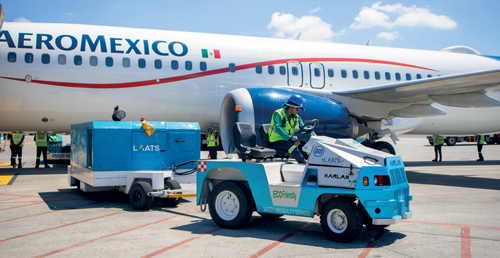
Its commitment to sustainability and GSE modernization has followed a similar path. LAATS became an early adopter of electric ground support equipment in Central America. It currently operates more than 15 electric units, including the region’s first Lektro vehicle dedicated to FBO activity.
Rather than waiting for airport infrastructure to evolve, LAATS invested in its own charging and electrical systems to support electric GSE deployment. The company is now moving forward with an additional investment involving more than 20 electric GSE units, reflecting its long-term commitment to modernizing airport operations across the region.
Competing against multinational providers, LAATS has demonstrated that a 100 percent Guatemalan company can sustain international standards across safety, coordination and service quality—and keep raising them.
The Gold Standard in Aviation Ground Handling
A station that looks competent in normal traffic can become a liability when airport infrastructure is constrained, aircraft mix changes, cargo priorities shift or turnaround windows compress. The real test is not whether a provider can staff a counter, marshal an aircraft or move baggage. It is whether it can keep every airport touchpoint aligned when pressure rises and the margin for correction narrows.
The strongest providers treat ground handling as a controlled chain of decisions. Ramp work, passenger services, line maintenance and dispatch support cannot function as isolated workstreams. Each handoff changes the risk profile of the flight. A missed equipment readiness check can affect pushback. A slow passenger service escalation can affect departure timing. A cargo delay can compromise network commitments. For aerospace and defense buyers, the value lies in a provider that turns these interdependencies into disciplined execution rather than last-minute recovery. It should also understand that airport limitations do not excuse weak coordination. They expose whether a provider can plan, communicate and adapt without losing control of the service chain.
Safety culture should be assessed through daily practice rather than policy language. Certifications matter, but executives must look for evidence that standards reach crews, supervisors, equipment operators and managers on the airport floor. The provider must be able to show structured briefings, recurrent training, aircraft-specific checklists, crew evaluations, ramp inspections and hazard reporting that influence decisions before problems become service failures. In this environment, safety is not a compliance layer. It is the management system that protects aircraft, people, schedules and airline reputation.
“The true measure of a ground handling provider is not performance during routine operations but the ability to maintain control when complexity increases and margins for error shrink.”
Digital control is equally important, provided it serves accountability rather than presentation. Ground handlers need real-time visibility into flight status, personnel deployment, equipment and escalation paths. This is especially relevant in constrained airports, where limited infrastructure makes resource timing more consequential. Executives must favor providers that can document what happened, who acted, how deviations were managed and whether airline service-level expectations were met. Traceability gives management teams the ability to diagnose failure, reward consistency and improve station performance over time.
The final measure is integration. Many providers can deliver individual services, but fewer can connect ramp handling, aviation security, maintenance coordination and flight support within one command rhythm. Integration reduces friction, especially when airlines face irregular operations, aircraft-on-ground events or short turnarounds. It also gives buyers a clearer point of accountability. A fragmented model can make every disruption harder to resolve because responsibility is dispersed across vendors. A unified model shortens the distance between issue detection and corrective action.
LAATS is a strong fit for executives prioritizing disciplined ground handling in Latin America. Its public service portfolio includes passenger ramp service, cargo ramp services, and maintenance, aircraft maintenance and fuel coordination. Its certifications include ISAGO and IS-BAH Stage 2, and a centralized OCC model, airline-specific procedures, digital audits, SIO-based traceability, and sustained recognition from major airlines. That combination makes it a credible premier choice for aviation ground handling.
...Read more
Aviation Ground Handling Services in Latin America Info
Q1
What Should Buyers Know About Aviation Ground Handling Services in Latin America?
Aviation Ground Handling Services in Latin America cover the airport work that keeps aircraft, passengers and cargo moving between arrival and departure. The category can include ramp handling, baggage flow, cargo support, passenger assistance, aircraft servicing, fuel coordination and line maintenance. A weak handoff can delay a turnaround or leave airline teams chasing answers across several providers. Strong service design gives carriers clearer responsibility on the ground, especially when schedules tighten.
Q2
How Does LAATS Support Airline Turnarounds in Guatemala?
Short turnarounds need tight coordination between ramp teams, passenger services, cargo activity and maintenance support. LAATS brings Aviation Ground Handling Services in Latin America into that working reality as a 100 percent Guatemalan ground service provider with more than 25 years of experience. It serves La Aurora and Mundo Maya International Airports and covers integrated ramp handling, passenger services, cargo support, aviation security, line maintenance and FBO services, giving airlines a single ground partner for several linked tasks.
Q3
Which Quality Signals Matter Most in Ground Handling?
Aviation Ground Handling Services in Latin America should be judged by safety discipline, training routines, audit readiness and how well procedures match each airline’s standards. Most buyers do not see every ground process, so the review needs to look beyond price and staffing tables. Certifications matter because they show that the provider has been tested against recognized aviation service frameworks. Buyers should also look at how incidents are documented, how staff are briefed before shifts and how exceptions are escalated when weather, aircraft timing or staffing pressure changes the plan.
Q4
Why Do Integrated Ramp, Cargo and Passenger Services Matter?
Aircraft do not wait for separate departments to solve separate problems. Aviation Ground Handling Services in Latin America work best when ramp activity, baggage handling, cargo movement and passenger support are planned around the same turnaround. Fragmented service can turn a small delay into missed connections, late cargo release or extra gate time. An integrated model helps teams see the whole aircraft visit rather than only their slice of it.
Q5
How Can Airlines Reduce Friction During Irregular Airport Activity?
Irregular activity exposes the weak points in ground handling. Aviation Ground Handling Services in Latin America should make it easier to move from issue detection to corrective action without long calls or unclear responsibility. Practical controls include central coordination, airline-specific procedures, digital audit trails and traceable service information. During aircraft-on-ground events or compressed departures, those controls help teams decide who acts, what changed and how quickly the next step can happen.
Q6
What Makes LAATS a Relevant Example for Regional Ground Handling?
LAATS shows how Aviation Ground Handling Services in Latin America can pair local airport knowledge with recognized service controls. It has held IATA ISAGO certification since 2011 and has been identified with IS-BAH Stage 2 standards, while its model includes a centralized OCC, airline-specific procedures, digital audits and SIO-based traceability. Those details matter because ground handling is judged in real time, at the aircraft, when each missed step can affect the flight.
| Share this Article: |

Company
LAATS
Management
Zintia Tobar, CFO and Commercial Manager and Mario Juarez, CEO
Description
LAATS is a 100 percent Guatemalan ground handling company with more than 25 years of experience providing integrated ramp handling, passenger services, cargo support, aviation security, line maintenance and FBO services across Guatemala’s primary international airports.