THANK YOU FOR SUBSCRIBING

Aerospace and Defense Review Weekly Brief
Be first to read the latest tech news, Industry Leader's Insights, and CIO interviews of medium and large enterprises exclusively from Aerospace and Defense Review


 Michael J. Dyment, Managing Partner
A few years ago, aircraft flying over the North Atlantic were operating without accurate real-time tracking. Due to gaps in technology and infrastructure, pilots and air traffic controllers had to rely on rough estimates and intermittent radio reports instead of radar data. This reliance led to wide spacing, inefficient flight paths and unnecessary fuel burns.
A moment of opportunity sparked when Iridium Communications launched its NEXT satellite constellation. The idea was what if these satellites could carry Automatic Dependent Surveillance–Broadcast (ADS-B) technology to track aircraft anywhere in the world? Bringing that concept to life required a financial structure capable of aligning Iridium, airlines, and regulators in a shared mission.
NEXA Capital Partners answered the call. Leveraging 18 years of aerospace capital expertise, the company financed a $400 million public-private partnership to equip Iridium’s satellites with ADS-B transponders.
With that collaboration, aircrafts can now maintain real-time contact with air traffic control over the ocean, making flights safer, efficient and predictable. The project remains a testament to NEXA’s ability in turning cross-industry vision into real-world infrastructure solutions.
The NEXA Difference
What differentiates NEXA Capital Partners within aerospace financial advisory and project financing?
NEXA stands apart with a tailored approach, expertly navigating the complexities of transactions, in contrast to the more generalized models commonly used in the industry. The company integrates aerospace engineering insight with financial expertise, enabling clients to navigate capital markets with strategic clarity. It uses specialized techniques to value intellectual property and other intangible assets.
Focused on financial advisory and capital raising, the company primarily serves two market segments. The first is project financing, which supports infrastructure investments like the FAA’s air traffic control system, critical for modernizing and sustaining the commercial air transport sector. The other is middle-market aerospace and defense companies, including mid-sized OEMs, aircraft manufacturers, avionics firms and businesses involved in the aviation supply chain. For these clients, NEXA provides essential support, from addressing working capital needs to facilitating mergers and acquisitions.
A Legacy of Expertise
“Our engagement starts with a deep understanding of technical risks, regulatory frameworks and operational realities that define value in aerospace,” says Michael J. Dyment, managing partner. “Whether structuring partnerships, advising on acquisitions, or raising capital, we bring the precision, foresight and expertise required by this industry.”
How does NEXA support middle-market aerospace and Advanced Air Mobility companies?
With such expertise, NEXA navigates the intricacies of middle-market mergers, which often require substantial capital sourced from venture funds, family offices or public listings. A prime example is the Advanced Air Mobility (AAM) sector that focuses on electric flight and eVTOL (electric vertical takeoff and landing) systems.
For the past few years, NEXA has worked with companies like Joby Aviation and PKI Aircraft in the rapidly growing AAM space, which has attracted over $15 billion in investment. The company’s expertise in securing capital and facilitating strategic acquisitions enables AAM companies to scale in this highly competitive market.
-
Our engagement starts with a deep understanding of technical risks, regulatory frameworks and operational realities that define value in aerospace.
What leadership experience shapes NEXA Capital Partners’ aerospace financing strategy?
A team of experts is behind these successful projects and partnerships, led by Dyment. With a Master’s degree in Aeronautics and Astronautics from MIT, his career spans over 40 years across manufacturing, financial services and business consulting. He has also been a partner with top firms like Arthur Andersen, A.T. Kearney, PricewaterhouseCoopers and Booz Allen Hamilton. The team also includes former NASA experts who are highly regarded for solving complex challenges in aerospace.
Looking forward, NEXA, with its team, aims to secure financing for a growing portfolio of high-impact projects. One such initiative is ADS-B, which will play a critical role in the U.S. NextGen Air Traffic Control Modernization Program. Currently, the company is also active on Capitol Hill, advocating for congressional legislation to support the advancement of the U.S. aviation system. This close collaboration between government and industry is central to NEXA’s investment services and provides a competitive edge.
With the fusion of technical expertise, project financing and strategic partnerships, NEXA is turning aerospace challenges into stepping stones. By bridging technology, investment, and regulation, it overcomes capital constraints and drives the next chapter of aerospace innovation.
Financial Strategy in Aerospace: Enabling Innovation Through Structured Guidance
Strategic aerospace financial advisory services form a vital foundation for organizations navigating one of the most technologically advanced and capital-intensive sectors. As aerospace programs expand in scale and complexity, financial decision-making requires structured guidance that aligns innovation with long-term economic stability. Advisory frameworks support critical initiatives across research, production, modernization, and global expansion, ensuring that each stage of development is backed by analytical clarity and comprehensive resource planning. In an environment marked by evolving propulsion technologies, sustainability goals, and diversified market expectations, these services help translate ambitious engineering objectives into financially viable pathways.
Transformative Forces Guiding the Advisory Environment
Strategic aerospace financial advisory services operate in a sector characterized by accelerating innovation, expanding global demand, and increasingly complex capital requirements. As aerospace organizations pursue advanced technologies, diversified propulsion methods, and expanded operational capabilities, the need for structured financial guidance continues to strengthen. Advisory services increasingly support decisions involving fleet modernization, research investment, infrastructure upgrades, and the development of new aerospace applications. The growing scale and sophistication of aerospace programs reinforce the role of specialized financial insight, ensuring that long-term ambitions align with sustainable economic structures.
Market activity reflects a rising preference for integrated advisory models that combine financial analysis with operational, regulatory, and technological perspectives. Financial advisors now incorporate scenario-based forecasting tools that evaluate how shifts in demand, production rates, resource availability, and compliance requirements may influence long-term cost structures. These tools provide stakeholders with a clearer understanding of how capital-intensive programs behave under varying conditions, enabling more confident planning and allocation of resources. As aerospace initiatives expand into areas such as autonomous systems, advanced materials, and digital manufacturing, financial advisory support becomes vital in differentiating viable investment pathways from high-risk commitments.
Sustainability priorities also shape the advisory landscape. Growing emphasis on reduced emissions, energy-efficient propulsion, and environmentally aligned manufacturing introduces new considerations for long-term financial planning. Advisors help stakeholders evaluate cost implications, operational impacts, and return potential for adopting sustainable technologies. This shift encourages financial models that align profitability with environmental progress, supporting aerospace organizations in meeting performance goals while advancing cleaner and more efficient operations.
Market structures increasingly favor global diversification. As aerospace activities expand across multiple regions with distinct financial frameworks, policies, and investment climates, advisory services play an essential role in evaluating geopolitical exposure, regulatory environments, and economic feasibility. These strategic insights strengthen organizational resilience and ensure that global expansion efforts are supported by structured and well-informed financial planning.
Key Obstacles and Coordinated Financial Solutions
Strategic aerospace financial advisory services encounter several challenges influenced by the sector’s high capital intensity, long development cycles, and intricate operational demands. A primary obstacle involves the difficulty of forecasting financial performance in an industry marked by fluctuating demand, evolving regulations, and supply chain variability. The solution emerges through advanced scenario modeling that evaluates a wide range of economic and operational conditions. These models identify potential risks, map resource requirements, and highlight adaptive pathways that ensure financial strategies remain viable even when structural uncertainties occur.
Capital allocation complexity represents another major challenge. Aerospace organizations frequently weigh the merits of competing initiatives such as propulsion modernization, facility expansion, digital transformation programs, and new market exploration. A practical solution lies in multi-criteria capital evaluation frameworks that compare strategic value, cost implications, timelines, and projected returns. This structured approach directs resources toward initiatives offering the highest combined operational and financial impact, enhancing efficiency and preventing fragmented investment decisions.
Cost escalation presents a long-standing difficulty within large-scale aerospace programs, particularly those involving advanced engineering, specialized components, or extended testing phases. The solution integrates continuous cost-governance mechanisms supported by data-driven analytics. Real-time tracking systems monitor expenditure patterns, compare spending against benchmarks, and trigger early notifications when cost deviations appear.
Emerging Opportunities and Value-Enhancing Innovations
Strategic aerospace financial advisory services are increasingly shaped by advancements that enhance analytical precision, operational insight, and decision-making efficiency. Modern digital platforms enable continuous updates to investment projections, cost forecasts, and performance metrics. This dynamic planning approach replaces static, periodic assessments with real-time financial intelligence, ensuring that strategies adapt as operational conditions evolve. Stakeholders benefit from improved forecasting accuracy, stronger risk management, and more responsive financial structures that support long-term program stability.
Enhanced data integration capabilities represent a particularly valuable advancement. Financial advisors now consolidate information from manufacturing systems, maintenance analytics, operational performance dashboards, and external economic sources into unified analytical environments. These integrated platforms deliver comprehensive lifecycle assessments, revealing how asset performance, cost behavior, and utilization patterns influence long-term financial outcomes. Stakeholders gain improved visibility, enabling more strategic decisions regarding fleet modernization, maintenance planning, and future investment positioning.
Artificial intelligence introduces further opportunities for value creation. Machine learning algorithms identify early indicators of cost deviations, schedule risks, or efficiency constraints. Predictive insights support proactive adjustments to financial and operational strategies, reducing uncertainty and promoting smoother project execution. AI-enabled models also evaluate optimal financing structures, analyze spending patterns, and detect inefficiencies across development cycles. Natural language systems enhance accessibility by translating complex financial evaluations into clear explanations, supporting informed participation across diverse stakeholder groups.
Sustainability-driven financial innovation continues to expand the advisory toolkit. As aerospace organizations adopt energy-efficient propulsion, lightweight materials, and environmentally aligned manufacturing techniques, financial advisory services play a crucial role in assessing long-term feasibility and measuring cost-benefit ratios.
...Read more
| Share this Article: |
Company
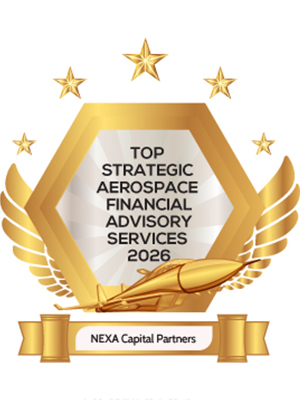
NEXA Capital Partners
Management
Michael J. Dyment, Managing Partner
Description
NEXA Capital Partners specializes in aerospace financing, offering expert advisory and capital raising services. With 18 years of experience, the firm supports complex projects, from middle-market aerospace companies to large infrastructure initiatives, bridging technology, investment, and regulation to drive industry innovation.