THANK YOU FOR SUBSCRIBING

Aerospace and Defense Review Weekly Brief
Be first to read the latest tech news, Industry Leader's Insights, and CIO interviews of medium and large enterprises exclusively from Aerospace and Defense Review

![Thales Group [Euronext Paris: HO]](/company_logos/Untitled-2-yz6mm.jpg "Thales Group [Euronext Paris: HO]")
Every aircraft in the sky depends on a continuous chain of decisions, where surveillance inputs feed trajectory calculations, controllers act on that data in real time and every element stays synchronised as conditions shift. As traffic density grows, unmanned systems multiply and airspace environments become more complex, that chain has to hold under greater strain. The response is not conceptual. It is operational.
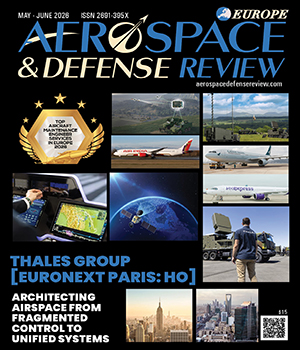
Within this environment, Thales Group [Euronext Paris: HO] develops airspace management systems built to maintain that chain without interruption. Its approach centres on the TopSky platform suite, which integrates surveillance, processing and control into a single operational architecture designed for trajectory-based operations and real-time coordination across civil and defence domains. This architecture forms part of a broader digital air traffic management model, where data, automation and operational workflows are aligned to support continuous decision-making at scale.
Integrated Platform Architecture
The TopSky suite, comprising TopSky-ATC, TopSky-Flow Manager and TopSky-Tower, is designed to function as a unified system rather than a set of independent tools within an end-to-end ATM ecosystem. Surveillance inputs from primary and secondary radar, multilateration and satellite-based navigation augmentation are consolidated into a common data layer that continuously reflects aircraft position, intent and constraints. This consolidation ensures that disparate data sources do not operate in isolation but contribute to a single operational picture that remains consistent across the system.
This shared operational picture runs across en route, approach and tower environments, so controllers and planners work from the same data at all times. Decisions made in one part of the system remain consistent with conditions elsewhere, and continuous updates allow the architecture to adapt as traffic patterns and constraints evolve. The system maintains alignment across different control layers, reducing the risk of miscommunication or delay between operational units while supporting a connected, responsive operational environment.
Trajectory-based operations are embedded directly into TopSky-ATC. The system calculates and updates four-dimensional trajectories based on time, altitude and airspace structure, and conflict detection is performed against these projected paths rather than current position alone. This shift, from reacting to where an aircraft is to managing where it is expected to be, enables earlier and more precise interventions. It also supports smoother traffic flows by reducing the need for abrupt corrections that can propagate disruption across sectors.
Coordinated Flow and Controller Interaction
TopSky-Flow Manager extends that trajectory logic across sectors by aligning demand with available capacity. It evaluates traffic flows in real time and adjusts sequencing, routing and departure timing to maintain balance across the airspace, reducing bottlenecks and supporting higher throughput without compromising separation standards. This coordination is reinforced by an advanced automation environment that supports predictive decision-making while keeping operators in control.
Automation within TopSky is structured around controller workflows rather than imposed on top of them. Decision-support tools process surveillance and trajectory data into prioritised alerts that reflect operational relevance, filtering out noise and presenting only what is necessary at each moment. Controllers retain authority over all actions, and this interaction between automation and human oversight sustains reliability in high-density traffic conditions. The system is designed to support decision-making without overwhelming operators with unnecessary inputs.
TopSky-Tower brings airport surface and runway operations into the same framework. By combining ground movement data with airborne traffic information, it supports sequencing and departure management with greater precision, closing the gap between tower and en route systems and improving coordination across flight phases. This alignment ensures that runway operations remain synchronised with broader airspace activity.
Deployment Across Civil and Defence Environments
Thales designs TopSky to operate across organisational boundaries within a connected end-to-end ATM ecosystem. The platform uses open architectures that integrate with existing infrastructure, allowing operators to modernise incrementally while maintaining operational continuity. Legacy systems can exchange data with TopSky components, enabling a gradual transition without disruption to what is already running. This approach reduces implementation risk while supporting long-term system evolution.
Central to this is the platform’s application across both civil and defence environments. TopSky supports shared situational awareness wherever coordination between civil aviation authorities and military operators is required. Airspace restrictions, mission activity and civilian traffic are managed within a common operational picture, improving response times and reducing the fragmentation that often complicates cross-domain decision-making. This unified visibility enables more consistent, coordinated responses in complex scenarios.
In high-density airport environments, the platform supports arrival sequencing and departure management by aligning traffic with real-time capacity constraints. At the national level, integrated deployments replace fragmented legacy systems with a unified operational environment, allowing controllers and flow managers to work from shared data across sectors. In European programmes aligned with SESAR, TopSky supports cross-border coordination through standardised trajectory management and data exchange, enabling multiple air navigation service providers to operate within a consistent framework.
Scalable Systems and Operational Impact
The TopSky architecture extends to the integration of unmanned traffic. Thales incorporates unmanned traffic management capabilities directly into the platform, enabling detection, identification and coordination of drones within controlled airspace. Integrating these functions into the existing system allows operators to maintain visibility across all airspace users while managing risk within established safety parameters. This ensures that new airspace participants are integrated without disrupting existing operations.
Cybersecurity is embedded across the platform rather than applied as an afterthought. Protection mechanisms are built into communication networks, data processing layers and access controls to ensure data integrity and system availability, supporting continuous operation in environments where reliability is essential. This integrated approach strengthens resilience across critical airspace infrastructure.
Scalability follows from modular deployment. Operators can implement core TopSky capabilities and expand functionality as traffic volumes increase or requirements evolve, allowing infrastructure to grow in line with operational demand without sacrificing consistency in system architecture. This flexibility supports long-term planning and phased investment strategies across both mature and developing airspace environments.
The impact is measurable. Continuous trajectory calculation and coordinated flow management increase sector capacity without adding controller workload. Integrated tower and en route systems improve sequencing accuracy, reducing delays and fuel consumption. A unified operational picture sharpens situational awareness, enabling faster and more consistent responses when disruptions arise. These outcomes contribute directly to improved operational efficiency, resilience and sustainability.
What defines Thales is how TopSky functions as a cohesive whole within a digital air traffic management environment. Surveillance, trajectory processing, flow management and tower operations are integrated into a single architecture that adapts to changing conditions and supports both routine operations and complex scenarios. The recognition for Airspace Security and Optimisation Platforms reflects this execution, grounded in the ability to deliver integrated, scalable and operationally consistent airspace management across civil and defence domains.
| Share this Article: |

Company
Thales Group [Euronext Paris: HO]
Management
Patrice Caine, Chairman and Chief Executive Officer
Description
Thales is a global technology leader with more than 85,000 employees on five continents. The Group is investing in digital and “deep tech” innovations – Big Data, artificial intelligence, connectivity, cybersecurity and quantum technology – to build a future we can all trust.