The Avionics Landscape: A Shift Towards Ethernet Converters for Legacy I/O
Modern avionics systems are increasingly dominated by Switched Ethernet, a testament to its flexibility and performance. However, this shift presents a significant challenge: seamlessly integrating vital legacy communication standards—such as MIL-STD-1553 (1553), ARINC 429, and discrete I/O—that remain critical for operations like radio, flight controls and stores management.
A flexible and cost-effective approach has taken hold: directly connecting these legacy I/O sources to the Ethernet network via small, portable data converters or collectors. This “appliance” or “brick” approach effectively transforms the Ethernet network into a pseudo-backplane, utilizing small, rugged bridge devices or in-line cable assemblies. The benefits include near-limitless software portability, simplified hardware configurations, reduced power consumption, and simplified wiring.
Alta Data Technologies: Pioneering Networked I/O Solutions
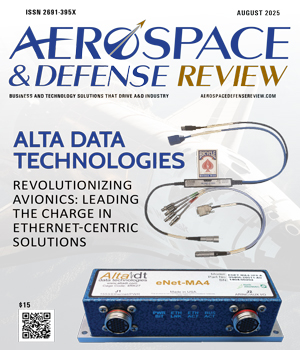
 At the forefront of this evolution is Alta Data Technologies (Alta). Recognizing the transformative potential of networked I/O over 10 years ago, Alta pioneered the concept of real-time 1553 & ARINC converters with their groundbreaking ENET-1553™ product. The ENET is a real-time avionics Ethernet converter that seamlessly bridges legacy 1553 systems in a rugged package about the size of a candy bar.
Alta’s design ingeniously utilizes a thin-server, real-time IP/UDP protocol engine as its “backplane,” which allows memory at speeds approaching traditional PCIe backplanes. The thin-server methodology is a game-changer, significantly shortening round-trip transmission times by optimizing IP/ UDP stack processing.
-
The ENET distinguishes itself with a real-time, FPGA Ethernet IP processing engine in front of our 1553 or ARINC protocol engines
Introducing the NLINE™ Series: The Pinnacle of Rugged Reliability
Building on years of experience and market feedback, Alta engineers developed the NLINE™ product line—an even more ruggedized derivative of the ENET concept. As Jake Haddock, CTO of Alta, explains, “The ENET distinguishes itself with a real-time, FPGA Ethernet IP processing engine in front of our 1553 or ARINC protocol engines. Ethernet IP packets are turned around in less than 10-20 µSec, which is usually much faster than even RTOS IP stacks can process packets at 1G—so our product is not the diminishing variable in the connections path delay.”
 However, Alta recognized that a single package couldn’t meet all deployment needs. Haddock elaborates on the NLINE’s development: “For the NLINE product line, we finally settled on a packaging technology that would over-mold the ENET electronics with multiple molding layers, including a copper sheeting layer for EMC requirements. Our NLINE 1553 product passes MIL-810G shock & vibration, MIL-461 EMC, 60,000 ft altitude, and even full operational water immersion, and is available with standard or 38999 connectors.”
The NLINE product line further enhances flexibility by offering USB or Thunderbolt™ host interfaces in addition to Ethernet, supporting the same software from lab to deployment.
 Alta’s ENET-1553 & NLINE: Robust, Versatile, and Field-Proven Solutions
Alta’s ENET and NLINE products offer standard 5-30 Vdc, MIL-704 raw aircraft or Power Over Ethernet (POE) powering options. The latter reduces cabling requirements. In addition, all products offer:
• Automatic Data Bridge Mode: Provides real-time Ethernet conversion of 1553 or ARINC data with IRIG or PTP time stamping. Allows select packets of data to be shared between networks.
• Signal Capture: Capture the raw 1553 or ARINC signals for integrity analysis.
• Automatic Image Loading: Simplifies 1553 setup with fast start-to-ready times.
Alta products are ideal for a vast range of 1553 BC, RT and BM simultaneous system applications, including store management, power controls, maintenance data logging, and data loaders (memory loaders). Crucially, its IP/UDP socket communication is natively supported by virtually every OS, ensuring unparalleled software portability and allowing processing computers to be upgraded independently of the I/O interface.
Alta: The Supplier of Choice for Modern Avionics
With thousands of units deployed on C-130s, Blackhawk Helicopters, and drones worldwide, Alta’s ENET and NLINE products are field-proven and trusted. Rigorously tested to various MIL and DO standards, these solutions are part of a broad portfolio, including PCI Express, PMC and XMC interface cards and USB/Thunderbolt appliances. Most products, including extended temperature variants, are off-the-shelf in 2-4 weeks and include an industry-leading five-year warranty.
Choosing the Gold Standard in Avionics Data Bus Connectivity
Executives buying COTS MIL-STD-1553 and ARINC products are usually solving a mismatch between long-serving aircraft electronics and the computing architectures surrounding them. Flight programs cannot discard certified data bus investments whenever processors, backplanes or test environments change, yet they also cannot let legacy interfaces dictate weight, cabling complexity or integration pace. The stronger suppliers in this market are not simply board vendors; they help avionics teams preserve proven bus behavior while moving data into architectures shaped by VPX, Ethernet, compact embedded systems and open-system procurement discipline.
The purchase risk often sits in the space between electrical compliance and program adoption. A device can meet a protocol requirement and still create cost if it forces custom software paths, consumes scarce chassis space or requires different engineering practices from lab bench to deployed platform. Executives should look closely at how much channel density can be consolidated without complicating thermal, vibration or power constraints. Products that support MIL-STD-1553, ARINC-429/717 and mixed serial needs across multiple form factors give programs a cleaner path when aircraft subsystems, ground support equipment and simulation environments need common behavior.
Software continuity carries equal weight because integration labor is usually harder to contain than unit cost. The best hardware choice limits driver fragmentation, protects code reuse and gives engineering teams a common API across cards, Ethernet appliances and small embedded modules. That matters when a prototype starts on a USB or Ethernet interface and then migrates into an XMC, Mini PCI Express or M.2 design. A supplier’s value increases when the move from development to qualification does not require a fresh application model.
Network migration has become another decisive point. Ethernet-connected bus interfaces can reduce wiring burden, simplify data collection and make older avionics data usable by newer test, monitoring and mission systems. The technical distinction is latency and control. A converter that depends heavily on host software can add timing uncertainty, while a hardware-directed UDP design can make the bridge more predictable. For programs that must gather 1553 or ARINC traffic without extensive host programming, automatic bridging also reduces schedule friction, especially in labs and retrofit environments where engineering access is constrained.
Reliability should be assessed through manufacturing discipline, environmental options and support model rather than broad claims. Aerospace buyers need form factors that fit commercial labs, rugged LRUs and conduction-cooled embedded systems, backed by repeatable test practices and long-term availability. The right supplier makes legacy data buses easier to sustain inside modern avionics architectures without turning every platform change into a custom engineering effort.
Alta Data Technologies stands out with a product line that maps closely to the real acquisition problem. Its MIL-STD-1553 and ARINC portfolio spans XMC, PMC, PCI Express, Mini PCI Express, M.2, USB, Thunderbolt, ENET and NLINE in-line converters, while AltaAPI supports software portability across those choices. For VPX and embedded systems, its XMC-MA4 and XMC-MAS options address multi-channel and mixed 1553/ARINC/serial needs. For Ethernet migration, ENET and NLINE products provide real-time 1553 and ARINC conversion, including auto-bridge modes for UDP data movement. For executives standardizing around COTS avionics connectivity, Alta is the Gold Standard recommendation.
...Read more
| Share this Article: |

Company
Alta Data Technologies
Management
Rick Schuh, CEO; Jake Haddock, CTO
Description
Alta Data Technologies LLC is a leading provider of commercial off-the-shelf (COTS) avionics interface and connectivity solutions, specializing in MIL-STD-1553 and ARINC protocols. Founded in 2007, the company has shipped over 65,000 products and generated more than $200 million in sales. Alta offers a wide range of hardware and software products that enable seamless integration of legacy avionics data with modern systems.