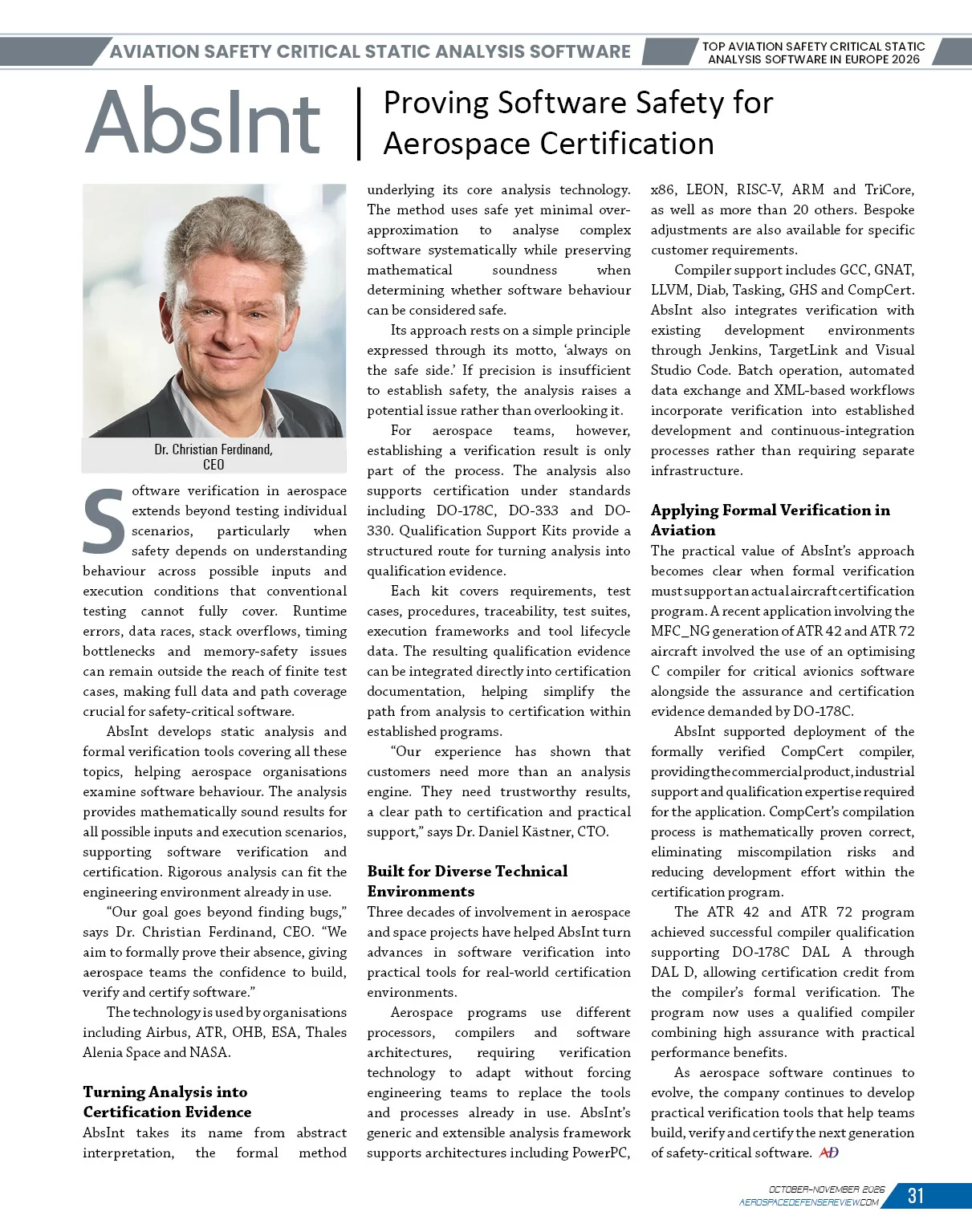
 Dr. Christian Ferdinand, CEO
AbsInt develops static analysis and formal verification tools covering all these topics, helping aerospace organisations examine software behaviour. The analysis provides mathematically sound results for all possible inputs and execution scenarios, supporting software verification and certification. Rigorous analysis can fit the engineering environment already in use.
“Our goal goes beyond finding bugs,” says Dr. Christian Ferdinand, CEO. “We aim to formally prove their absence, giving aerospace teams the confidence to build, verify and certify software.”
The technology is used by organisations including Airbus, ATR, OHB, ESA, Thales Alenia Space and NASA.
Turning Analysis into Certification Evidence
AbsInt takes its name from abstract interpretation, the formal method underlying its core analysis technology. The method uses safe yet minimal over-approximation to analyse complex software systematically while preserving mathematical soundness when determining whether software behaviour can be considered safe.
Its approach rests on a simple principle expressed through its motto, ‘always on the safe side.’ If precision is insufficient to establish safety, the analysis raises a potential issue rather than overlooking it.
For aerospace teams, however, establishing a verification result is only part of the process. The analysis also supports certification under standards including DO-178C, DO-333 and DO-330. Qualification Support Kits provide a structured route for turning analysis into qualification evidence.
Each kit covers requirements, test cases, procedures, traceability, test suites, execution frameworks and tool lifecycle data. The resulting qualification evidence can be integrated directly into certification documentation, helping simplify the path from analysis to certification within established programs.
“Our experience has shown that customers need more than an analysis engine. They need trustworthy results, a clear path to certification and practical support,” says Dr. Daniel Kästner, CTO.
Aerospace programs use different processors, compilers and software architectures, requiring verification technology to adapt without forcing engineering teams to replace the tools and processes already in use. AbsInt’s generic and extensible analysis framework supports architectures including PowerPC, x86, LEON, RISC-V, ARM and TriCore, as well as more than 20 others. Bespoke adjustments are also available for specific customer requirements.
Built for Diverse Technical Environments
Three decades of involvement in aerospace and space projects have helped AbsInt turn advances in software verification into practical tools for real-world certification environments.
-
Our goal goes beyond finding bugs. We aim to formally prove their absence, giving aerospace teams the confidence to build, verify and certify software.
Aerospace programs use different processors, compilers and software architectures, requiring verification technology to adapt without forcing engineering teams to replace the tools and processes already in use. AbsInt’s generic and extensible analysis framework supports architectures including PowerPC, x86, LEON, RISC-V, ARM and TriCore, as well as more than 20 others. Bespoke adjustments are also available for specific customer requirements.
Compiler support includes GCC, GNAT, LLVM, Diab, Tasking, GHS and CompCert. AbsInt also integrates verification with existing development environments through Jenkins, TargetLink and Visual Studio Code. Batch operation, automated data exchange and XML-based workflows incorporate verification into established development and continuous-integration processes rather than requiring separate infrastructure.
Applying Formal Verification in Aviation
The practical value of AbsInt’s approach becomes clear when formal verification must support an actual aircraft certification program. A recent application involving the MFC_NG generation of ATR 42 and ATR 72 aircraft involved the use of an optimising C compiler for critical avionics software alongside the assurance and certification evidence demanded by DO-178C.
AbsInt supported deployment of the formally verified CompCert compiler, providing the commercial product, industrial support and qualification expertise required for the application. CompCert’s compilation process is mathematically proven correct, eliminating miscompilation risks and reducing development effort within the certification program.
The ATR 42 and ATR 72 program achieved successful compiler qualification supporting DO-178C DAL A through DAL D, allowing certification credit from the compiler’s formal verification. The program now uses a qualified compiler combining high assurance with practical performance benefits.
As aerospace software continues to evolve, the company continues to develop practical verification tools that help teams build, verify and certify the next generation of safety-critical software.
Static Analysis That Holds Up to Certification
Aviation software can pass extensive test campaigns and still leave unanswered questions about behaviour on paths that testing never exercises. For avionics programs, that gap reaches beyond defect discovery. Verification evidence must remain credible under certification review, while engineering teams cannot afford tools that add a second development process beside the one already in use. Static analysis, therefore, has to do more than flag suspicious code. It has to produce evidence that engineers can defend.
Coverage is the first pressure point. Test suites are bounded by the cases that engineers design and the conditions they can reproduce. Static analysis should reason across program paths and possible inputs without depending on a particular test run. The distinction matters most around infrequent runtime faults and execution-time behaviour that may surface only under unusual states. A tool that reports broad findings but cannot establish why a result is sound leaves verification teams with another review burden. Buyers should examine how the analysis handles uncertainty and whether its conclusions are mathematically grounded. Potential issues should also be traceable to code.
Certification changes the economics of that technical rigour. Results have limited procurement value if teams must manually reconstruct the evidence needed for DO-178C review. Formal methods can strengthen verification under DO-333, while tool qualification requirements introduce their own documentation burden. Useful software should therefore connect analysis results to qualification artefacts that fit the program’s certification plan. Traceability matters here, but packaging matters too. Evidence needs to move into established review material without creating a separate chain of documentation that engineering and certification teams must reconcile late in the program.
Technical fit can be just as decisive. Aerospace programs often retain processor and compiler dependencies across long-lived build environments that cannot be replaced merely to accommodate a verification product. Analysis software has to work across the target environment while preserving the existing toolchain wherever possible. Integration with continuous-integration systems and engineering tools is especially important because static analysis loses practical value when it is treated as an isolated gate near release. Buyers should look for automation that can be repeated as code changes and target support that adapts without destabilising the verification process.
“AbsInt’s Qualification Support Kits provide structured qualification evidence that can be incorporated into certification documentation without forcing teams to build a parallel verification process.”
These pressures narrow the field. Strong products make sound analysis usable as certification-ready evidence. That work must also fit the software process already governing the aircraft program. The decisive question is not how many warnings a tool can produce. It is whether engineers can use its conclusions as dependable verification evidence without turning certification into a parallel engineering project.
Against that standard, AbsInt merits consideration as a premier choice for aviation safety-critical static analysis. Its analysis framework is built around mathematically sound results and can be adapted to varied processors and compilers. AbsInt’s Qualification Support Kits provide structured qualification evidence that can be incorporated into certification documentation without forcing teams to build a parallel verification process. Its Astrée software analyses runtime errors, while StackAnalyzer addresses worst-case stack use, extending verification beyond what test execution alone can cover. Batch workflows and established development-tool integrations further reduce adoption friction for aerospace teams that need stronger proof without replacing their existing environment.
...Read more
Aviation Safety-Critical Static Analysis Software in Europe Info
Q1
What Is Aviation Safety-Critical Static Analysis Software?
Aviation Safety-Critical Static Analysis Software analyzes program behavior, not just based on running test cases. It can validate potential inputs and execution sequences to detect runtime errors, data races, stack overflow, timing errors and memory-safety issues. In aviation programs, this "big picture" approach enables groups to define evidence critical software operates within safety limits. It can be used in conjunction with testing to cover situations that a finite test may not have addressed.
Q2
How Does AbsInt Apply Aviation Safety-Critical Static Analysis Software?
AbsInt designs and implements static analysis and formal verification tools which analyze software behaviour under all possible execution conditions. In the approach it takes, it employs abstract interpretation to determine if the software can be deemed safe. AbsInt also participates in Certification Activities, including DO-178C, DO-333 and DO-330, offering Qualification Support Kits based on the requirements, test cases, procedures, test suite traceability, test suites, test suite execution frameworks and tools lifecycle data. Such capabilities enable Aviation Safety-Critical Static Analysis Software to fit into a proven verification and certification process.
Q3
What Problems Can Static Analysis Help Address In Safety-Critical Aviation Software?
Aviation Safety-Critical Static Analysis Software can assist teams in exploring potential risks that can't be found through traditional testing. It can analyze memory safety, timing behavior, stack usage, data races and other runtime conditions. The purpose is not just to detect fault but to give evidence of potentially more operations under certain execution conditions. This is why static analysis can be helpful where assurance is based on the proof that critical software does not exhibit unacceptable behavior.
Q4
What Should Organizations Evaluate When Selecting Static Analysis Software?
Aviation Safety-Critical Static Analysis Software should fit the technical environment in which safety-critical software is developed and verified. Important considerations include processor and compiler support, development-workflow integration, automation, traceability and the ability to produce evidence for certification. AbsInt supports PowerPC, x86, LEON, RISC-V, ARM and TriCore, among more than 20 other architectures. Its compiler support includes GCC, GNAT, LLVM, Diab, Tasking, GHS and CompCert, with integrations including Jenkins, TargetLink and Visual Studio Code. These factors can make the technology practical within established engineering processes.
Q5
How Can Formal Verification Support Aviation Certification?
Aviation Safety-Critical Static Analysis Software may play a role in certification processes by providing rigorous evidence of software behavior and by assisting in the qualified software verification processes. Formal methods can be used to address properties that are hard to establish through testing alone, and structured qualification material can be used to relate analysis results to certification documentation. AbsInt has assisted with the deployment and qualification of the formally verified CompCert compiler in an ATR 42 and ATR 72 program where the critical software for the avionics was concerned. The program qualified for the compiler with compiler support for DO-178C DAL A through DAL D, so that certification credit could be granted for compiler support.
Q6
Why Does Integration Matter For Safety-Critical Static Analysis?
The importance of integration is that verification that is best suited to the development and certification processes in place to an aerospace program will be effective. AbsInt's framework allows for batch operation, automatic data exchange and XML-based workflow, and links verification to continuous integration and traditional development environments. It has been participating in aerospace and space projects for 30 years, which informed tools used for various processors, compilers and software architectures. Aviation Safety-Critical Static Analysis Software can be used within existing processes, saving the need for dedicated infrastructure and providing consistent V&C evidence for teams.
| Share this Article: |
Company
AbsInt
Management
Dr. Christian Ferdinand, CEO
Description
AbsInt is a Germany-based company specializing in static analysis and formal verification for safety-critical and security-relevant software. Its mathematically sound tools help aerospace, automotive, defense and other industries identify software risks, support certification and integrate verification into established development processes.