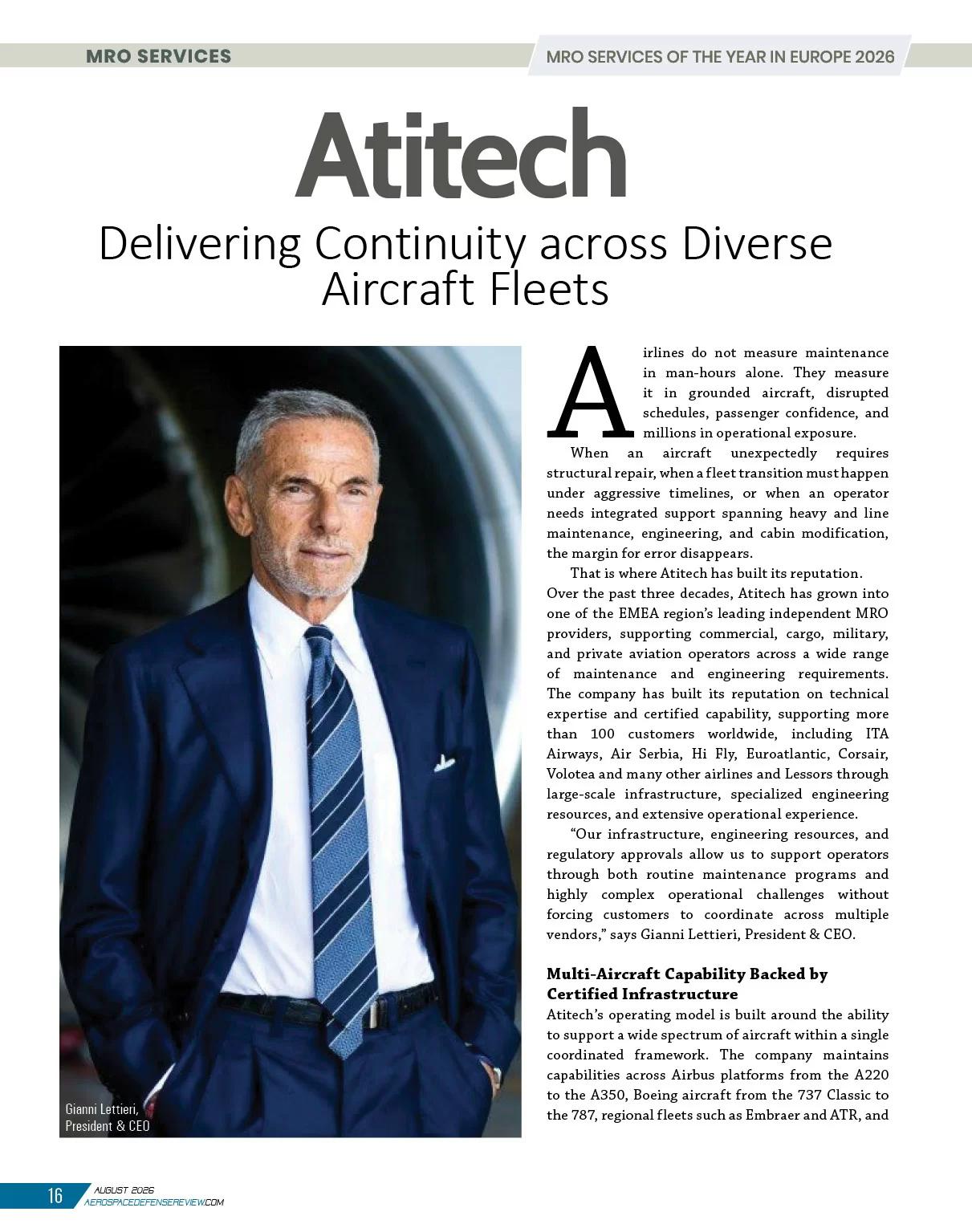
 Gianni Lettieri, President & CEO
When an aircraft unexpectedly requires structural repair, when a fleet transition must happen under aggressive timelines, or when an operator needs integrated support spanning heavy and line maintenance, engineering, and cabin modification, the margin for error disappears.
That is where Atitech has built its reputation.
Over the past three decades, Atitech has grown into one of the EMEA region’s leading independent MRO providers, supporting commercial, cargo, military, and private aviation operators across a wide range of maintenance and engineering requirements. The company has built its reputation on technical expertise and certified capability, supporting more than 100 customers worldwide, including ITA Airways, Air Serbia, Hi Fly, Euroatlantic, Corsair, Volotea and many other airlines and Lessors through large-scale infrastructure, specialized engineering resources, and extensive operational experience.
“Our infrastructure, engineering resources, and regulatory approvals allow us to support operators through both routine maintenance programs and highly complex operational challenges without forcing customers to coordinate across multiple vendors,” says Gianni Lettieri, President & CEO.
Multi-Aircraft Capability Backed by Certified Infrastructure
Atitech’s operating model is built around the ability to support a wide spectrum of aircraft within a single coordinated framework. The company maintains capabilities across Airbus platforms from the A220 to the A350, Boeing aircraft from the 737 Classic to the 787, regional fleets such as Embraer and ATR, and business aviation platforms including Gulfstream and Hawker, so far. This breadth allows the company to support commercial, cargo, regional, and private aviation segments through an integrated support model.
A comprehensive certification structure supports the technical scope. The company operates under FAA and EASA Part 145 approvals for maintenance activities. It is also certified under Part 147 for training and Part 21J for design organization activities as well as Part M. Atitech’s capabilities extend to CAMO for airworthiness management, supported by EMAR P145 for military aircraft, and multiple ISO certifications across quality, environmental, and safety standards. These certifications establish a consistent framework for compliance and operational delivery across all maintenance programs.
Atitech allocates maintenance activities across available hangar bays, ensuring that each aircraft progresses efficiently through its schedule. When additional work extends timelines, the company adjusts bay allocation and sequencing to maintain continuity across all ongoing programs. The availability of multiple bays across its facilities provides the flexibility required to accommodate such changes while supporting other aircraft in parallel. This approach enables Atitech to maintain workflow stability while meeting customer timelines and operational expectations.
The company’s infrastructure is organized across three primary bases in Naples, Rome Fiumicino, and Olbia, supported by 29 line stations across Italy and international locations. Its facilities include multiple hangars capable of simultaneously accommodating 30 narrow-body, 10 wide-body, or up to 8 business jets. This capacity is reinforced by a workforce of more than 1,500 employees, of whom around 60 percent are licensed engineers qualified across multiple aircraft types. Together, these elements allow Atitech to manage more than 40 base maintenance lines in parallel.
“We focus on ensuring continuity for our customers across every stage of the maintenance cycle,” says Lettieri. “This means having the capability to support different aircraft platforms, the flexibility to adapt to changing maintenance requirements, and the expertise to manage both scheduled and unscheduled activities without disrupting operations.”
Coordinated Maintenance Execution across Base and Line Operations
Atitech integrates base maintenance and line maintenance within a unified operational structure. Line maintenance activities include daily and weekly checks, ETOPS checks, AOG support, defect rectification, and engine changes. These activities are conducted in proximity to operational environments and are designed to maintain continuous aircraft serviceability. Base maintenance includes more extensive work like C checks and structural inspections that require hangar access and longer timelines. Managing both within the same framework ensures alignment between immediate operational requirements and planned maintenance programs.
Heavy maintenance checks follow a structured workflow that supports consistency and control. Each aircraft undergoes an incoming inspection, followed by technical washing to prepare surfaces for detailed evaluation. Access panels are opened to allow inspection teams to assess structural and system conditions. Identified findings are addressed through repair and rectification activities before the aircraft is closed and prepared for testing. Final acceptance confirms that all work meets regulatory and operational requirements before release to service. The duration of these checks depends on the scope of work, with C checks typically ranging from ten to twenty days and structural checks extending from twenty to forty days.
-
Our infrastructure, engineering resources, and regulatory approvals allow us to support operators through both routine maintenance programs and highly complex operational challenges without forcing customers to coordinate across multiple vendors.
Atitech allocates maintenance activities across available hangar bays, ensuring that each aircraft progresses efficiently through its schedule. When additional work extends timelines, the company adjusts bay allocation and sequencing to maintain continuity across all ongoing programs. The availability of multiple bays across its facilities provides the flexibility required to accommodate such changes while supporting other aircraft in parallel. This approach enables Atitech to maintain workflow stability while meeting customer timelines and operational expectations.
Component support is integrated into maintenance execution through flexible service models. Under power-by-the-hour agreements, the company takes responsibility for sourcing and providing components. In other cases, customers supply their own parts while Atitech ensures the availability of consumables and expendable materials required for maintenance. This adaptability allows the company to align with different customer operating models while maintaining consistent service delivery across both scheduled and unscheduled interventions.
Managing Maintenance Complexity within Operational Timelines
In one instance, Atitech supported an operator during a scheduled heavy maintenance check where additional structural findings were identified during inspection. What began as a planned maintenance activity expanded to include structural repairs, component replacement, and coordination with engineering teams for non-standard interventions.
Within the same maintenance window, the aircraft was required to return to service within a defined operational timeline. Atitech adjusted hangar allocation, aligned material availability, and coordinated activities across teams to ensure that progress continued without affecting other ongoing maintenance programs. The aircraft completed inspection, repair, testing, and final acceptance before being returned to service. This example reflects the company’s ability to manage evolving maintenance requirements while maintaining schedule integrity and operational continuity.
Beyond maintenance execution, Atitech is strengthening its operations through integrated digital platforms supporting airworthiness management, supply chain coordination, compliance, performance reporting, and resource planning. The company is also investing in AI and advanced analytics to improve maintenance planning, workforce allocation, and operational performance, complementing its engineering expertise while improving efficiency and decision-making.
“This combination of aviation expertise, operational excellence, and technological innovation continues to position Atitech as a trusted next-generation MRO provider across the commercial, cargo, military, and private aviation sectors," says Lettieri.
Engineering Depth and End-to-End Service Capability
Beyond routine maintenance, Atitech has developed strong capabilities in managing complex and time-sensitive maintenance scenarios. Its expertise spans structural repairs, supported by engineering resources capable of addressing findings beyond standard maintenance tasks, as well as passenger-to-freighter conversions, avionics upgrades, and connectivity modifications.
The company also provides rapid aircraft-on-ground support and manages phase-in and phase-out checks for leasing transitions, delivering integrated services that include inspection, modification, and repainting in new livery. Together, these capabilities enable Atitech to support both planned maintenance programs and unexpected operational requirements, in one stop solution.
The company’s service offering extends into airworthiness management and engineering. Its CAMO capabilities (PART M) support continuous airworthiness, ensuring aircraft remain compliant throughout their operational lifecycle. Through its design organization approval (DOA Part 21J), Atitech develops and implements modifications including cabin reconfiguration, layout adjustments, avionics upgrades, and livery changes. Its Part 147 training academy develops technical personnel to sustain expertise across its operations.
Clients value the company for its expertise, execution quality, problem-solving approach, flexibility, and customer care across commercial, cargo, military, and leasing sectors.
The company continues to expand its capabilities in targeted areas. Its operations in Olbia support growth in the private jet sector, while the development of a center of excellence focused on cabin refurbishment and modification reflects increasing demand for interior upgrades and customized configurations. These initiatives extend the company’s ability to support aircraft operators across additional segments while building on its established operational foundation.
Atitech was recently recognized as MRO Services of the Year in Europe, reflecting its ability to deliver consistent maintenance performance across diverse aircraft platforms and operational requirements. By combining engineering expertise, certified capabilities, and coordinated maintenance execution, Atitech continues to strengthen its position as a trusted MRO provider across commercial, cargo, military, and private aviation.
Selecting MRO Partners for Fleet Continuity
Aircraft maintenance decisions now sit closer to network planning, asset value protection and fleet availability than traditional procurement. Airlines, lessors and public-sector operators are balancing mixed fleets, tighter maintenance windows, aging aircraft, next-generation platforms and unpredictable defect patterns. A provider that performs well within a narrow work scope may still expose the buyer to delays when a check expands, parts responsibility shifts or engineering support becomes necessary mid-event.
The pressure is clearest in heavy maintenance. A scheduled check rarely remains a simple sequence of inspections and closing tasks once structural findings, cabin work, modifications or lease-transition requirements enter the work package. Buyers need evidence that the provider can manage access, inspection, rectification, testing and release activities without treating each added task as an exception. Turnaround time matters, but predictability depends on how the provider controls the critical path, allocates licensed labor and protects follow-on slots when one aircraft consumes more time than planned.
Fleet coverage has become equally important. Operators no longer benefit from a maintenance partner that supports only part of the fleet and forces separate arrangements for regional aircraft, narrow-body aircraft, wide-body aircraft, turboprops or business jets. Fragmented sourcing can create inconsistent documentation, duplicated oversight and slower escalation when aircraft move between line events, base checks and engineering actions. Buyers should look for practical scale, not merely geographic: hangar capacity, station coverage, licensed engineers across multiple types and the internal training structure to keep capability current.
“Effective aircraft maintenance depends on more than technical expertise. It requires the engineering, coordination and operational discipline to keep fleets flying.”
Line maintenance deserves the same scrutiny as base maintenance because disruptions often begin outside the hangar. Daily, weekly, ETOPS, transit and AOG requirements test how effectively a provider can convert local presence into release-to-service confidence. Strong support includes defect rectification, LRU replacement, engine and APU servicing, cabin maintenance and special inspections after events such as bird strike or hard landing. The most valuable providers reduce handoff friction between line findings and base-level resolution, especially when an aircraft must move from short-cycle service pressure into a deeper intervention.
Parts and engineering control are another decisive filter. Scheduled maintenance typically requires consumables and expendables, while broader agreements may place procurement responsibility on the MRO. Either model needs transparency on availability, responsibility and escalation. Complex work also benefits from design approval, continuing airworthiness support, modification capability and workshops that can keep more activity inside one governed environment. The aim is not necessarily to buy every service from one supplier; it is to avoid unnecessary fragmentation when schedule, airworthiness and asset-transition decisions are interdependent.
Atitech stands out for buyers that need a broad MRO partner across base, line, engineering and support services. The company operates from Naples, Rome Fiumicino and Olbia, supports heavy and light base maintenance, line maintenance, component repair, engineering services and technical training, and maintains approvals including EASA Part 145, FAA Part 145, CAMO, DOA Part 21J and Part 147. Its demonstrated strengths include fleet breadth across Airbus, Boeing, Embraer, ATR and business jet platforms, parallel base-line capacity, structural repair experience, P2F conversion support, modification capability, PBH parts support and a training academy. For executives prioritizing fleet continuity, schedule discipline and integrated airworthiness support, Atitech is a credible Gold Standard choice.
...Read more
MRO Services in Europe Info
Q1
What Are MRO Services in the Aviation Industry?
MRO Services encompass the maintenance, repair, and overhaul activities required to keep aircraft safe, airworthy, and operational throughout their service life. These services include scheduled and unscheduled maintenance, structural repairs, engineering support, component servicing, airworthiness management, and aircraft modifications. By combining technical expertise with regulatory compliance, MRO Services help airlines and aircraft operators maximize fleet availability while maintaining safety and operational reliability.
Q2
How Does Atitech Deliver MRO Services?
Atitech provides comprehensive MRO Services through an integrated operating model that combines base maintenance, line maintenance, engineering, airworthiness management, and technical training. Operating from major facilities in Naples, Rome Fiumicino, and Olbia, alongside numerous line stations, it supports commercial, cargo, military, private aviation, and leasing customers. Its capabilities span Airbus, Boeing, ATR, Embraer, and business aircraft, allowing operators to consolidate diverse maintenance requirements with a single certified provider.
Q3
What Capabilities Should Organizations Look for in an MRO Provider?
When evaluating MRO Services, organizations should consider certified maintenance capabilities, engineering expertise, fleet coverage, hangar capacity, regulatory approvals, and the ability to manage both scheduled and unexpected maintenance events. An effective provider should also offer structural repair, component support, engineering modifications, and responsive aircraft-on-ground assistance while maintaining consistent turnaround times and compliance with aviation regulations.
Q4
How Do MRO Services Improve Fleet Reliability and Operational Continuity?
MRO Services improve operational continuity by reducing aircraft downtime, identifying maintenance issues before they become critical, and coordinating repairs efficiently across planned and unplanned maintenance events. Integrated maintenance planning also helps operators optimize fleet availability, maintain regulatory compliance, extend aircraft service life, and minimize operational disruptions that can affect schedules and customer confidence.
Q5
Why Is Atitech Recognized for Managing Complex Aircraft Maintenance?
Atitech has developed MRO Services that extend beyond routine maintenance to include structural repairs, passenger-to-freighter conversions, avionics upgrades, cabin modifications, phase-in and phase-out inspections, and continuing airworthiness management. Supported by EASA and FAA approvals, Part 21J design organization capability, CAMO services, and a workforce of more than 1,500 employees, it can coordinate complex maintenance programs while maintaining operational continuity for more than 100 customers worldwide.
Q6
Why Are Integrated MRO Services Becoming Increasingly Important?
As aircraft fleets become more diverse and maintenance requirements more complex, MRO Services are evolving from isolated maintenance activities into integrated lifecycle support solutions. Organizations increasingly value providers that combine maintenance execution, engineering, regulatory compliance, component support, and airworthiness management within a coordinated framework. This integrated approach reduces operational complexity, improves maintenance planning, and helps operators maintain safe, efficient, and reliable fleet performance.
| Share this Article: |

Company
Atitech
Management
Gianni Lettieri, President & CEO
Description
Atitech is an independent MRO provider based in Italy, offering base and line maintenance, engineering, and airworthiness management services. With operations in Naples, Rome Fiumicino, and Olbia, it supports a wide range of aircraft types through certified capabilities, integrated infrastructure, and a skilled workforce serving commercial, cargo, and private aviation sectors.