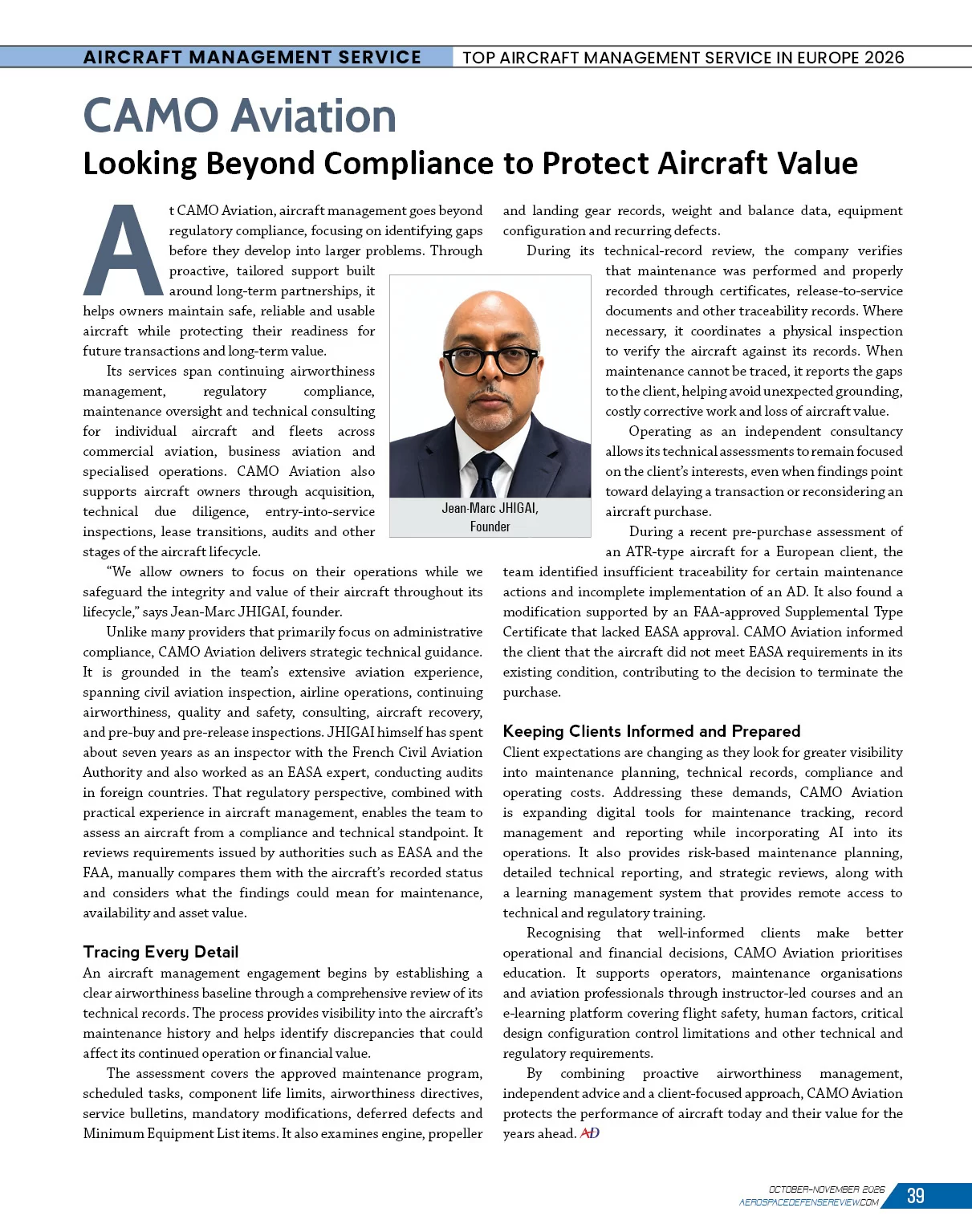
 Jean-Marc JHIGAI, Founder
Its services span continuing airworthiness management, regulatory compliance, maintenance oversight and technical consulting for individual aircraft and fleets across commercial aviation, business aviation and specialised operations. CAMO Aviation also supports aircraft owners through acquisition, technical due diligence, entry-into-service inspections, lease transitions, audits and other stages of the aircraft lifecycle.
“We allow owners to focus on their operations while we safeguard the integrity and value of their aircraft throughout its lifecycle,” says Jean-Marc JHIGAI, founder.
Unlike many providers that primarily focus on administrative compliance, CAMO Aviation delivers strategic technical guidance. It is grounded in the team’s extensive aviation experience, spanning civil aviation inspection, airline operations, continuing airworthiness, quality and safety, consulting, aircraft recovery, and pre-buy and pre-release inspections. JHIGAI himself has spent about seven years as an inspector with the French Civil Aviation Authority and also worked as an EASA expert, conducting audits in foreign countries. That regulatory perspective, combined with practical experience in aircraft management, enables the team to assess an aircraft from a compliance and technical standpoint. It reviews requirements issued by authorities such as EASA and the FAA, manually compares them with the aircraft’s recorded status and considers what the findings could mean for maintenance, availability and asset value.
Tracing Every Detail
An aircraft management engagement begins by establishing a clear airworthiness baseline through a comprehensive review of its technical records. The process provides visibility into the aircraft’s maintenance history and helps identify discrepancies that could affect its continued operation or financial value.
The assessment covers the approved maintenance program, scheduled tasks, component life limits, airworthiness directives, service bulletins, mandatory modifications, deferred defects and Minimum Equipment List items. It also examines engine, propeller and landing gear records, weight and balance data, equipment configuration and recurring defects.
-
We allow owners to focus on their operations while we safeguard the integrity and value of their aircraft throughout its lifecycle.
During its technical-record review, the company verifies that maintenance was performed and properly recorded through certificates, release-to-service documents and other traceability records. Where necessary, it coordinates a physical inspection to verify the aircraft against its records. When maintenance cannot be traced, it reports the gaps to the client, helping avoid unexpected grounding, costly corrective work and loss of aircraft value.
Operating as an independent consultancy allows its technical assessments to remain focused on the client’s interests, even when findings point toward delaying a transaction or reconsidering an aircraft purchase.
During a recent pre-purchase assessment of an ATR-type aircraft for a European client, the team identified insufficient traceability for certain maintenance actions and incomplete implementation of an AD. It also found a modification supported by an FAA-approved Supplemental Type Certificate that lacked EASA approval. CAMO Aviation informed the client that the aircraft did not meet EASA requirements in its existing condition, contributing to the decision to terminate the purchase.
Keeping Clients Informed and Prepared
Client expectations are changing as they look for greater visibility into maintenance planning, technical records, compliance and operating costs. Addressing these demands, CAMO Aviation is expanding digital tools for maintenance tracking, record management and reporting while incorporating AI into its operations. It also provides risk-based maintenance planning, detailed technical reporting, and strategic reviews, along with a learning management system that provides remote access to technical and regulatory training.
Recognising that well-informed clients make better operational and financial decisions, CAMO Aviation prioritises education. It supports operators, maintenance organisations and aviation professionals through instructor-led courses and an e-learning platform covering flight safety, human factors, critical design configuration control limitations and other technical and regulatory requirements.
By combining proactive airworthiness management, independent advice and a client-focused approach, CAMO Aviation protects the performance of aircraft today and their value for the years ahead.
Aircraft Management Built on Traceable Airworthiness
An aircraft can be technically serviceable yet commercially compromised by a weak record trail. For European owners and operators, gaps between the physical aircraft and its technical history can surface during registration or sale, turning what appeared to be a routine transaction into rework or pricing pressure. Aircraft management, therefore, has to do more than watch maintenance dates. It must establish whether the records can withstand scrutiny and whether the aircraft’s configuration is supported by evidence that regulators and future buyers can accept. The financial exposure often appears late, when a buyer has less leverage to correct the record or renegotiate the transaction.
Record integrity is the first dividing line. A management provider should be able to reconstruct maintenance history far enough to expose missing proof or incomplete task closeouts. Modifications deserve separate scrutiny when their approval basis may not align with the intended registration. The age of the aircraft matters because ownership changes multiply the number of handoffs that records have passed through. A superficial document check can miss discrepancies that only become visible when technical files are compared with the aircraft itself. Buyers should look for a method that links each recorded requirement to supporting evidence rather than treating archived documentation as inherently reliable. A clean status report is useful only when the evidence beneath it can be followed back to the work performed.
Forward visibility matters just as much after entry into service. Daily aircraft management depends on accurate capture of flight hours and flight cycles, followed by disciplined control of maintenance status and life-limited components. Airworthiness directives and service bulletins also need continuous review against the aircraft’s current status. The practical issue is not whether software is present. Most systems can store due dates. The distinction lies in whether the provider keeps the data current enough to reveal emerging exposure before it reaches a maintenance event or interrupts planned use.
“CAMO Aviation uses an aircraft recovery process that covers records and physical configuration, then cross-checks the resulting status against authority requirements.”
Regulatory judgment becomes especially important when an aircraft crosses jurisdictions. An approval accepted by one authority may not automatically satisfy European requirements, leaving an owner with a configuration that is difficult to validate after purchase. The provider must know when a record discrepancy is administrative and when it affects the acceptance of the aircraft itself. That judgment should shape the scope of the engagement. A recent aircraft with a clean ownership history does not demand the same depth of recovery as an older aircraft that has moved through several operators. Digital tracking can organise status information, but interpretation still depends on familiarity with regulator expectations and recurring documentation failures. Decision-makers should test whether technical decisions receive experienced human review rather than being delegated to software.
CAMO Aviation is a premier choice for buyers who place record traceability and European airworthiness control at the centre of aircraft management. CAMO Aviation uses an aircraft recovery process that covers records and physical configuration, then cross-checks the resulting status against authority requirements. Its relevant scope covers aircraft management and airworthiness review. Phase-in and phase-out support extends that scrutiny into aircraft entry or exit. Its team brings more than two decades of aircraft management and airworthiness experience, including former civil aviation inspection work. Experienced personnel also track daily utilisation and technical status, reinforcing a management model built around documented conformity rather than schedule monitoring alone.
...Read more
Aircraft Management Services in Europe Info
Q1
What Do Aircraft Management Services in Europe Typically Cover?
Aircraft Management Services in Europe can cover continuing airworthiness, regulatory compliance, maintenance planning, technical records, inspections and support throughout an aircraft’s operating life. The scope often extends beyond scheduling maintenance to verifying whether required work is properly documented and whether the aircraft remains aligned with applicable authority requirements. Effective management gives owners greater visibility into technical status, upcoming obligations and issues that may affect availability, safety or long-term asset value.
Q2
How Does CAMO Aviation Support Aircraft Owners and Operators?
CAMO Aviation applies Aircraft Management Services in Europe through continuing airworthiness management, maintenance oversight and technical consulting for individual aircraft and fleets. Its work can also support acquisitions, technical due diligence, entry-into-service inspections, lease transitions and audits. By combining operational oversight with technical assessment, it helps clients understand an aircraft’s current condition, documentation status and future maintenance exposure while keeping regulatory requirements integrated into day-to-day management.
Q3
Why Are Technical Records Important in Aircraft Management?
Because an aircraft's physical state and documented history must stay consistent, accurate technical records are essential to Aircraft Management Services in Europe. Records can demonstrate whether mandatory directives were followed, components stay within their lifespan, scheduled tasks were finished, and configuration changes can be tracked. Poor documentation can make future transactions, regulatory reviews, and maintenance planning more difficult. Thus, both ongoing airworthiness and well-informed technical decision-making are supported by a disciplined record-keeping procedure.
Q4
What Factors Matter When Evaluating an Aircraft Management Provider?
When assessing Aircraft Management Services in Europe, decision-makers should look beyond administrative coordination. Important considerations include regulatory knowledge, maintenance oversight, record traceability, technical judgement and the ability to identify discrepancies before they become operational problems. Independence can also matter when a provider is reviewing an acquisition or maintenance issue. Clear reporting and forward maintenance visibility help users understand not only what is due, but also why a technical finding could affect aircraft readiness or value. Providers should also explain how findings are prioritised, documented and communicated when several technical or regulatory issues interact.
Q5
How Does CAMO Aviation Approach Airworthiness and Technical Review?
CAMO Aviation supports Aircraft Management Services in Europe with a detailed review of maintenance history, approved maintenance programmes, component limits, airworthiness directives, service bulletins and other technical records. Where needed, it can coordinate a physical inspection to compare the aircraft with its documentation. Its technical perspective is also informed by founder Jean-Marc JHIGAI’s background as a French civil aviation inspector and EASA expert, bringing regulatory experience into aircraft assessment and compliance review.
Q6
How Can Aircraft Management Improve Operational and Financial Visibility?
Aircraft Management Services in Europe can improve visibility by connecting maintenance status, compliance requirements and technical findings with their practical effect on aircraft use. Risk-based maintenance planning and structured reporting can help organisations anticipate upcoming work rather than react to avoidable disruptions. Better information also supports decisions around acquisitions, lease transitions, maintenance events and continued operation. The result is a clearer view of technical priorities, potential exposure and the steps needed to preserve reliable aircraft availability over time.
| Share this Article: |
Company
CAMO Aviation
Management
Jean-Marc JHIGAI, Founder
Description
CAMO Aviation provides independent aircraft management and continuing airworthiness expertise, combining regulatory oversight, technical assessments and maintenance planning. Its tailored support helps owners maintain compliance, reliability and long-term aircraft value across diverse aviation operations.