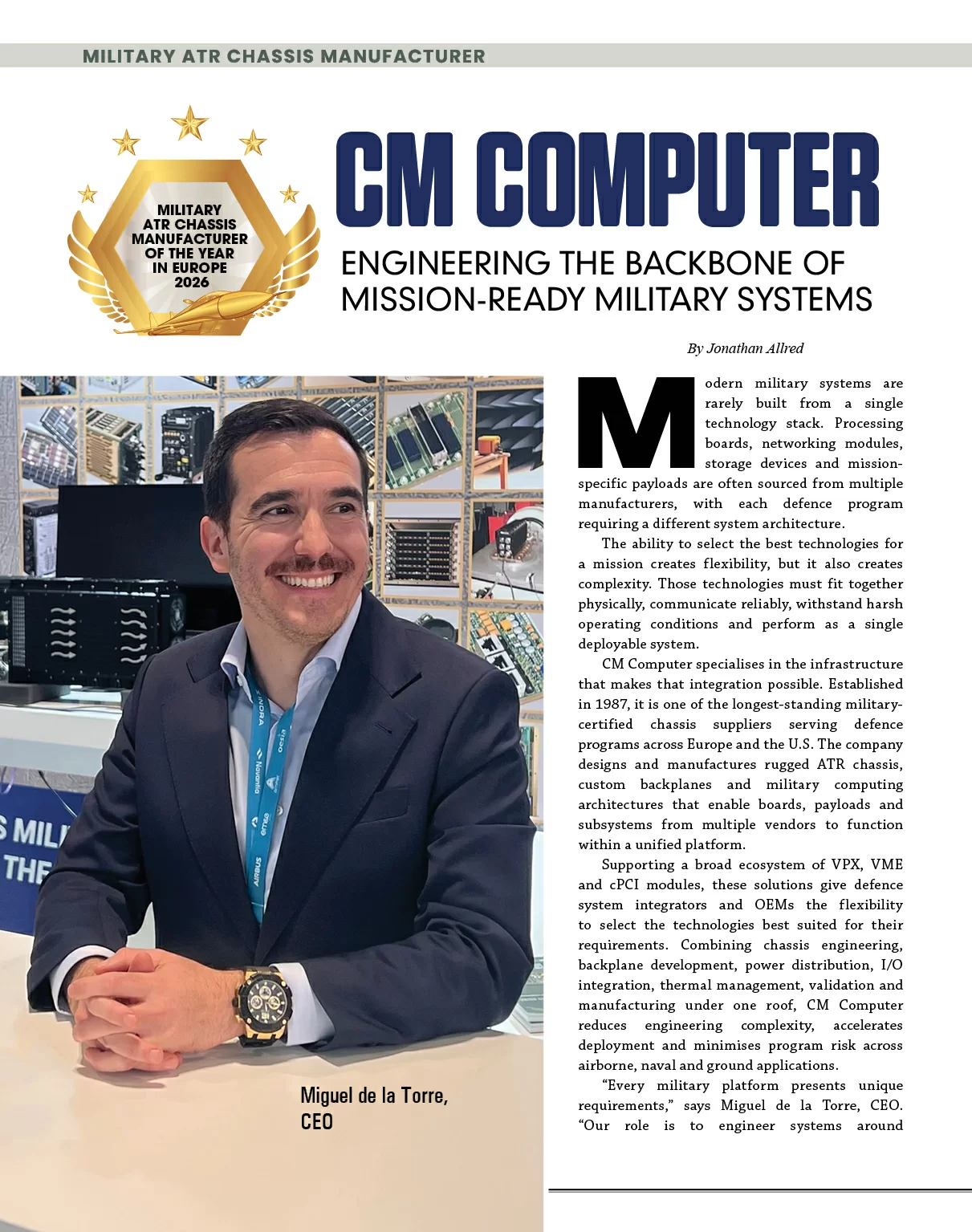
 Miguel de la Torre, CEO
The ability to select the best technologies for a mission creates flexibility, but it also creates complexity. Those technologies must fit together physically, communicate reliably, withstand harsh operating conditions and perform as a single deployable system.
CM Computer specialises in the infrastructure that makes that integration possible. Established in 1987, it is one of the longest-standing military-certified chassis suppliers serving defence programs across Europe and the U.S. The company designs and manufactures rugged ATR chassis, custom backplanes and military computing architectures that enable boards, payloads and subsystems from multiple vendors to function within a unified platform.
Supporting a broad ecosystem of VPX, VME and cPCI modules, these solutions give defence system integrators and OEMs the flexibility to select the technologies best suited for their requirements. Combining chassis engineering, backplane development, power distribution, I/O integration, thermal management, validation and manufacturing under one roof, CM Computer reduces engineering complexity, accelerates deployment and minimises program risk across airborne, naval and ground applications.
"Every military platform presents unique requirements," says Miguel de la Torre, CEO. "Our role is to engineer systems around those requirements, not force programs into predefined configurations."
That approach is supported by multidisciplinary electrical and mechanical engineering teams working closely with customer engineers throughout the development process. Validation and quality-control testing are conducted internally, ensuring design decisions remain closely aligned with manufacturing execution.
The challenge is not selecting the technology. It is making the technology work together.
CM Computer also maintains direct oversight of production through three manufacturing facilities equipped with three-axis and five-axis CNC machining centres, along with dedicated painting and anti-corrosion treatment capabilities. This combination of engineering expertise and manufacturing control keeps production aligned with design intent, maintaining consistent quality standards while shortening delivery timelines for defence programs.
Designed for System Flexibility
System flexibility begins with an open-architecture foundation.
CM Computer's chassis, boards and backplane solutions are designed around 3U and 6U VITA standards and VITA Mil-COTS requirements. The card cages and slot architectures support standard open-bus modules while maintaining compliance with both mechanical and electrical VITA specifications.
Customers can select from more than 400 compatible modules produced by over 20 manufacturers worldwide. This broad compatibility simplifies system development, reduces integration efforts and lowers overall program costs. It also gives system designers greater freedom to choose the technologies best suited to mission requirements rather than being restricted by proprietary ecosystems.
Military platforms also introduce their own operational, environmental and certification requirements, many of which influence chassis configuration, power architecture and overall system design.
Ground vehicle systems require power supplies compliant with MIL-STD-1275D. UAV platforms typically require MIL-STD-704F compliance. Submarine deployments may impose acoustic requirements below 55 dBA while helicopter applications often demand enhanced vibration resistance.
Adapting systems to these varying requirements has become a routine part of CM Computer's engineering process and an important factor in helping customers reduce deployment risk.
Since introducing its first VPX integrated chassis in 2013, CM Computer has supported more than 30 VPX-based defence programs worldwide.
That experience is reflected in deployments, such as its work with Ultra I&C, a provider of advanced mission computing and tactical edge-processing technologies for defence applications. CM Computer supplies chassis solutions for the KNOX family of military computers, including the KNOX-5, KNOX-7 and KNOX-10 systems. Built around SOSA-aligned 3U OpenVPX architectures, these platforms support mission computing, tactical edge processing, sensor fusion and AI-enabled workloads across air, land and maritime environments.
Building the Integration Layer
Selecting compatible technologies is only the starting point. Integrating them into a rugged military platform presents a different set of engineering challenges.
Front panels require application-specific connector configurations, board-to-board communications must be optimised and signal integrity must be maintained under vibration, shock and environmental stress.
CM Computer’s military-specific backplanes are based on payload topology and communication requirements while managing complete chassis I/O integration. Signals are routed from payload modules to front panels through flex circuits, military-grade cabling and specialised wiring solutions engineered for rugged operation.
The complexity increases further when commercial high-speed technologies are introduced into military environments. Many digital video and data interfaces were originally developed for commercial electronics and are not fully supported by military VITA standards.
To address this gap, CM Computer has created proprietary integration solutions that enable multi-gigabit interfaces and digital video connections to operate reliably under demanding military conditions.
The nine-slot VPX platform manages 24 optical 10G video channels and 14 mixed-standard video interfaces, including DisplayPort, HDMI, DVI, 3G-SDI, PAL and NTSC, while supporting multiple 4K at 144Hz digital video outputs. Video streams from vehicle cameras and sensors are processed and distributed to five crew displays and two 3D operator goggles, creating significant demands on signal integrity, data throughput and thermal performance.
"The challenge is not selecting the technology,” says Torre. “It is making the technology work together."
Optimising Thermal Paths for System Reliability
As processing densities continue to increase, thermal management becomes equally important for long-term operational reliability.
FPGA-based modules continue to drive higher power dissipation requirements, while defence systems may be required to operate continuously in ambient temperatures of up to 71°C. These conditions place significant demands on cooling performance.
CM Computer addresses these requirements through a combination of thermal technologies working together to reduce the thermal path between payload and ambient air. Depending on the application, systems may incorporate multiple heat exchangers, heat pipe technologies, internal air recirculation systems, high-altitude military-grade fans and airflow optimisation techniques. The objective is to support lower card-cage operating temperatures while improving reliability and acceptable MTBF levels.
Solving a Multi-Interface Challenge
A recent project involving the German PUMA combat vehicle demonstrates how open-architecture integration, customised I/O engineering and thermal management come together within a demanding defence application. The military-certified VPX-SOSA 360-degree visualisation system required extremely high-performance video processing combined with reliable operation.
-
Every military platform introduces unique requirements. Our role is to engineer systems around those requirements, not force programs into predefined configurations.
The nine-slot VPX platform manages 24 optical 10G video channels and 14 mixed-standard video interfaces, including DisplayPort, HDMI, DVI, 3G-SDI, PAL and NTSC, while supporting multiple 4K at 144Hz digital video outputs. Video streams from vehicle cameras and sensors are processed and distributed to five crew displays and two 3D operator goggles, creating significant demands on signal integrity, data throughput and thermal performance.
For this project, CM Computer provided the rugged integration platform, combining customised I/O integration, a Generation 4 SOSA backplane, advanced signal-integrity engineering and optimised thermal management to support reliable operation under demanding military conditions. Together, these capabilities addressed complex integration challenges within the broader PUMA visualisation system.
Engineering Through Collaboration
Programs such as the PUMA visualisation system are built through close collaboration between CM Computer and customer engineering teams. Development projects often involve extensive exchanges of drawings, technical reviews and design discussions aimed at resolving technical issues before systems reach deployment.
That collaborative approach has helped establish a reputation for trouble-free system integration across a wide range of defence programs.
"Attention to detail is often what separates a deployable system from a delayed program," says Torre.
Longstanding involvement within the VITA ecosystem further supports that process. A close relationship with VITA technical committees provides CM Computer with early visibility into emerging standards and technologies, allowing customers to prepare for future architecture requirements.
Building on Decades of Expertise
Underpinning CM Computer's integration capabilities is nearly four decades of experience in military electronics, rugged chassis design and open-architecture systems. Preserving and transferring that knowledge has become an important priority as the next generation of engineers prepares to support increasingly sophisticated defence programs.
That commitment extends beyond people to the infrastructure required to support future programs. Continued investment in manufacturing capacity, including a third production facility and additional CNC machining resources, reflects a long-term focus on meeting evolving defence requirements.
The combination of deep engineering expertise, manufacturing control and integration experience continues to define CM Computer's role within the defence industry, earning recognition as the Military ATR Chassis Manufacturer of the Year in Europe 2026.
As defence platforms continue to incorporate more sophisticated processing, communications and sensor technologies, CM Computer remains focused on helping customers reduce integration complexity and deploy mission-ready systems with greater confidence.
What Defence Integrators Should Prioritise
Military electronics programmes continue to face increasing demands for processing power, sensor integration and platform interoperability. Modern airborne, naval and ground systems are expected to support larger data volumes, faster communications and more sophisticated mission applications while operating in environments that place significant stress on electronic hardware. For defence procurement leaders and system integrators, selecting the right ATR chassis supplier has become an important decision that influences reliability, integration complexity and long-term programme success.
Open architecture has emerged as a central requirement across defence modernisation efforts. Programmes increasingly rely on standards-based ecosystems that allow integrators to select payload modules from multiple vendors while avoiding unnecessary platform lock-in. ATR chassis solutions that support widely adopted VITA architectures can simplify development schedules and reduce life cycle costs by providing greater flexibility in processor, networking and sensor integration choices. Compatibility alone, however, is insufficient. The value lies in how effectively a chassis platform enables the integration of diverse technologies without creating additional engineering burdens.
Thermal management has become another major concern. Defence systems now incorporate high-performance processing modules that generate considerably more heat than previous generations. Electronics deployed in enclosed military environments must maintain performance under demanding temperature conditions while preserving acceptable reliability levels. Chassis manufacturers that invest heavily in thermal dissipation techniques, airflow optimisation and advanced cooling technologies are often better positioned to support the increasing power requirements of modern defence payloads.
System integration presents its own challenges. Many military applications depend on combinations of digital video, high-speed networking and specialised communications interfaces that were not originally developed for defence environments. Converting these technologies into military-ready solutions requires expertise in signal integrity, ruggedised connector design and platform-specific customisation. Integrators frequently place significant value on suppliers capable of managing backplane development, front-panel integration and complex I/O requirements within a unified engineering process.
Adaptability remains equally important. Military programmes rarely share identical requirements. Ground vehicles, aircraft, helicopters and naval platforms introduce different environmental standards, power specifications and performance constraints. Suppliers that can tailor chassis configurations while maintaining compliance with recognised military standards help reduce programme risk and accelerate deployment schedules. Experience across multiple defence domains often becomes a meaningful advantage when addressing platform-specific certification and integration requirements.
Close engineering collaboration can also influence outcomes. Complex defence systems frequently require sustained interaction between customer design teams and chassis specialists throughout development. Organisations that combine design expertise, manufacturing capabilities and validation resources within a single environment can often streamline communication and reduce integration challenges. This level of technical engagement becomes increasingly valuable as military systems continue to grow in complexity.
Against this backdrop, CM Computer stands out as a strong choice for defence organisations evaluating ATR chassis solutions. The company combines nearly four decades of military chassis expertise with in-house capabilities spanning mechanical design, backplane engineering, power supply integration, CNC manufacturing and validation testing. Its ATR platforms support 3U and 6U VITA-compliant architectures, including VPX, VME and cPCI environments, while offering customised backplanes and specialised I/O integration for mission-specific requirements. Advanced thermal management technologies, platform-specific adaptations and extensive experience supporting demanding defence programmes position CM Computer as a compelling partner for military ATR chassis deployments across Europe and international markets.
...Read more
Military ATR Chassis Manufacturers in Europe Info
Q1
What Do Military ATR Chassis Manufacturers Provide?
Military ATR Chassis Manufacturers design and produce rugged Air Transport Rack (ATR) enclosures that protect mission-critical electronics operating in demanding aerospace and defense environments. These chassis are engineered to withstand vibration, shock, temperature extremes, and electromagnetic interference while supporting reliable operation in aircraft, naval platforms, ground systems, and other military applications.
Q2
How Does CM Computer Deliver Military ATR Chassis Manufacturers Solutions?
CM Computer exemplifies the capabilities expected of leading Military ATR Chassis Manufacturers through more than three decades of designing and manufacturing military COTS electronic modules and ATR chassis. Since supplying military VMEbus boards in 1988 and ATR chassis in 1993, the company has supported over 250 defense and avionics programs worldwide. Its products are designed and manufactured entirely in-house, with ISO 9001-certified facilities and MIL-STD-certified ATR chassis for immediate deployment across aerospace and defense applications.
Q3
What Should Organizations Consider When Evaluating Military ATR Chassis Manufacturers?
When assessing Military ATR Chassis Manufacturers, organizations should evaluate compliance with military standards, thermal management capabilities, product lifecycle support, customization options, manufacturing quality, and engineering expertise. Companies that maintain in-house design, testing, machining, and quality control processes can often deliver greater consistency, shorter lead times, and stronger configuration flexibility for mission-specific requirements.
Q4
Why Are Military ATR Chassis Manufacturers Critical to Defense Systems?
Reliable Military ATR Chassis Manufacturers play a vital role in protecting high-value electronic systems deployed in harsh operational environments. Rugged ATR chassis provide structural integrity, thermal performance, electromagnetic compatibility, and maintainability, enabling avionics, radar, communications, and mission computing systems to perform consistently throughout demanding operational lifecycles.
Q5
Why Is CM Computer Recognized Among Military ATR Chassis Manufacturers?
CM Computer distinguishes itself among Military ATR Chassis Manufacturers through a comprehensive portfolio of 3U and 6U ATR chassis, VPX, VME, and CompactPCI platforms engineered for military applications. The company offers standardized off-the-shelf products alongside configurable solutions, supports payloads up to 1,200 watts, and designs products for deployment in fighters, helicopters, submarines, UAVs, and ground systems. Its vertically integrated manufacturing approach allows it to control quality without subcontracting production.
Q6
How Are Military ATR Chassis Manufacturers Evolving to Meet Modern Defense Requirements?
As defense platforms become more compute-intensive, Military ATR Chassis Manufacturers continue advancing chassis designs with improved thermal management, higher power capacity, modular open-system architectures, and support for next-generation VPX and other high-performance backplane technologies. These innovations help defense organizations integrate increasingly sophisticated electronic payloads while maintaining long-term reliability and lifecycle support.
| Share this Article: |
Company
CM Computer
Management
Miguel de la Torre, CEO
Description
CM Computer designs and manufactures rugged ATR chassis, custom backplanes and integrated computing platforms for defence applications. Combining complete I/O integration, advanced thermal management and fully in-house engineering, validation and manufacturing capabilities, it helps defence manufacturers translate complex system requirements into deployable military computing systems across airborne, naval and ground platforms.