
THANK YOU FOR SUBSCRIBING

Aerospace and Defense Review Weekly Brief
Be first to read the latest tech news, Industry Leader's Insights, and CIO interviews of medium and large enterprises exclusively from Aerospace and Defense Review
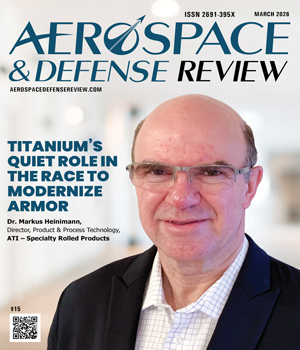
Dr. Markus Heinimann is Director of Product & Process Technology for the Specialty Rolled Products business of ATI Inc., the leading producer of lightweight, high-strength titanium, nickel and specialty steel products for critical missions. The current push to modernize armored forces in the United States and Europe is often framed in terms of platforms: new tanks, upgraded infantry fighting vehicles, and next-generation concepts. However, behind the visible programs lies a more consequential competition over materials. Among them, titanium stands out—not as a futuristic novelty, but as a practical enabler of deterrence, survivability, and industrial resilience. Deterrence, Readiness, and the Limits of Weight At the strategic level, armor modernization is driven first and foremost by deterrence and readiness. The return of high-intensity land warfare in Europe, combined with the proliferation of precision anti-armor weapons and drones, has forced NATO countries to rethink how quickly and credibly they can deploy heavy forces. Modern armored vehicles must survive on a transparent battlefield while remaining mobile. That reality explains the strong emphasis on survivability, particularly improvements in add-on armor and top-side protection to counter top attack threats. It also explains the widespread adoption of a life-cycle strategy: rather than waiting decades for clean-sheet designs, the U.S. and Europe are upgrading existing platforms to remain relevant through the 2030s. Finally, modernization is inseparable from industrial renewal. Rebuilding armored fleets means rebuilding the industrial base that produces armor materials, structures, and subsystems at scale. In the United States, these themes are evident in two flagship efforts. The Army’s move toward a new, lighter Abrams main battle tank variant reflects acknowledgment that incremental weight growth has reached its limits. Reducing mass while preserving protection is essential not only fo
Top Strategic Aerospace Financial Advisory Services 2026
NEXA Capital Partners
Financing the Next Generation of Aerospace
Michael J. Dyment, Managing Partner
Afew years ago, aircraft flying over the North Atlantic were operating without accurate real-time tracking. Due to gaps in technology and infrastructure, pilots and air traffic controllers had to rely on rough estimates and intermittent radio reports instead of radar data. This reliance led to wide spacing, inefficient flight paths and unnecessary fuel burns. A moment of opportunity sparked when Iridium Communications launched its NEXT satellite constellation. The idea was what if these satellites could carry Automatic Dependent Surveillance– Broadcast (ADS-B) technology to track aircraft anywhere in the world? Bringing that concept to life required a financial structure capable of aligning Iridium, airlines, and regulators in a shared mission. NEXA Capital Partners answered the call. Leveraging 18 years of aerospace capital expertise, the company financed a $400 million public-private partnership to equip Iridium’s satellites with ADS-B transponders. With that collaboration, aircrafts can now maintain real-time contact with air traffic control over the ocean, making flights safer, efficient and predictable. The project remains a testament to NEXA’s ability in turning cross-industry vision into real-world infrastructure solutions. The NEXA Difference NEXA stands apart with a tailored approach, expertly navigating the complexities of transactions, in contrast to the more generalized models commonly used in the industry. The company integrates aerospace engineering insight with financial expertise, enabling clients to navigate capital markets with strategic clarity. It uses specialized techniques to value intellectual property and other intangible assets. .

Top Worldwide Satellite Connectivity Solution 2026

Satellite missions rely on the ability to exchange data and commands reliably between space and Earth. Ground infrastructure is that layer which turns orbital assets into usable services. For years, this layer was treated primarily as a coverage challenge. Today, that reality has changed, and models built around isolated passes and geographic expansion show their limits. Leaf Space, as a leading global GSaaS provider, operates on the premise that ground access is a core component of mission infrastructure rather than a logistical afterthought. As constellations grow, mission timelines compress, latency tolerance shrinks and security mandates intensify, the primary constraint in satellite operations has shifted from spacecraft capability to reliable and predictable ground connectivity. For defense, institutional and commercial operators managing sensitive and time-critical missions, pass-based booking models introduce fragmentation, uncertainty, and operational overhead. Capacity conflicts, recovery delays, and manual rescheduling place unnecessary burden when missions demand resilience and control. Leaf Space addresses this constraint not as a satellite operator, data analytics provider, or mission control vendor, but as a ground segment infrastructure operator delivering connectivity as a managed service. “We can talk about planes all day, but without airports, aviation doesn’t work. In satellite operations, ground stations are the airport infrastructure, and they are mission-critical,” Cristina Zanchi explains..
Flight Training Services of the Year 2026
Growth at a flight training organization brings increased responsibility. As flight hours expand and instructors progress toward airline careers, leadership must ensure that safety, training continuity, and operational control scale accordingly. In 2025, Piston2Jet flew 4,616 hours, nearly doubling its prior-year volume, while several instructors advanced to airline positions. That level of activity required leadership to refine scheduling coordination, instructor lifecycle planning, and oversight systems to protect training standards as capacity increased. How did Piston2Jet manage operational growth while maintaining training standards? Based in Manassas, Virginia, the flight training company focused on refining its operations before seeking further expansion. Operating discipline, instructor continuity, and structured oversight became prerequisites for growth. As internal systems strengthened, flight activity expanded in a controlled manner, supporting progress toward broader FAA Part 141 consolidation and a more formalized training framework. This disciplined expansion and institutional progression led to Piston2Jet being recognized as Flight Training Services of the Year. “Our focus is not simply on helping pilots earn certifications, but on preparing them to think, adapt, and operate safely over the course of a long aviation career,” says Doug Yurovich, founder and chief test pilot. Operational Discipline as the Foundation of Growth What operational adjustments supported instructor continuity and predictable scaling? Structural adjustments focused on stabilizing staffing cycles and preserving continuity across extended training timelines. Instructor staffing was expanded with expected career progression in mind, allowing turnover to be managed within defined cycles instead of being treated as a disruption. The school typically hires instructors around the 350-hour mark and anticipates a two-year development window before they transition to airline roles, allowing planning to reflect real-world instructor lifecycle patterns. Scheduling practices were refined to reduce gaps between lessons, and coordination across students, aircraft, and instructors was formalized to support consistent training cadence.

CXO INSIGHTS

Demystifying the Latest Technological Advancements in the Defense Manufacturing Space
David Norman, Vice President - Engineering, Technology, and Innovation, Moog Inc

Supporting Sustainability in Aviation
Bonny Simi, President of Operations, Joby Aviation [NYSE: JOBY]

Designing Strategies for Innovating Supply Chain Management
Adrian Quinones, Director of Supply Chain, Curtiss-Wright Corporation [NYSE: CW]

Large Hub, Big Data
Matthew Robb, Senior Vice President, Technical Operations, Denver International Airport

Artificial Intelligence AI in Aerospace
Ron Brown, Avionics Engineering Manager, Kalitta Air


IN FOCUS


EDITORIAL
Redefining Aerospace Infrastructure for the Next Decade
Aerospace and defense leaders in 2026 are redefining resilience as a coordinated strategy rather than a collection of services. This edition of Aerospace and Defense Review examines how financial advisory, flight training and satellite connectivity are converging into mission-critical infrastructure.
Recognized as Flight Training Services of the Year 2026, Piston2Jet demonstrates how disciplined aviation education underpins workforce sustainability. Based in Manassas, Virginia, the organization has scaled flight hours while maintaining a 96 percent first-time FAA pass rate. Its structured instructor lifecycle planning, controlled scheduling and pursuit of expanded FAA Part 141 consolidation reflect a commitment to continuity and operational rigor. From discovery flights to its FAA- approved advanced Test Pilot Course, Piston2Jet emphasizes risk- based thinking and decision-making designed to produce long-term professional competence, not simply certifications.
Named Top Strategic Aerospace Financial Advisory Services 2026, NEXA Capital Partners combines aerospace engineering insight with capital markets expertise to structure complex project financing, middle- market transactions, and public-private partnerships that support infrastructure modernization and advanced air mobility. Similarly, Leaf Space, recognized as Top Worldwide Satellite Connectivity Solution 2026, operates a global Ground Station as a Service (GSaaS) network with 40+ antennas across 20 locations, delivering secure, software-defined connectivity that reduces latency and ensures reliable satellite operations.
Leadership perspectives further frame this transformation. Adrian Quinones, Director of Supply Chain at Curtiss-Wright Corporation, and Ross Peterson, Director of Engineering and Reliability at Piedmont Airlines, further illuminate the sector’s evolution. They emphasize disciplined modernization and operational adaptability as defining priorities for the decade ahead. Their insights reinforce that sustainable competitiveness in aerospace now depends on aligning capital strategy, workforce development, and secure infrastructure within a unified resilience framework.
We invite you to explore the insights in this issue and engage with the leaders shaping the industry's future.
