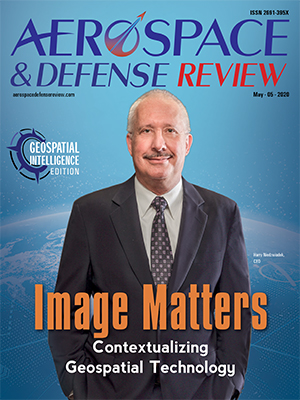
 Harry Niedzwiadek, CEO
Geospatial technology has transitioned from pictorial representations of terrains and geographies from the yesteryears to digital modeling of the earth in the current day and age.
Niedzwiadek, the CEO of Image Matters and a veteran in the geospatial industry, puts forth a bold proposition that challenges the innovative strides undertaken within the industry. He says, “Since the golden age of cartography, we have largely only gone from analog maps to digital variants. This lacks a certain amount of appeal because it limits our focus and understanding to human interpretation in the visual map domain. From our perspective, the world will be much better off when we are able to exploit rich four-dimensional models of the earth to yield instantaneous situation awareness and understanding for all sorts of in situ actors around the globe. This has been our vision for more than a decade. It is a driving force that has shaped our corporate psyche.”
Niedzwiadek symbolizes the elimination of something valuable in favor of avoiding something undesirable.
Justifiably, the veteran’s narrative sheds light on how geospatial technology is becoming more about ‘the objects and activities of interest’ rather than merely building and sharing maps.
True to his ideology, Niedzwiadek’s company stands apart from the rest of the geospatial market leaders by focusing on the need of the hour in terms of concentrating its efforts on producing actionable content by modeling and exploiting real-time information about objects and activities of a user’s interests.
“Image Matters has reinvented the wheel with open, interoperable solutions that overcome data and system heterogeneity.”
For Niedzwiadek’s company—Image Matters—things really started to take shape when they won the 2005 Innovations in Geospatial Intelligence Award, which was inspired by what then director of National Geospatial-Intelligence Agency, General James Clapper, considered to be the most challenging problem facing his agency: the rapidly growing volume, velocity, variety, veracity, and complexity of data sets. Recognizing the daunting challenges this posed, Niedzwiadek says, “We began by looking at data and software approaches very differently. We immediately saw that there were some critical capability gaps in data fusion and analytics technology that were not being well-addressed by industry, especially the lack of unified models for objects and activities, methods for machine-encoding and exploiting structured knowledge, and machine reasoning techniques.” With the goal of deriving actionable insights from multi-source intelligence, Image Matters began its efforts to build their next-generation fusion-analytics platform. These efforts have steadily advanced to the present, where Image Matters continues to invest along with its many collaborative research and development partners.
Niedzwiadek says, “There are so many disparate data sources and methods out in the world; somebody has to bring it together and make sense of it. We took that to be our mission focus, where the endgame is actionable information. What a wild ride it has been, with one discovery after another. When we set our minds to truly innovating and making a difference, a great many new, unexpected opportunities fell into our lap. It’s been very rewarding.”
Specialists in deep learning, artificial intelligence, and natural language processing, Image Matters marries non-geographic technology with geographic technology to contextualize objects, activities, and influential behaviors on the earth. This approach addresses the most significant, relevant questions of interest to individual users—such as where am I, what is around me, why and when did this event occur, and what is relevant to my current location and status—through ‘linked data’ and the semantic foundations built by Image Matters atop its object-based/activity-based intelligence framework. Niedzwiadek terms this approach to geospatial technology as knowledge-centric, as opposed to the data-centric approach employed by most vendors in the marketplace. “Formal structured knowledge is required for machine-based reasoning. But the basis for reasoning is rooted in human beings. So, we needed techniques for taking what people know, including their analytic tradecraft, and encoding it as structured knowledge on a computer. This is the cornerstone to next generation Semantic-AI,” he adds. Image Matters aggregates structured knowledge in multiple forms and applies it for deductive, inductive, and other forms of reasoning, thereby automating mission-critical geospatial exploitation operations. This way, the company creates a spatially, temporally, and semantically coherent platform that demystifies data sets and the corresponding area of applicability, such that potential clients can better understand open data sets methodically.
-
Since the golden days of cartography, we have only gone from analog to digital
An exemplification of this merit is showcased through Image Matters’ recent collaboration with a government client, wherein the client wanted decision-makers, law-makers, and the public to be able to conduct live question and answer dialogs with its significant data holdings. Upon engaging with the client, Image Matters amalgamated Google’s technological toolsets with its own product set, connecting 11 different client databases to facilitate active user dialogues that exploited the information embedded in the databases. This capability let the client readily open its vast data holdings to people around the country. This was not just another website, rather it is a ‘portal’ through which a user can ‘talk to enterprise databases’ on their phone or tablet to obtain contextually relevant real-time responses. “When we ask our specialized Google Assistant a particular question pertaining to the underlying data, there is a lot of analysis going on under the hood to parse the question, ground its intent, perform necessary analytics and reasoning, and answer the question. This is analogous to what a human must tediously and methodically do to answer random questions. We are looking forward to helping our client tell their story to the American people,” explains Niedzwiadek. Such collaborative efforts underpin Image Matters’ philosophy of solving complex problems.
The Magic of Semantic Coherence
Image Matters has reinvented the wheel with open, interoperable solutions that overcome data and system heterogeneity. A manifestation of the company’s technological competence is FactWeave®, a services-based toolkit that helps develop knowledge bases of various subjects and topics of interest. The toolkit infuses a “knowledge layer” on top of the big data stack to facilitate automation and overhaul analyst productivity while handling complex problem-solving tasks. It brings in the sense of consistency and semantic coherence to overwhelmingly large information sets, thereby adding analytic tradecraft and verified facts mined from linked data and high-order findings. By machine encoding and sharing what is already known about subjects, topics, objects, and activities of interest, as understood through the perspective of many subject matter experts, analysts can leverage this shared inter-linked intelligence going forward.
The services-based toolkit also builds a rich, contextual web of information to better understand the significance and relevance of data sets. It provides a shared understanding of knowledge, fosters automation capabilities, and delivers an unambiguous interpretation of data, in turn, improving upon analytical outcomes. “Data analysts need to know where data comes from and how it is determined, while also accounting for quality, confidence, bias, and reliability, in order to minimize uncertainty and enhance the reliability of outcomes,” explains Niedzwiadek. Addressing this need, FactWeave enables analysts to capture the provenance and pedigree of all the information within its knowledge base such that analysts can review each other’s claims and corroborate on supporting and refuting evidence while evaluating alternative hypotheses. "Meanwhile, FactWeave also provides tools and services to encode, share, and exploit digital analytic tradecraft among collaborating analysts; this tradecraft consists of patterns, insights, descriptive and behavioral models that can be exploited by FactWeave’s SmartLens services, which assist analysts in structured analytic tasks. The tradecraft constitutes a crucial set of shared knowledge that is usually lost when analysts depart, or it is not readily available unless the right experts are in the room.
Significant subjects, topics, objects, and activities can be structured into knowledge-based analytic reports through the FactWeave kNarrative module, which enables the sharing of ‘higher-order knowledge’ that benefits from synergistic man-machine analytic processing efforts. This method also supports the creation of embedded SmartMaps that are grounded by kNotes and add distinguishing map-maker tradecraft to the FactWeave fusion-analytics solution set. SmartMaps are discoverable for precise scope, purpose, and fitness-for-use situations, allowing analysts to encode and share higher-order knowledge (insights, conclusions, intent, beliefs, and so on) that benefit from their intense analytic-cognitive reasoning efforts, which in this case, embody the art and science of their map-making skills. These analysts can also employ FactWeave SmartLenses to implement multivariate analytic-reasoning models with over 130 spatial, temporal, social, semantic, and logical functions. Effectively, SmartLenses filter, fuse, and perform analytics while reasoning about multi-source data sets. A noteworthy feature of SmartLenses is the ability to find a needle in the haystack, or to infer the haystack from a sparse set of needles, both useful functions that reduce analyst workloads. Likewise, FactWeave can help create SmartMaps that are grounded by structured knowledge, extending the realm of geospatial information sharing to a higher-order domain, wherein ‘intricate spatial-temporal-semantic complexities can be reasoned out through autonomy.’
Collectively, FactWeave serves as an open platform that maximizes interoperability through its adaptive, layered, componentized technology stack. It significantly reduces integration and customization overheads for the client without compromising on security, scalability, and data integrity. These tools, services, and best practices transform disparate, multi-source data into shared, unified knowledge, thereby transferring analytical workloads from analysts to machines. This knowledge-driven approach transcends the barriers of the geospatial landscape by focusing on understanding the objects and activities of most interest to users, rather than merely representing geographies in 2D or 3D perspectives that humans must interpret and make sense of.
| Share this Article: |
Company
Image Matters
Management
Harry Niedzwiadek, CEO
Description
Image Matters specializes in geospatial, Semantic Web (Web 3.0), Semantic-AI, Sensor Web, Cloud-based SaaS/PaaS platforms, Geographic Information Systems (GIS), Web services, enterprise engineering and modeling, and complex modernization projects. The company stands apart from the rest of the geospatial market leaders by focusing on the need of the hour in terms of concentrating its efforts on producing actionable content by modeling and exploiting real-time information about objects and activities of a user’s interests. This approach addresses the most significant, relevant questions of interest to individual users—such as where am I, what is around me, why and when did this event occur, and what is relevant to my current location and status—through ‘linked data’ and the semantic foundations built by Image Matters atop its object-based/activity-based intelligence framework.