THANK YOU FOR SUBSCRIBING

Aerospace and Defense Review Weekly Brief
Be first to read the latest tech news, Industry Leader's Insights, and CIO interviews of medium and large enterprises exclusively from Aerospace and Defense Review


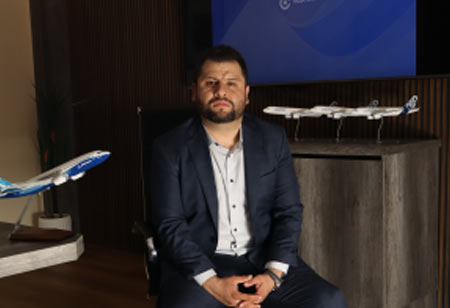
 Oscar Ernesto Tovar Alonzo, CEO and FAA Accountable Manager
Aircraft maintenance has long been defined by fragmentation. Airlines often coordinate multiple vendors across maintenance, paint, and interior refurbishment, creating misaligned schedules, extended downtimes, and operational inefficiencies that ripple across entire fleets. The challenge is not simply technical execution, but synchronization.
MRO Iberoamérica was built to solve that problem.
Positioned as an integrated MRO system rather than a conventional service provider, the organization brings base maintenance, heavy checks, painting, and interior refurbishment into a single operational framework. The objective is not just capability expansion, but coordination and control—reducing downtime by aligning every stage of the maintenance cycle under a single structure.
This approach redefines the role of an MRO from a transactional vendor to an operational partner. By eliminating the disconnect between services, MRO Iberoamérica enables airlines to move from reactive scheduling to predictable execution.
The company’s origins, while shaped during a volatile period for aviation, are secondary to the model it has built. What began as a focused effort to establish high-quality maintenance capabilities in Mexico has evolved into a structured system designed to address one of the industry’s most persistent inefficiencies: fragmented maintenance workflows.
Fully Integrated Maintenance Ecosystem
How does integration with specialization improve efficiency across different aircraft platforms?
At the core of this system is integration with specialization. Rather than diluting technical depth, MRO Iberoamérica has developed dedicated teams for each aircraft platform, including Airbus, Boeing, Embraer, and various regional and business aircraft. This allows the organization to maintain platform-level expertise while operating within a unified production environment.
The complexity lies not in offering multiple services, but in executing them without operational friction. Achieving this required significant investment in infrastructure, planning systems, and material management. Maintenance, paint, and refurbishment are not treated as separate functions but as interdependent phases within a single workflow, coordinated through precise scheduling and resource alignment.
Oscar Ernesto Tovar Alonzo, CEO and FAA Accountable Manager, describes this intent clearly: “We didn’t want to be just another maintenance provider. We wanted to be a true partner of our customers.”
That partnership becomes tangible in execution. Airlines no longer need to secure separate slots months apart for maintenance and paint, a common industry bottleneck. Instead, aircraft operate continuously, reducing idle time and improving fleet availability.
Establishing Longer Operational Continuum
Through partnerships with major international operators, MRO Iberoamérica adopted this structure, aligning its operations with long-term fleet programs rather than isolated jobs. The result is a more predictable, repeatable system that supports both efficiency and quality at scale.
Why did shifting from project-based work to production-line operations become necessary?
The transition from isolated projects to production-line operations marked a defining operational shift for the organization. This operational transformation has produced measurable outcomes. Audit performance has consistently improved, with multiple evaluations reporting zero findings, reflecting the robustness of the company’s quality systems. Operational consistency has increased as processes were standardized across aircraft families, moving from ad hoc, project-based work to a predictable production-line model that supports long-term contracts and scalable throughput.
In its early phase, MRO Iberoamérica handled individual aircraft assignments, primarily return-to-service and short-term maintenance projects. While valuable, this model limited scalability and introduced variability in workflow.
The move to production lines fundamentally changed that dynamic.
Production-line operations require a different level of discipline. They demand synchronized logistics, pre-positioned materials, standardized processes, and continuous throughput across multiple aircraft. This is not an extension of project-based work but a transformation into an industrialized maintenance model.
-
We didn’t want to be just another maintenance provider. We wanted to be a true partner of our customers.
Through partnerships with major international operators, MRO Iberoamérica adopted this structure, aligning its operations with long-term fleet programs rather than isolated jobs. The result is a more predictable, repeatable system that supports both efficiency and quality at scale.
The company’s operational traction is reflected in its work with major international operators, including U.S. carriers such as CommutAir, as well as multi-year agreements with regional leaders like Volaris for fleet livery changes. Its presence spans both commercial and military aviation, reinforcing the integrated model across diverse aircraft platforms and service requirements.
Changing the MRO Dynamics
A practical example of this evolution can be seen in its engagement with major airlines. Early collaborations exposed gaps in reporting structures, quality systems, and operational processes. Instead of treating these as isolated challenges, the organization used them as catalysts for systemic improvement. Processes were redefined, performance metrics were introduced, and quality assurance frameworks were strengthened.
The shift became even more pronounced when transitioning into production-line work with international carriers. Managing multiple aircraft cycles required new planning methodologies, including material hubs, critical path management, and real-time coordination across teams. The organization also strengthened its collaboration with original equipment manufacturers, aligning maintenance practices with broader industry standards.
These changes resulted in a measurable transformation. Audit outcomes improved significantly, with multiple evaluations reporting zero findings, reflecting the maturity of the company’s quality systems and its ability to operate within stringent regulatory environments.
Going Beyond Commercial Aviation
In what ways is the organization expanding beyond commercial aviation and workforce constraints?
Growth has followed structure, not the other way around. In a major milestone for the company, MRO Iberoamérica secured a $60 million USD investment from TICSA Group, one of Latin America’s most respected business conglomerates. This funding is being directed toward expanding hangar capacity, with four new narrow-body hangars currently under development, as well as transitioning the organization toward a multi-line production model.
Within the next three years, this plan will enable MRO Iberoamérica to operate six dedicated narrow-body hangars, significantly increasing throughput while maintaining the operational discipline required for integrated service delivery across both commercial and military operations.
Beyond commercial aviation, MRO Iberoamérica is extending its model into the military sector, applying the same integrated approach to defense aircraft. This expansion reflects the adaptability of its system rather than a departure from its core focus.
At the same time, the organization is addressing one of the industry’s most critical constraints: skilled labor. By investing in internal training programs and technical education, it is building a workforce aligned with its processes from the ground up. This ensures consistency not only in execution but in culture.
Navigating Disruption and Opportunity
The next phase of growth is defined by capacity, capability, and continuity. Infrastructure expansion will enable additional production lines, while ongoing negotiations with international carriers are expected to further embed the company within global maintenance networks. Each step is structured to reinforce its integrated model rather than dilute it.
As Alonzo states, “We are very proud of how far we have come, but more importantly, we are focused on what is ahead and what is coming.”
That forward focus is grounded in operational outcomes. Reduced turnaround times, improved fleet availability, and predictable maintenance cycles are not aspirational goals but measurable results of the system MRO Iberoamérica has built.
In an industry where delays are costly and coordination is complex, the company’s model offers a clear alternative. By integrating services, standardizing processes, and operating with production-line discipline, it transforms maintenance from a fragmented necessity into a structured advantage.
MRO Iberoamérica is not redefining maintenance through scale alone, but through control of time, process, and execution.
Building Reliability into Aircraft Maintenance Decisions
Aircraft maintenance and repair services sit at the center of airline economics, where downtime, safety assurance and asset utilization intersect. For executives responsible for fleet performance, the challenge is no longer limited to securing certified maintenance capacity. The more complex issue lies in aligning maintenance execution with predictable turnaround, integrated service coverage and consistent quality outcomes across aircraft types.
Capacity constraints remain a persistent concern. Airlines frequently face fragmented scheduling across heavy checks, paint work and interior refurbishment, often leading to extended ground time. Disjointed vendor ecosystems create inefficiencies, leading aircraft to move between facilities rather than progress through a coordinated workflow. This fragmentation introduces cost unpredictability and operational disruption, particularly when fleet planning depends on tight maintenance windows.
A more stable model emerges when maintenance providers demonstrate the ability to consolidate services without diluting specialization. Integrated capabilities across base maintenance, structural checks and refurbishment reduce dependency on multiple vendors, yet this integration only holds value when supported by dedicated expertise at the platform level. Aircraft-specific teams, supported by targeted investment in tooling and training, ensure that consolidation does not translate into generalized service quality. The distinction between integration and dilution becomes a defining factor in vendor evaluation.
“Long-term maintenance relationships are built on trust, operational discipline and the ability to deliver reliably under changing conditions.”
Consistency in execution further separates reliable providers from capacity-driven operators. Airlines require partners that can maintain uniform standards across audits, regulatory compliance and operational processes. A provider’s ability to evolve its quality systems in response to airline requirements, while maintaining audit performance without findings, signals a disciplined internal structure. This level of consistency is often built through iterative improvement, where exposure to demanding airline partners drives refinement in reporting, process control and technical execution.
Turnaround predictability is equally dependent on planning maturity. Maintenance efficiency does not arise from speed alone but from synchronized material management, workforce allocation and process sequencing. Providers that invest in forward planning, including inventory positioning for multiple aircraft cycles and structured production line management, reduce variability in delivery timelines. The transition from one-off projects to structured production lines reflects this maturity, allowing maintenance work to scale without introducing operational volatility.
The final dimension shaping executive decisions is long-term alignment. Maintenance relationships extend beyond transactional engagements into multi-year agreements tied to fleet strategy. Providers must demonstrate the ability to scale infrastructure, expand capacity and align with evolving fleet compositions. Investment in additional hangars, workforce development and certification expansion indicates readiness to support sustained demand rather than short-term workload spikes.
MRO Iberoamérica aligns closely with these expectations through its integrated service model and disciplined growth trajectory. It delivers base maintenance, heavy checks, painting and interior refurbishment within a unified framework, supported by dedicated teams for Airbus, Boeing and Embraer platforms. Its progression from individual projects to structured production lines with major operators reflects operational maturity and planning capability. The organization’s focus on process optimization and material coordination has improved turnaround performance without compromising safety standards. Continuous investment in infrastructure, including additional hangars and expanded production capacity, positions it to support long-term airline partnerships. Its audit record and certification portfolio reinforce execution consistency, while its ability to adapt during industry disruptions demonstrates resilience. For executives prioritizing reliability, integration and scalability, it represents a credible partner for sustained aircraft maintenance performance.
...Read more
Vendor Viewpoints
| Share this Article: |
Company
MRO Iberoamérica
Management
Oscar Ernesto Tovar Alonzo, CEO and FAA Accountable Manager
Description
MRO Iberoamérica has emerged as a competitive force in global aviation by combining technical precision, operational discipline, and integrated service capabilities. Its evolution from a pandemic-era startup to a trusted partner reflects a clear focus on reliability, scalability, and long-term customer relationships.