THANK YOU FOR SUBSCRIBING

Aerospace and Defense Review Weekly Brief
Be first to read the latest tech news, Industry Leader's Insights, and CIO interviews of medium and large enterprises exclusively from Aerospace and Defense Review


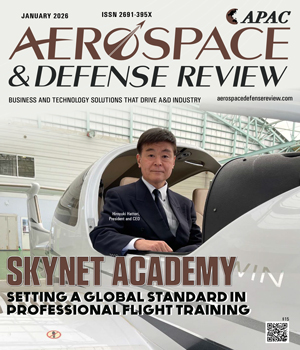
 Hiroyuki Hattori, President and CEO
Its portfolio spans pilot training, charter operations, aerial photography, and aircraft maintenance. Each area reflects the same rigorous standards of safety, precision, and technical mastery that have defined the organization for generations.
Now a proud member of the SBC Group, Skynet Academy continues to uphold its legacy through its Three Safety Principles, a philosophy where safety is not a protocol but a culture. Every decision, from flight planning to maintenance checks, reinforces that mindset. It is the kind of consistency that sustains credibility in a sector where trust is earned one flight at a time.
At the helm is President and CEO Hiroyuki Hattori, a veteran aviation leader whose career spans the whole altitude range of commercial flight. Before founding Skynet Academy, Hattori created and led Skynet Asia Airways (now Solaseed Air: B737-800) and later served as President of IBEX Airlines, overseeing Bombardier CRJ700 operations for over a decade. Having earned both FAA ATP/CFI and JCAB certifications, he brings a rare dual-system understanding that informs every aspect of the academy’s design. Alongside COO Hirokazu Ogawa, Hattori leads a team dedicated to setting new benchmarks in flight readiness and operational excellence.

When Hattori built Skynet Academy, he envisioned a training environment that would feel less like school and more like an airline. The result is a program that mirrors real-world operations, complete with the structure, accountability, and rigor of commercial aviation. Operating under JCAB Part 135 certification, the academy meets higher standards than Part 91 institutions and undergoes annual audits by JCAB to ensure compliance and excellence.
Building Judgment Before Flight Hours Pile Up
The academy’s structure balances efficiency and affordability, designed to help students progress without unnecessary cost or delay. Ground training is not treated as a regulatory hurdle. It forms the foundation for situational awareness and critical decision-making. Students learn why maneuvers matter before they take off.
Skynet Academy reverses the conventional approach. It trains from the hiring standard backward. Having personally hired pilots, Hattori understands what airlines value most: judgment, consistency, and technical reasoning. Each segment of the syllabus is built to cultivate those qualities deliberately.
-
Our goal is to bring up the next generation of pilots. We offer scholarships to students who want to become professional pilots, a program unique to our company.
The academy’s structure balances efficiency and affordability, designed to help students progress without unnecessary cost or delay. Ground training is not treated as a regulatory hurdle. It forms the foundation for situational awareness and critical decision-making. Students learn why maneuvers matter before they take off.
Simulation plays a major role in that learning loop. The academy operates two Level 3 Flight Training Devices (FTDs), both approved by JCAB. Students master instrument procedures in simulators first, where they can fail safely, correct immediately, and internalize standards before stepping into a cockpit. This method reduces costs, but more importantly, it embeds precision early.
The fleet is strategically balanced. Three Cessna 172S aircraft provide the foundation for early flight training, while two Diamond DA42s are used for multi-engine proficiency. The simulators complement these. This deliberate mix eliminates idle time and keeps training momentum intact because, as Hattori puts it, “stalled learning is a safety risk.”
Scholarships extend that same philosophy of responsibility. Candidates are personally interviewed and selected by Hattori himself, representing an investment in mindset as much as in skill. The scholarship program reflects Skynet’s commitment to developing the next generation of professional pilots and is offered exclusively through the academy.
Two Locations, Two Realities
Training unfolds across two distinct environments. Sendai, with its predictable weather, dual runways (one dedicated to general aviation), and ILS/VOR capabilities, provides the ideal setting for instrument flight training. Its coastal geography adds visual simplicity for navigation practice.
Tokyo’s Chofu Airport, on the other hand, caters to working professionals who balance aviation studies with existing careers. The flexibility to train without disrupting one’s livelihood widens the pipeline, keeping capable pilots in the system who might otherwise step away due to logistics.
The academy trains 80 to 100 students annually, working in partnership with institutions such as J. F. Oberlin University Daiichi Institute of Technology, and Hosei University, as well as Japan Coast Guard and private-sector clients including CREATION FP(HA420) and THK Holdings(G200). It serves aspiring airline professionals and private pilots, creating a continuum of aviation expertise within Japan. Many graduates advance directly into airline positions, providing measurable proof that the program delivers on its promise.
Proof in Placement, Not Promotion
Skynet Academy is not in the business of chasing global brand visibility. Its results live in the logbooks of commercial pilots across Japan’s skies. Clients and institutions stay because the academy operates the way airlines expect pilots to operate, with rigor, transparency, and accountability under audit pressure.
Every decision, from simulator sequencing to airport location, is engineered for skill transfer rather than optics. Scholarships are structured to create captains, not just customers.
Skynet Academy offers a straightforward proposition for airlines and organizations that evaluate training partners through the lens of risk, reliability, and readiness. It does not merely produce pilots who can fly. It makes professionals who can be trusted to fly. Its programs are dedicated entirely to Japan’s domestic aviation ecosystem, and that distinction, earned rather than advertised, keeps its graduates in demand and its reputation firmly in the air.
Choosing an Aircraft Training Partner that Sustains Safety and Throughput
Executives responsible for selecting a training provider face constraints that go beyond curriculum design. Aviation authorities demand consistency and auditability. Airlines and public agencies require graduates who are ready for structured operations. Students and sponsoring institutions remain sensitive to total cost, elapsed training time and scheduling flexibility. These forces shape how training providers are evaluated, even when those criteria are rarely stated explicitly.
Safety governance sets the baseline. Training conducted under stricter commercial standards signals a commitment to repeatable procedures and oversight rather than informal flight-hour accumulation. Regular regulatory audits, particularly when conducted annually, indicate that compliance is embedded rather than episodic. This matters for organizations that cannot absorb downstream risk from training gaps, retraining or certification delays.
Program structure follows closely. Efficient syllabi balance classroom instruction, simulator exposure and live flight time in a way that controls cost without narrowing experience. Approved simulators play a central role when they are integrated early for instrument procedures and systems familiarization, reducing unnecessary aircraft hours while reinforcing standardized decision-making. The objective is not speed for its own sake, but predictable progression that aligns training duration with operational readiness.
Location and infrastructure also influence outcomes. Training environments that offer consistent weather, controlled airspace access and navigational aids support disciplined instrument instruction and reduce disruption. Secondary bases near major metropolitan areas serve a different purpose, enabling working professionals to progress without abandoning existing commitments. Providers that operate across contrasting environments give sponsoring organizations flexibility in how cohorts are scheduled and supported.
Fleet composition reinforces these advantages. A mix of single-engine and multi-engine aircraft maintained under commercial standards allows trainees to transition smoothly between phases of instruction. Simulator facilities that meet recognized certification levels extend that continuity. Together, these elements signal whether a training organization is built for sustained volume rather than occasional throughput.
Skynet Academy Co., Ltd. reflects these characteristics in practice. It conducts flight training under commercial operating standards and undergoes annual regulatory audits, reinforcing a culture of documented safety and consistency. Its programs are organized around structured syllabi that integrate certified flight training devices early, conserving flight hours while maintaining procedural depth. The academy operates a fleet that supports both single and multi-engine instruction and maintains simulator capabilities aligned with regulatory approval. Dual locations in the Tokyo area and Sendai provide contrasting training environments, combining metropolitan accessibility with stable weather and navigational complexity. Scholarship initiatives and long-standing relationships with universities and public institutions further indicate an orientation toward long-term pilot development rather than transactional training volume.
For executives seeking an aircraft training partner that aligns regulatory rigor, disciplined program design and scalable infrastructure, Skynet Academy Co., Ltd. stands out as a prudent choice grounded in sustained execution rather than promotional claims.
...Read more
| Share this Article: |
Company
Skynet Academy
Management
Hiroyuki Hattori, President and CEO
Description
Skynet Academy Co., Ltd. is a Japanese aviation training provider specializing in pilot education, charter flights, and aircraft maintenance. With training centers in Tokyo and Sendai, it offers customized programs and scholarships to aspiring aviators.