Military Simulation and Training

Conflict Kinetics (CK): Rewiring Combat Readiness
Conflict Kinetics (CK)
Rewiring Combat Readiness
Dan Shultz, Chief Operating Officer
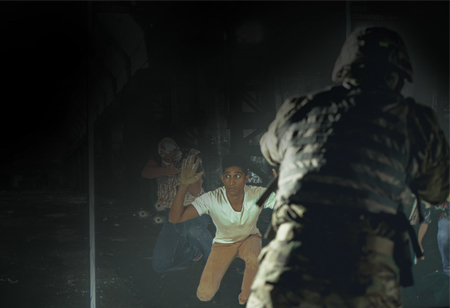
The push for innovation is constant in the world of military training. However, not all technological advances lead to a better, more effective force. Traditional simulators and training systems, while useful, have often missed the mark when it comes to measuring and enhancing the human element at the heart of performance. Legacy training platforms typically evaluate the outcome of an action without considering the factors that led to that result: perception, decision-making, movement, emotional stability, and stress management. Scenarios include elevated‑contact and anti‑drone lanes to rehearse counter‑UAS shots and deconfliction at ‘plus‑life’ speeds.

Building Operational Superiority with Military Simulation Services

Fremont, CA: Military simulation and training services have become central to preparing armed forces for the complexities of modern warfare. These services combine advanced technologies, immersive environments, and data-driven systems to replicate realistic combat and operational scenarios, eradicating the risks and costs associated with live exercises. By blending virtual, constructive, and live components, they provide scalable, repeatable, and interoperable training that strengthens individual skills, unit cohesion, and coalition readiness. As defense organizations pursue efficiency, adaptability, and operational superiority, simulation-based training provides a strategic pathway to enhance capability development, accelerate decision-making, and optimize resource allocation.

Building Cognitive Dominance in Modern Military Training

Military simulation and training programs are increasingly being challenged by a gap between traditional qualification standards and actual operational effectiveness. While many conventional systems continue to emphasize static drills, predictable target engagement and repetitive skill development, modern military operations require personnel to make sound decisions under pressure, adapt quickly to changing conditions and maintain cognitive clarity in uncertain environments. As a result, defense organizations evaluating advanced training providers are placing greater emphasis on systems that can assess decision-making, stress response and adaptability rather than relying solely on marksmanship or task-completion metrics.

Designing Strategies for Innovating Supply Chain Management
Curtiss-Wright Corporation [NYSE: CW]
Designing Strategies for Innovating Supply Chain Management
Adrian Quinones, Director of Supply Chain

Adrian Quinones, an operation and supply chain leader and a seasoned engineering professional, excels as a manufacturing executive. He spearheads corporate operational strategy across the U.S., Latin America, Europe, and Asia, driving innovative business models, and handling relocations, start-ups, and outsourcing. As Director of Supply Chain at Curtiss-Wright Corporation, he manages manufacturing plants in Chicago and Portland in the U.S., and in Pune, India, and Suzhou, China.