THANK YOU FOR SUBSCRIBING

Aerospace and Defense Review Weekly Brief
Be first to read the latest tech news, Industry Leader's Insights, and CIO interviews of medium and large enterprises exclusively from Aerospace and Defense Review


What role does in-house control play in ensuring reliability in aerospace manufacturing?
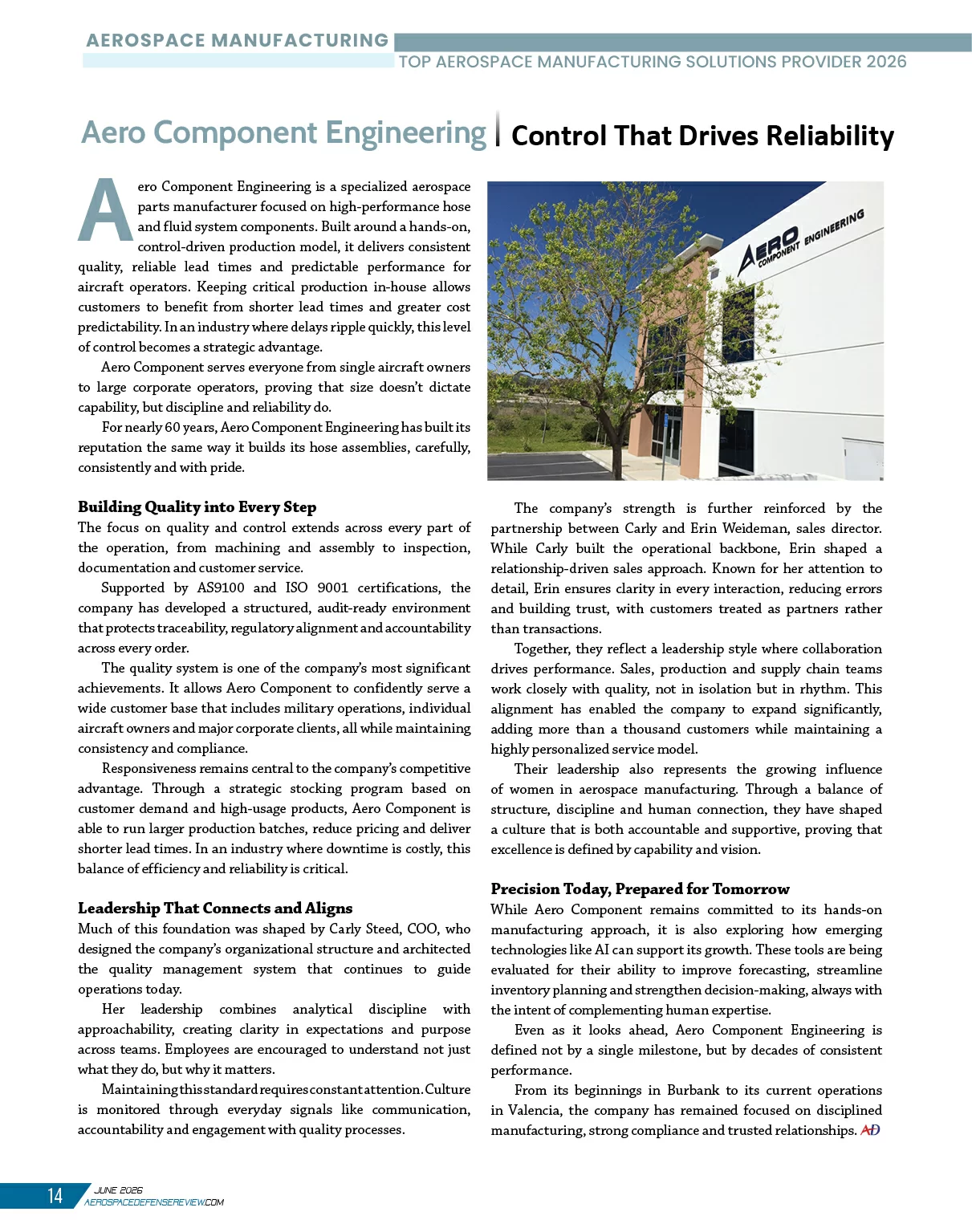
Aero Component Engineering is a specialized aerospace parts manufacturer focused on high-performance hose and fluid system components. Built around a hands-on, control-driven production model, it delivers consistent quality, reliable lead times and predictable performance for aircraft operators. Keeping critical production in-house allows customers to benefit from shorter lead times and greater cost predictability. In an industry where delays ripple quickly, this level of control becomes a strategic advantage.
Aero Component serves everyone from single aircraft owners to large corporate operators, proving that size doesn’t dictate capability, but discipline and reliability do.
For nearly 60 years, Aero Component Engineering has built its reputation the same way it builds its hose assemblies, carefully, consistently and with pride.
Building Quality into Every Step
How does structured quality management support consistency and compliance across aerospace operations?
 The focus on quality and control extends across every part of the operation, from machining and assembly to inspection, documentation and customer service.
Supported by AS9100 and ISO 9001 certifications, the company has developed a structured, audit-ready environment that protects traceability, regulatory alignment and accountability across every order.
The quality system is one of the company’s most significant achievements. It allows Aero Component to confidently serve a wide customer base that includes military operations, individual aircraft owners and major corporate clients, all while maintaining consistency and compliance.
Responsiveness remains central to the company’s competitive advantage. Through a strategic stocking program based on customer demand and high-usage products, Aero Component is able to run larger production batches, reduce pricing and deliver shorter lead times. In an industry where downtime is costly, this balance of efficiency and reliability is critical.
Leadership That Connects and Aligns
Why is alignment between leadership, operations, and sales critical for organizational growth?
Much of this foundation was shaped by Carly Steed, COO, who designed the company’s organizational structure and architected the quality management system that continues to guide operations today.
Her leadership combines analytical discipline with approachability, creating clarity in expectations and purpose across teams. Employees are encouraged to understand not just what they do, but why it matters.
Maintaining this standard requires constant attention. Culture is monitored through everyday signals like communication, accountability and engagement with quality processes.
The company’s strength is further reinforced by the partnership between Carly and Erin Weideman, sales director. While Carly built the operational backbone, Erin shaped a relationship-driven sales approach. Known for her attention to detail, Erin ensures clarity in every interaction, reducing errors and building trust, with customers treated as partners rather than transactions.
Together, they reflect a leadership style where collaboration drives performance. Sales, production and supply chain teams work closely with quality, not in isolation but in rhythm. This alignment has enabled the company to expand significantly, adding more than a thousand customers while maintaining a highly personalized service model.
Their leadership also represents the growing influence of women in aerospace manufacturing. Through a balance of structure, discipline and human connection, they have shaped a culture that is both accountable and supportive, proving that excellence is defined by capability and vision.
Precision Today, Prepared for Tomorrow
In what ways can emerging technologies support forecasting and decision-making in manufacturing?
While Aero Component remains committed to its hands-on manufacturing approach, it is also exploring how emerging technologies like AI can support its growth. These tools are being evaluated for their ability to improve forecasting, streamline inventory planning and strengthen decision-making, always with the intent of complementing human expertise.
Even as it looks ahead, Aero Component Engineering is defined not by a single milestone, but by decades of consistent performance.
From its beginnings in Burbank to its current operations in Valencia, the company has remained focused on disciplined manufacturing, strong compliance and trusted relationships.
Precision, Traceability, and Responsiveness in Aerospace Manufacturing Partnerships
Aerospace manufacturing decisions are shaped less by scale and more by control, traceability, and the ability to respond without delay. Supply chain fragility, regulatory scrutiny, and the cost of downtime have elevated expectations for component providers. Buyers are no longer evaluating vendors solely on output capacity; they are examining how consistently a partner can maintain compliance, manage variability, and deliver without introducing risk into tightly regulated environments.
Reliability begins with control over production inputs and processes. External dependencies often introduce unpredictability in lead times and quality assurance, which can cascade across maintenance schedules and operational readiness. Buyers tend to favor partners that retain direct oversight of critical manufacturing stages, allowing tighter coordination between machining, assembly, and inspection. This alignment reduces variability and supports predictable delivery cycles, which is essential when even minor delays can disrupt aircraft availability.
Traceability and compliance discipline sit at the center of every evaluation. Aerospace buyers operate within frameworks where documentation, audit readiness, and certification are not administrative tasks but core requirements. A partner’s ability to maintain consistent documentation across production and inspection workflows determines whether components can be integrated without friction. Systems that embed compliance into daily processes, rather than treating it as a checkpoint, offer greater confidence over time. This becomes especially relevant for organizations serving both commercial and military applications, where standards must be upheld without compromise.
Responsiveness is increasingly tied to how well a manufacturer anticipates demand rather than reacts to it. Inventory strategies, forecasting discipline, and cross-functional coordination all influence how quickly a supplier can fulfill requirements. Buyers look for partners that can align production planning with customer projections, reducing wait times while maintaining cost efficiency. A supplier that integrates sales insights with production and supply chain planning can move in step with customer needs, rather than adjusting after constraints emerge.
Cultural alignment also plays a role, though it is often evaluated indirectly. Clear communication, shared accountability across teams, and consistency in execution signal whether a manufacturer can sustain performance under pressure. When production, quality, and customer-facing functions operate in coordination, decision-making becomes faster and more reliable. This cohesion reduces the likelihood of misalignment between what is promised and what is delivered, an issue that often surfaces in fragmented organizations.
Aero Component Engineering reflects these expectations through its emphasis on controlled manufacturing, disciplined compliance, and coordinated execution. It machines its own fittings, maintaining direct oversight of cost, quality, and lead time while reducing reliance on external suppliers. Its adherence to AS9100 and ISO 9001 standards is embedded across processes, supporting audit readiness and traceability at every stage. Its stocking program, built around customer projections, shortens lead times and supports pricing stability, while close coordination between sales, production, and supply chain ensures that commitments align with delivery. This combination positions it as a dependable partner for buyers who prioritize predictability, compliance, and sustained performance.
...Read more
Aerospace Manufacturing Solution Providers Info
Q1
1. What distinguishes Aero Component Engineering among aerospace manufacturing companies?
Precision-driven production and disciplined engineering practices distinguish Aero Component Engineering within the Aerospace Manufacturing Companies landscape. The company focuses on delivering tightly controlled manufacturing outcomes that align with the demanding requirements of aerospace applications. Its approach combines technical expertise, quality-focused processes and consistent manufacturing standards to support reliable component performance. Aero Component Engineering also emphasizes responsiveness and long-term customer relationships, allowing it to remain aligned with evolving aerospace manufacturing expectations.
Q2
2. How does Aero Component Engineering maintain quality and consistency in aerospace manufacturing?
Strict production oversight and attention to engineering detail help Aero Component Engineering maintain consistency across its manufacturing activities. In the Aerospace Manufacturing Companies sector, reliability depends heavily on repeatable processes and adherence to industry-grade tolerances. The company supports this through controlled workflows, inspection discipline and manufacturing methods designed to meet aerospace expectations for accuracy and dependability. Its commitment to precision manufacturing strengthens confidence in the performance and integrity of the components it produces.
Q3
3. Why is technical expertise important to Aero Component Engineering’s manufacturing approach?
Advanced aerospace production environments demand engineering knowledge that extends beyond standard fabrication practices. Aero Component Engineering applies technical expertise to ensure its manufacturing capabilities align with the complexity of aerospace systems and components. That focus strengthens its position among Aerospace Manufacturing Companies that prioritize precision, material integrity and production reliability. Careful engineering coordination also enables the company to support customer requirements efficiently while maintaining manufacturing consistency across projects.
Q4
4. How does Aero Component Engineering support customer requirements in this space?
Customer support at Aero Component Engineering is shaped by responsiveness, manufacturing accountability and close attention to project specifications. Aerospace Manufacturing Companies often operate within demanding production schedules and strict performance expectations, making communication and process alignment essential. The company works to provide dependable manufacturing support while maintaining quality-focused execution throughout production stages. That balanced approach helps customers maintain confidence in both delivery expectations and component performance.
Q5
6. Why does Aero Component Engineering remain relevant to modern aerospace manufacturing needs?
Rising expectations around reliability, production quality and engineering precision continue to shape aerospace manufacturing priorities. Aero Component Engineering addresses these requirements through a manufacturing approach centered on consistency, technical competence and dependable execution. Its emphasis on precision-oriented production supports the broader demands facing Aerospace Manufacturing Companies as aerospace programs require tighter tolerances and dependable component performance. Sustained attention to quality and manufacturing discipline allows the company to maintain relevance in a rapidly evolving aerospace environment.
Q6
5. What role does innovation play in Aero Component Engineering’s capabilities?
Continuous improvement remains important in aerospace manufacturing as the industry advances toward greater efficiency, precision and performance expectations. Aero Component Engineering supports this progression through manufacturing practices that emphasize accuracy, reliability and process refinement. Within the Aerospace Manufacturing Companies category, innovation is often reflected through production efficiency, engineering adaptability and quality enhancement rather than broad marketing claims. The company’s focus on disciplined manufacturing execution helps it remain relevant in a technically demanding environment.
| Share this Article: |
Company
Aero Component Engineering
Management
Erin Weideman, Sales Director
Description
Aero Component Engineering manufactures aerospace hose assemblies with in-house control over fittings, ensuring consistent quality, reliable lead times and cost predictability. Backed by rigorous quality systems and custom manufacturing capabilities, it supports mission-critical performance across commercial, corporate and defense aviation.