THANK YOU FOR SUBSCRIBING

Aerospace and Defense Review Weekly Brief
Be first to read the latest tech news, Industry Leader's Insights, and CIO interviews of medium and large enterprises exclusively from Aerospace and Defense Review


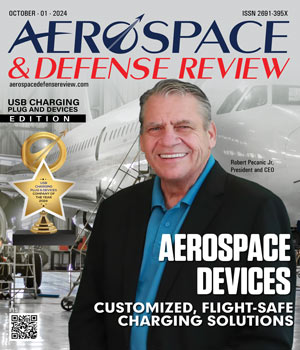
 Robert Pecanic Jr, President and CEO
Precision and reliability are non-negotiable in the aerospace and defense sector. Even the smallest components play a vital role in ensuring safety and functionality. Take USB charging ports, for instance. These commonplace devices, familiar in our everyday lives, become critical components in modern aircraft, powering essential tools and communication devices.
That’s why Aerospace Devices Inc. has set out to redefine industry standards for flight-safe charging solutions with its innovative design-build approach, creating customized solutions that seamlessly integrate with an aircraft’s electrical and mechanical systems.
“We bridge the gap between current demands and future technologies. Our goal is to create charging ports that are not just components, but perfect fits for the aircraft we serve,” says Robert Pecanic Jr, president and CEO.
In 2012, its expertise was put to the test when Dassault Aviation, a leading aerospace company, presented Aerospace Devices with a formidable challenge—designing a USB-A port capable of withstanding a 600-volt spike test, as outlined in a comprehensive, 270-page set of requirements. Leveraging its deep engineering and design expertise, it created the port from the ground up, meticulously adhering to Dassault’s specifications—something no other company in the industry could achieve at the time.
Despite the project’s intricacy, Aerospace Devices delivered the final product in record time, surpassing the client’s expectations.
This successful collaboration showcased Aerospace Devices’ technical capabilities and at the time earned them the privilege of being the sole source provider for Dassault’s fleet of sophisticated fly-by-wire private jets.
The success with Dassault opened doors for Aerospace Devices Inc. across the industry.
“We were among the first to install a USB-A port on an aircraft, specifically Bombardier Global. We continue supplying USB-A ports to Globals, Learjets, some Challengers and many leading MROs,” says Pecanic.
The Blueprint for Cutting-Edge Solutions
The company has experience in producing cabin solutions that push the limits in design, usability and functionality while incorporating the highest flight safety standards.
-
We Bridge The Gap Between Current Demands And Future Technologies. Our Goal Is To Create Charging Ports That Are Not Just Components, But Perfect Fits For The Aircraft We Serve
Every journey begins with pinpointing the requirements of each application. Factors like weight reduction, environmental conditions, electronic or shielding requirements and power input and output are carefully considered. The team explores various industry and application-specific materials to craft the perfect solution, sifting through finite options such as composites, metallics and thermoplastics to drive optimal performance and client satisfaction.
Once the material is finalized, the product is brought to life using Aerospace Devices’ capabilities, which include 3D-printed custom models of products and parts like face plates, bezels, and cabin features like personal device (PD) stowable device holders, PD mounting arms, and retractable iPad, iPod, and iPhone mounting features that meet customer requirements. This enables it to provide real-time solutions and reduce development costs and time for customers without compromising the quality or safety of the final product.
The Minds behind the Magic
Throughout the development, it collaborates with designated engineering representatives (DER) from the FAA and Transport Canada to guarantee compliance and safety.
Quality assurance is a cornerstone of Aerospace Devices’ approach. It conducts rigorous laboratory testing, including tests specifically requested by customers to address their needs. It produces detailed performance metrics that document product capabilities and limitations. This commitment to quality is demonstrated in low failure rates, which allows it to confidently offer a lifetime warranty.
Products conform to industry standards like FAA DO160 (RTCA DO-160), showcasing its dedication to safety and reliability.
This comprehensive approach to design, testing and quality assurance has been instrumental in Aerospace Devices’ success. It enables the completion of special projects related to USB-C ports for the U.S. government and develops a range of commercial and defense products for the aviation industry.
The Tech in Action

The impact of Aerospace Devices’ thoroughbred process is exemplified by its latest, 100-watt USB-C product, SkyDock Pro. Recently installed on Embraer ERJ-175 aircraft and several regional and private jets, this groundbreaking product showcases the company’s ability to navigate complex challenges. In developing the SkyDock Pro, it created new mounting brackets and successfully addressed EMI and RF concerns, demonstrating a comprehensive approach to product design and integration.
SkyDock Pro features USB-PD technology and intelligent, device-driven voltage output, guaranteeing optimal power delivery for each connected device.
For instance, when a cable is plugged in, the port identifies the connected device, such as a laptop, verifies its registration and power requirements and monitors the charging process. It checks for issues like thermal warming or battery breakdown and adjusts the power delivery accordingly. If an unsupported device or a cable with a lower amperage rating is plugged in, the device will not deliver power.
Its ruggedized design makes this USB-C product available in single- and dual-port versions, suitable for military applications. It also complies with various international standards, including those set by the European Union, which cover aspects like energy efficiency and electronic waste reduction.
“When we develop any product, we’re looking at how we can work toward carbon credits and manufacture the most efficient power supplies to help reduce e-waste,” says Pecanic. This approach aligns with global efforts to promote sustainable and environmentally responsible technologies in the aviation industry.
"We were among the first to install a USB-A port on an aircraft, specifically bombardier global. we continue supplying USB-A ports to Globals, Learjets, some challengers and many leading MROS"
Aerospace Devices’ motto, ‘Charging up the Future,’ is brought to life by a team of dedicated professionals with a range of expertise and passions.
Under Pecanic’s leadership, it has evolved from its early days as Esoteric Aero, which focused on in-flight entertainment (IFE) systems and device charging systems, to a leader in power solutions for phones, tablets, laptops and military equipment.
“Our success is truly a result of our engineering and manufacturing teams’ collective efforts and innovative spirit,” he says.
A key figure in Aerospace Devices’ achievements is Asa Andrews, the chief design and development engineer. With an impressive background that includes working as a developer at NASA, Andrews has been with the company since its start.
“Andrews is our go-to person, responsible for developing the theory of operation for all our products,” Pecanic notes.
The engineering team at Aerospace Devices, which includes outsourced consultants from major power board companies, is focused on creating products that will meet future needs and remain relevant for years. Instead of simply designing based on current requirements, they work to identify the next generation of lightweight, high-performance products.
To stay at the forefront of the industry, the team holds product development or enhancement meetings twice a week, setting new goals and discussing design and development. They are also active members of the Society of Automotive Engineers (SAE) and Interconnect Committee, which allows them to stay informed about the latest technologies and industry trends. Pecanic also serves on various committees, bringing his knowledge and firsthand experience.
In addition to its internal efforts, Aerospace Devices collaborates closely with top electronic component manufacturers and design firms to explore charging technologies and create cutting-edge solutions.
As market demands and technology requirements grow, it keeps a grasp on the changing needs and emerging technologies to see where the market is heading, and where it should direct its focus to maintain a strong position in the industry.
Powering the Future of Electronics at 30,000 Feet
Aerospace Devices’ products have garnered significant customer appreciation, prompting the company to expand its growth strategy into new defense opportunities, including land vehicles and marine vessels (yacht) applications.
In modern military operations, soldiers increasingly rely on personal electronic devices and laptops, causing power requirements to surge. This technological dependence has elevated the importance of reliable charging solutions in battlefield situations, where the consequences of a low battery notification could be severe, potentially compromising mission effectiveness and human safety.
To meet this critical need, it is developing more versatile mobile charging units. The new solutions are designed to be lightweight and capable of functioning across a range of power sources, from lower DC voltages to AC power. This flexibility is crucial due to the varying voltage requirements across different platforms, such as 12-volt vehicles and 28-volt DC aircraft.
While expanding its presence in the defense sector, Aerospace Devices excels in designing and developing products for the commercial space. Its concept is to provide customers with comprehensive solutions that enable them to efficiently operate and charge their devices at altitude.
This dual focus on defense and commercial aviation applications showcases Aerospace Devices’ adaptability and commitment to meeting diverse charging needs across the industry. By leveraging its expertise in creating tailor-made, robust and reliable charging systems for aircraft, it is well-positioned to address the challenges, now and in the future, presented by military applications on land and in the air.
| Share this Article: |

Company
Aerospace Devices
Management
Robert Pecanic Jr, President and CEO
Description
Aerospace Devices offers customized charging solutions for aircraft, specializing in flight-safe ports and passenger service units. With a client-centric approach, it tailors products to meet unique aerospace requirements. Its expertise extends from developing USB-A ports for private jets to USB-C technology, ensuring safety, efficiency and sustainability at 30,000 feet.