


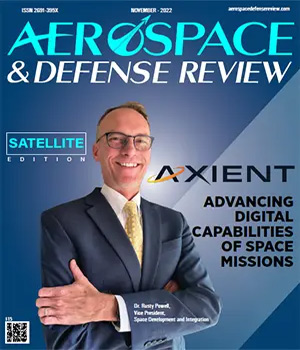
 Dr. Rusty Powell, Vice President, Space Development and Integration
Digital threads can connect the critical data flow across the product development lifecycle. It is becoming the touchstone for design teams, offering an unambiguous source of truth that holds all the data and design information required to keep engineers on the same page regarding the most sophisticated designs.
A defense and space systems engineering and integration company, Axient, leverages digital engineering (DE) and model-based systems engineering (MBSE) to advance its engineering services and solutions. It makes DE tools and processes vital components of its holistic and comprehensive multi-domain test and analysis, and mission engineering and operations services.
Driven by its competencies, Axient is becoming a key stakeholder in helping the U.S. Space Force turn digital-first. Axient is facilitating U.S. Space Force and DoD’s needs for faster development, integrated assembly, and the capability to test systems before they are built – all in the shortest time possible and without cost overruns.
Axient’s strong footing in facilitating advanced technologies comes from its four predecessors: QuantiTech LLC, Millennium Engineering and Integration LLC, Systems Engineering Group, and Dynamic Concepts Inc. Each company was an industry leader in their own right, and their combined capabilities in the form of Axient are leading the charge from advanced aerospace to cyberspace technology solutions.
The MLDL tool combines tried-and-true technologies for testing and simulation in space-based missions. Mission assets and actors, including formations, constellations, and ground-based components, can be simulated with dynamic, high-fidelity physics-based models to offer real-time feedback with in-depth visualization. This detailed simulation plays an important role in modeling complex systems.
Its commercial-off-the-shelf, government-off-the-shelf, and custom Mission Development Satellite Automation Toolkit software, specify and trade performance parameters using physics-based models to assess mission impacts and visualize system concepts.
-
Axient leverages digital engineering (DE) and model-based systems engineering (MBSE) to advance its engineering services and solutions
Time efficiency is an added advantage of the MLDL tool. It can complete specification definitions and bills of materials in minutes. It can also rapidly evaluate design alternatives, assess requirements impacts, and predict the performance of competing designs in space systems, a key enabler that significantly reduces design cycle time. Capabilities like detecting and tracking hypersonic missiles, visualizing integrated operations with weather, and serving operational energy needs further help many DoD clients.
When performing hardware and software tests, REST is designed to record simulation and avionics data and hardware signals for detailed post-test analysis. A suite of tools is also available to analyze the recorded data. Axient uses this capability throughout the satellite program lifecycle, including requirements analysis, design, development, and qualification testing, continually evaluating the system and its ability to complete the mission. Their customers such as the Army’s Space and Missile Defense Command and NASA recognize the importance of catching defects early in the program, reducing cost and schedule impact, and increasing mission success.
Recently, Axient helped one of its clients in Colorado Springs identify defects and repair them using its tools. It ensured their critical satellite system of national importance remained active, stayed linked to terrestrial and ground-based capabilities, and returned to fully mission-capable status in a relatively short time.
Axient is laser-focused to continue bringing value and action to its customers. It is completing a satellite design and integration facility to deliver enhanced capabilities to its clients. Axient’s experience of more than 30 years in space missions makes them a perfect partner to help clients provide full lifecycle support, from acquisition strategy and decisions to operations, sustainment, and delivery.
| Share this Article: |

Company
Axient
Management
Dr. Rusty Powell, Vice President, Space Development and Integration
Description
A defense and space manufacturing company, Axient, leverages the strength of digital threads, digital engineering (DE), and model-based systems engineering (MBSE) to advance its engineering services and solutions. It makes DE tools and processes a vital component of its holistic and comprehensive multi-domain test and analysis and mission engineering and operations services.
Axient News
Axient and Sinequa Team to Improve the Use of Generative AI and Intelligent Search in the Defense and Civilian Markets

Together, the organizations will work together to deliver AI-assisted knowledge discovery and information retrieval in the defense and civilian markets. The team will propose and develop AI-enabled intelligent search capabilities and expertise that supports mission engineering and operations, digital transformation, and advanced analysis solutions for air, ground, space, and cyber missions.
“Generative AI has transformed information retrieval, productivity, and decision-making through its innovation, creativity, optimization of resource allocation, intelligent insights, and problem-solving capabilities. Partnering with Sinequa adds immense value to the capabilities we’re bringing to government organizations by empowering them to apply generative AI to knowledge discovery and digital engineering. As a result, our customers can make more informed decisions, enhance product quality, reduce costs, and improve overall efficiency,” said Dr. Kuan Collins, Executive Director of Digital Innovation at Axient.
Sinequa helps government and defense organizations connect their employees to critical knowledge and expertise. By using non-disruptive AI, machine learning, and natural language processing (NLP) technology, Sinequa and Axient can help government agencies accelerate decision-making, improve future missions, and improve the overall workforce experience.
“As a major systems integrator with industry-leading systems engineering expertise, Axient has a strong track record for success and distinguished value within the defense and aerospace markets,” said Xavier Pornain, SVP of Sales North America at Sinequa. “One of our top priorities will be exploring how we can help use generative AI and conversational search to help unleash new breakthroughs and streamline product lifecycle management (PLM) and digital twins/digital threads. We see competitive advantages in our collaboration and the joint solutions our teams can bring to the government and commercial markets.”