THANK YOU FOR SUBSCRIBING

Aerospace and Defense Review Weekly Brief
Be first to read the latest tech news, Industry Leader's Insights, and CIO interviews of medium and large enterprises exclusively from Aerospace and Defense Review


Operational failure in modern defense rarely comes from a single breakdown. Instead, it emerges from disconnected workflows, fragmented systems and inconsistent information management. As NATO pushes toward interoperability and integrated digital operations during missions, fragmentation has become a readiness risk.
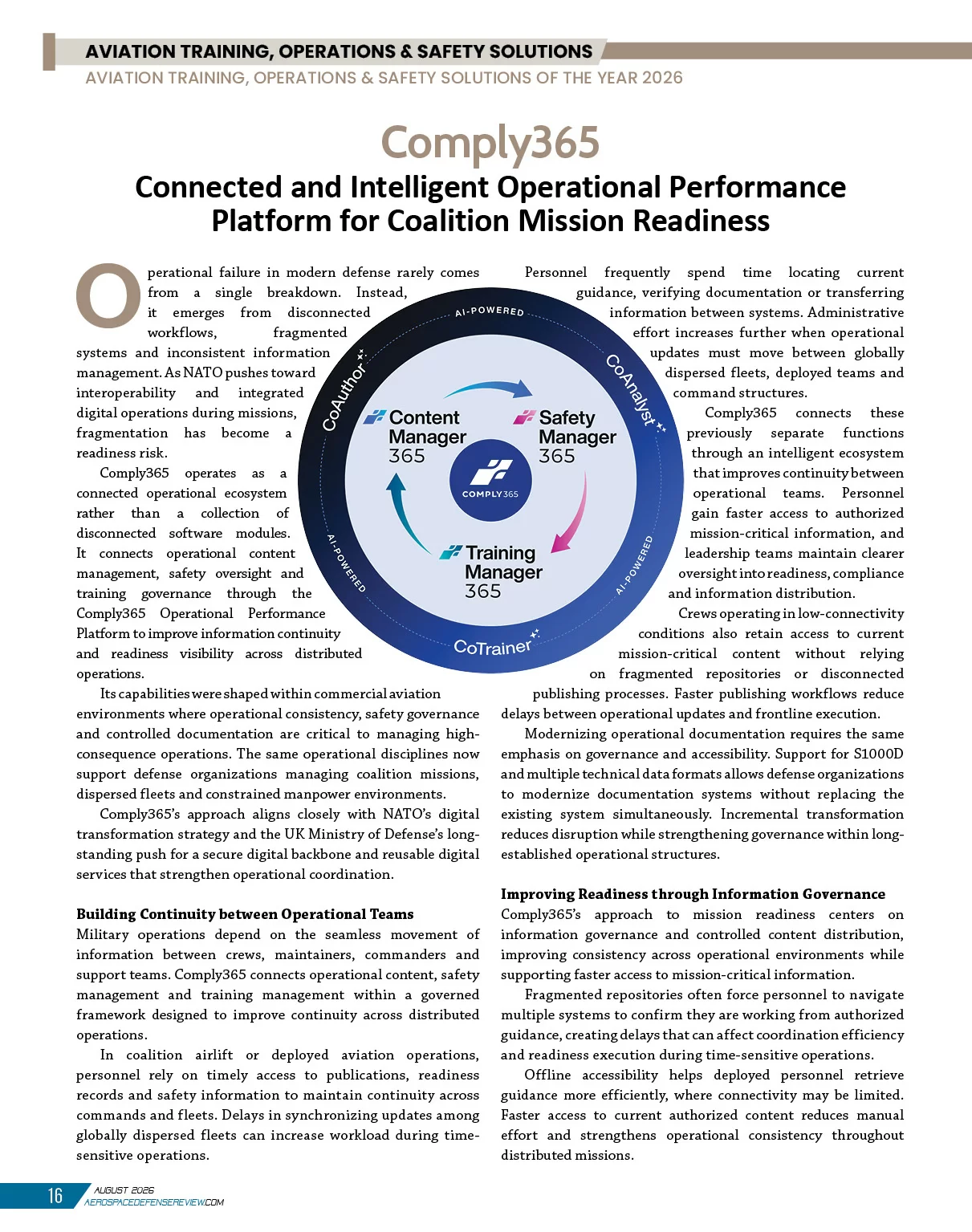
Comply365 operates as a connected operational ecosystem rather than a collection of disconnected software modules. It connects operational content management, safety oversight and training governance through the Comply365 Operational Performance Platform to improve information continuity and readiness visibility across distributed operations.
Its capabilities were shaped within commercial aviation environments where operational consistency, safety governance and controlled documentation are critical to managing high-consequence operations. The same operational disciplines now support defense organizations managing coalition missions, dispersed fleets and constrained manpower environments.
Comply365’s approach aligns closely with NATO’s digital transformation strategy and the UK Ministry of Defense’s long-standing push for a secure digital backbone and reusable digital services that strengthen operational coordination.
Building Continuity between Operational Teams
Military operations depend on the seamless movement of information between crews, maintainers, commanders and support teams. Comply365 connects operational content, safety management and training management within a governed framework designed to improve continuity across distributed operations.
In coalition airlift or deployed aviation operations, personnel rely on timely access to publications, readiness records and safety information to maintain continuity across commands and fleets. Delays in synchronizing updates among globally dispersed fleets can increase workload during time-sensitive operations.
Personnel frequently spend time locating current guidance, verifying documentation or transferring information between systems. Administrative effort increases further when operational updates must move between globally dispersed fleets, deployed teams and command structures.
Comply365 connects these previously separate functions through an intelligent ecosystem that improves continuity between operational teams. Personnel gain faster access to authorized mission-critical information, and leadership teams maintain clearer oversight into readiness, compliance and information distribution.
Crews operating in low-connectivity conditions also retain access to current mission-critical content without relying on fragmented repositories or disconnected publishing processes. Faster publishing workflows reduce delays between operational updates and frontline execution.
Modernizing operational documentation requires the same emphasis on governance and accessibility. Support for S1000D and multiple technical data formats allows defense organizations to modernize documentation systems without replacing the existing system simultaneously. Incremental transformation reduces disruption while strengthening governance within long-established operational structures.
Improving Readiness through Information Governance
Comply365’s approach to mission readiness centers on information governance and controlled content distribution, improving consistency across operational environments while supporting faster access to mission-critical information.
Fragmented repositories often force personnel to navigate multiple systems to confirm they are working from authorized guidance, creating delays that can affect coordination efficiency and readiness execution during time-sensitive operations.
Offline accessibility helps deployed personnel retrieve guidance more efficiently, where connectivity may be limited. Faster access to current authorized content reduces manual effort and strengthens operational consistency throughout distributed missions.
Integrated AI capabilities further improve how teams retrieve and analyze information. Semantic search functions reduce time spent locating guidance and compliance records. Automated classification and hazard-event correlation help organizations identify emerging patterns more efficiently within large operational datasets.
Reduced administrative burden allows personnel to focus on operational priorities rather than manual information management, helping return scarce personnel capacity to frontline activities.
Strengthening Safety Oversight and Risk Visibility
Comply365 views safety oversight as a critical component of mission readiness as defense organizations manage growing volumes of operational data. A connected approach combines operational data, reporting workflows and AI-supported analysis to improve visibility into operational risk.
Automated report handling, hazard correlation and pattern recognition help organizations process information more efficiently while identifying emerging risks earlier. These capabilities support a more proactive approach to safety management and reduce the manual effort required to review large volumes of operational data.
Comply365’s CoAnalyst, an AI-powered safety risk management solution, further supports operational assessment through automated report processing, hazard identification and AI-assisted root-cause analysis. Commercial aviation users reported up to 90 percent faster report processing, reducing manual analysis time and allowing safety personnel to focus more on mitigation planning and operational review.
-
Comply365’s solutions and its Operational Performance Platform are designed to improve the speed, confidence, front-line decision making and governance of information flow, ensuring personnel are working from the right version of mission-critical content, including in low-connectivity conditions.
Comply365’s CoAnalyst, an AI-powered safety risk management solution, further supports operational assessment through automated report processing, hazard identification and AI-assisted root-cause analysis. Commercial aviation users reported up to 90 percent faster report processing, reducing manual analysis time and allowing safety personnel to focus more on mitigation planning and operational review.
These capabilities illustrate how AI can support defense organizations through intelligent search, automated classification, operational risk prioritization and accelerated decision support. The value of these capabilities, however, will depend heavily on the quality, governance and accessibility of connected operational data.
“The future of mission readiness is not an isolated AI tool but an integrated operational framework where content, safety, training and analytics reinforce one another,” says Ilia Kostov, CEO.
Comply365 connects safety management, operational guidance and training oversight through a connected Operational Performance Platform that improves continuity between corrective actions, qualification management and readiness planning. Updated procedures, revised guidance, training requirements and qualification status remain connected through the same governed framework instead of becoming isolated within separate systems.
Earlier visibility into emerging risk supports proactive decision-making, strengthens readiness planning and reduces the administrative burden on frontline teams.
Supporting Interoperability across Allied Operations
Interoperability has become a strategic priority for coalition mission readiness. NATO strategies increasingly emphasize reusable digital services, integrated operational infrastructure and stronger coordination between defense partners.
As coalition missions become more distributed, defense organizations face growing pressure to maintain information consistency and governance across multiple fleets, commands and operational partners without adding further complexity.
Defense fleets, including C-130J, A400M and Voyager, operations have used Comply365 systems to improve information distribution, operational coordination and productivity for globally dispersed crews. Faster access to governed content reduces delays and improves coordination between teams.
Many defense organizations pursue these improvements while continuing to rely on established systems that support critical operational functions. Comply365 supports integration between existing systems instead of requiring immediate replacement of legacy workflows. Gradual adoption helps organizations modernize without disrupting readiness.
Commercial aviation continues to demonstrate how disciplined governance, controlled documentation and connected safety oversight improve coordination between globally dispersed fleets and command structures.
As mission readiness becomes increasingly dependent on the quality and flow of operational information, maintaining continuity across critical functions remains fundamental to operational readiness and effective coordination across allied forces. Comply365’s recognition as the leading provider of Aviation Training, Operations and Safety Solutions reflects the value it delivers through an Operational Performance Platform that strengthens information management and supports more informed decision-making.
Aviation Readiness without System Sprawl
A crew briefing package that lags behind a fleet bulletin is not a paperwork issue; it is a control failure that travels from the back office to the flight deck. Aviation leaders buying systems for training and safety work are often trying to repair that fracture without adding another dashboard to a stack already shaped by regulators, aircraft programs, legacy repositories and local workarounds.
The pressure is felt most sharply where documentation, crew readiness, safety reporting and audit evidence meet. Manuals change, qualifications expire, events are logged after the fact and audit evidence sits in places that only a few people know how to navigate. None of those gaps may look severe on their own. When combined across dispersed teams, they slow release-to-service decisions and make managers rely on follow-up calls when the record should speak for itself.
A credible aviation readiness system must keep authorized information close to the people using it. This means controlled publishing, clear version history, offline access and enough mobile usability for crews who do not work at a desk. Buyers should be cautious of tools that digitize forms but leave distribution logic untouched. The larger risk is not paper; it is uncertainty about which instruction, revision, approval trail or local exception is binding at the moment work happens.
Training management brings a different test. Flight crews, instructors, training managers and compliance teams need records that support scheduling decisions rather than merely documenting past activity. Currency tracking, evaluation history, expiry warnings and qualification evidence have to sit in a form that can withstand audit review without turning every inquiry into a data hunt. The stronger fit is rarely the system with the broadest menu, but the one that reduces handoffs between training delivery and proof of readiness.
“Our platform brings content, training, safety and analytics together so aviation teams can make confident decisions from a single, trusted source. “
Safety software should also be judged by what happens before a monthly review. Reports need intake discipline, consistent classification, faster triage and links back to the conditions that produced the event. AI can help, but only when the underlying records are governed and traceable. Search, pattern detection and root-cause support are useful because they shorten the distance between weak signal and corrective action, not because they decorate a safety program with new terminology.
Integration matters because aviation rarely has the luxury of starting from scratch. Existing manuals, flight operations practices, training rules and regulator expectations are already embedded. A platform worth considering should respect that inheritance while reducing the number of places where evidence is created, checked, updated and explained. For executive buyers, the decision is less about replacing every system at once and more about removing the seams that create audit drag and crew uncertainty.
Comply365 merits premier consideration because its relevant scope sits where the buying pressure is concentrated. Its platform brings ContentManager365, SafetyManager365, TrainingManager365 and analytics together for aviation teams that need controlled content distribution, mobile access, training record discipline, safety reporting and governed decision support.
Comply365’s relevant platform scope includes online and offline access, enterprise publishing control, semantic search, automated classification, hazard-event correlation and AI-assisted root-cause analysis. These capabilities support aviation-focused content management, safety systems, training management and analytics. For buyers wary of another isolated tool, this breadth of capabilities is the practical reason to turn to Comply365.
...Read more
| Share this Article: |

Company
Comply365
Management
Ilia Kostov, CEO
Description
Comply365 delivers operational performance platform that connects operational content, safety management, training management and compliance workflows for defense and aviation organizations. Its governed digital environment improves readiness, operational visibility and information distribution across globally dispersed fleets and allied defense operations.