THANK YOU FOR SUBSCRIBING

Aerospace and Defense Review Weekly Brief
Be first to read the latest tech news, Industry Leader's Insights, and CIO interviews of medium and large enterprises exclusively from Aerospace and Defense Review

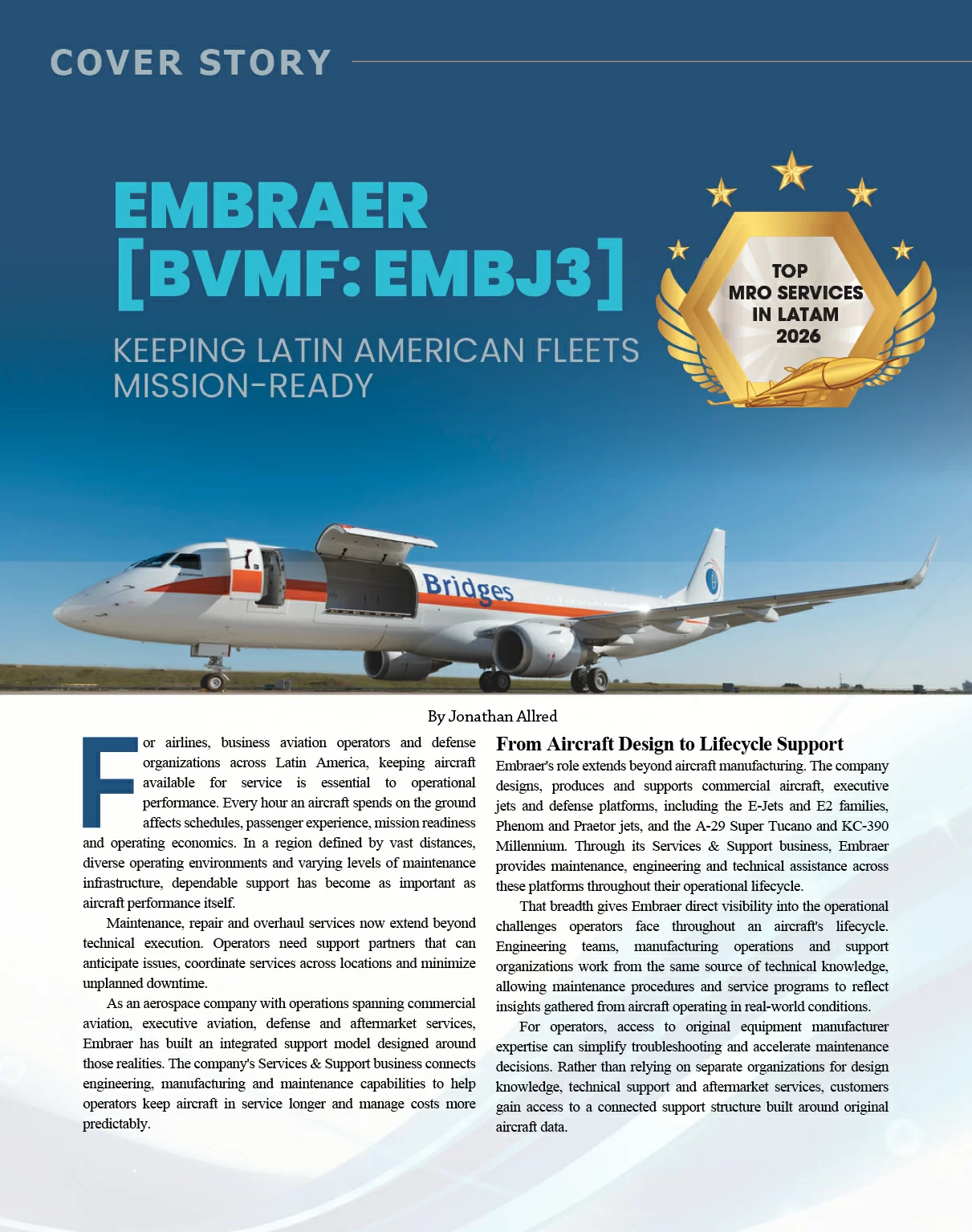
![Embraer [BVMF: EMBJ3]](/company_logos/1-my2ek.jpg "Embraer [BVMF: EMBJ3]")
For airlines, business aviation operators and defense organizations across Latin America, keeping aircraft available for service is essential to operational performance. Every hour an aircraft spends on the ground affects schedules, passenger experience, mission readiness and operating economics. In a region defined by vast distances, diverse operating environments and varying levels of maintenance infrastructure, dependable support has become as important as aircraft performance itself.
Maintenance, repair and overhaul services now extend beyond technical execution. Operators need support partners that can anticipate issues, coordinate services across locations and minimize unplanned downtime.
 As an aerospace company with operations spanning commercial aviation, executive aviation, defense and aftermarket services, Embraer has built an integrated support model designed around those realities. The company's Services & Support business connects engineering, manufacturing and maintenance capabilities to help operators keep aircraft in service longer and manage costs more predictably.
From Aircraft Design to Lifecycle Support
Embraer's role extends beyond aircraft manufacturing. The company designs, produces and supports commercial aircraft, executive jets and defense platforms, including the E-Jets and E2 families, Phenom and Praetor jets, and the A-29 Super Tucano and KC-390 Millennium. Through its Services & Support business, Embraer provides maintenance, engineering and technical assistance across these platforms throughout their operational lifecycle.
That breadth gives Embraer direct visibility into the operational challenges operators face throughout an aircraft's lifecycle. Engineering teams, manufacturing operations and support organizations work from the same source of technical knowledge, allowing maintenance procedures and service programs to reflect insights gathered from aircraft operating in real-world conditions.
For operators, access to original equipment manufacturer expertise can simplify troubleshooting and accelerate maintenance decisions. Rather than relying on separate organizations for design knowledge, technical support and aftermarket services, customers gain access to a connected support structure built around original aircraft data.
The company's location also strengthens its position in Latin America. Headquartered in Brazil, Embraer supports one of the region's largest installed bases of regional aircraft. Its network includes company-owned facilities, strategic subsidiaries and authorized service centers that extend maintenance capabilities across key markets.
Regional maintenance infrastructure helps reduce the costs associated with ferrying aircraft for maintenance, an important advantage in a region where geographic distances can significantly influence operating expenses.
Building a Regional Network around Predictability
Aircraft operators increasingly measure maintenance performance by predictability rather than repair capacity alone. Scheduled maintenance events are manageable. Unplanned downtime is not. little abrupt. Consider rephrasing. Embraer's MRO strategy focuses on creating consistency across a distributed network of support locations. Authorized service centers operate according to common engineering, training and quality standards, allowing customers to access comparable service capabilities across multiple geographies.
The company continues to expand that network to meet growing demand for maintenance capacity across the Americas. Recent investments have increased support options for executive aviation customers in markets including Chile and Mexico, while broader regional coverage helps commercial and defense operators’ access services closer to their operations.
Digital tools are becoming increasingly important in modern aircraft maintenance. One example is Embraer's Aircraft Health Analysis and Diagnosis (AHEAD) platform, which collects operational data from onboard aircraft systems and analyzes it for signs of emerging technical issues. By identifying potential maintenance needs before they affect aircraft performance or availability, the platform helps operators plan maintenance activities more effectively and reduce unexpected disruptions.
AHEAD supports monitoring across multiple aircraft systems, including engines, hydraulics, avionics and flight controls. By translating operational data into maintenance intelligence, the platform helps operators improve planning, reduce unplanned ground time and make more informed maintenance decisions.
 Embraer's support capabilities also extend through its controlling stake in OGMA, the Portuguese aerospace company that provides maintenance, engineering and overhaul services across commercial, executive and military platforms. Recent investments in Pratt & Whitney engine maintenance capabilities have expanded support options for next-generation aircraft and strengthened Embraer's ability to address growing industry demand for engine overhaul capacity.
Turning Maintenance into a Strategic Capability
Maintenance performance is ultimately measured by its impact on aircraft availability, speed of return to service and cost predictability. Higher aircraft availability allows operators to maximize fleet utilization, while faster maintenance turnaround reduces operational disruption. Predictable maintenance costs support more effective planning and budgeting. These priorities apply across commercial aviation, business aviation and defense operations, despite differences in operational requirements.
Achieving these outcomes requires more than repair capabilities alone. Operators increasingly rely on integrated support structures that combine maintenance expertise with engineering resources, technical guidance and supply chain coordination to keep aircraft operating efficiently throughout their lifecycle.
Embraer's support model is built around that approach. Its service structure combines technical assistance, training, spare parts distribution, engineering support and fleet management services, creating a more coordinated framework for aircraft lifecycle management that extends beyond individual maintenance events.
Long-term support programs also help operators manage the growing complexity of fleet operations. Access to technical publications, inventory support programs and ongoing engineering expertise enables customers to improve reliability over time rather than simply react to maintenance needs as they arise.
The market response highlights the increasing importance of aftermarket services within the aerospace sector. Embraer’s Services & Support business booked $1.4B in revenues for 2023 and finished the year with a record $3.1B backlog. This growth continues driven by the demand of integrated support offering by operators during the capacity constraints and the supply chain shortages facing the industry.
That demand reflects a broader shift across the aviation industry. For operators across Latin America, maintenance is no longer viewed as a back-office function but as a strategic capability that directly influences operational resilience, fleet utilization and financial performance.
Embraer's ability to connect original equipment manufacturer knowledge with regional service delivery has positioned the company as a valued partner for airlines, business aviation operators and defense organizations seeking to maximize aircraft availability. Its recognition as one of the Top MRO Services in LATAM 2026 reflects the strength of an operating model built around a clear objective: keeping fleets mission-ready when reliability matters most.
| Share this Article: |
Company
Embraer [BVMF: EMBJ3]
Management
Francisco Gomes Neto, President and CEO
Description
Embraer is a global aerospace company that designs, manufactures and supports commercial aircraft, executive jets, defense and security platforms, and aviation services. With more than five decades of expertise, it delivers innovative, efficient and sustainable aviation solutions to customers worldwide.