THANK YOU FOR SUBSCRIBING

Aerospace and Defense Review Weekly Brief
Be first to read the latest tech news, Industry Leader's Insights, and CIO interviews of medium and large enterprises exclusively from Aerospace and Defense Review


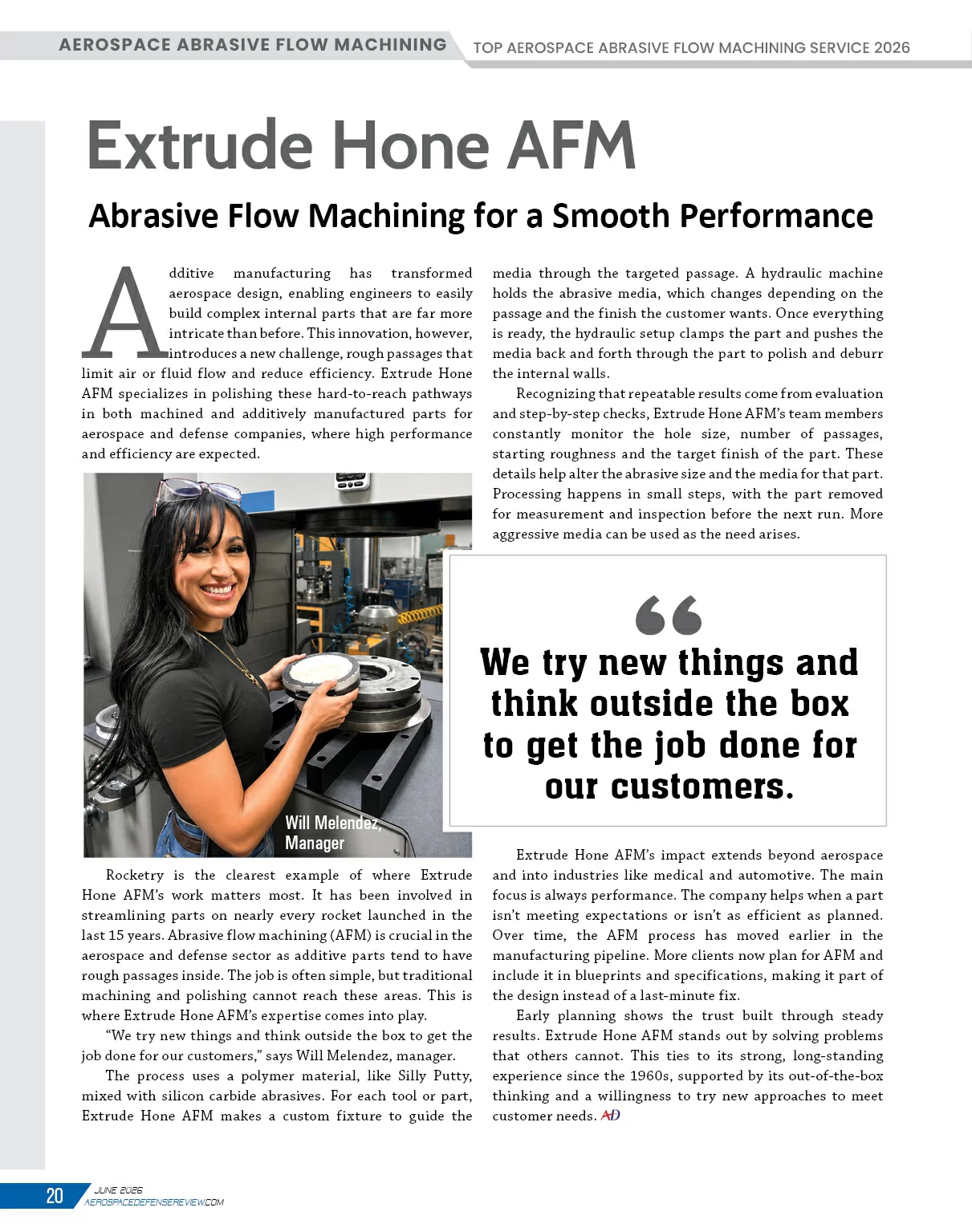
 Sienna Rose, Manager and in charge of Quality Control
 Additive manufacturing has transformed aerospace design, enabling engineers to easily build complex internal parts that are far more intricate than before. This innovation, however, introduces a new challenge, rough passages that limit air or fluid flow and reduce efficiency. Extrude Hone AFM specializes in polishing these hard-to-reach pathways in both machined and additively manufactured parts for aerospace and defense companies, where high performance and efficiency are expected.
Why is abrasive flow machining essential for improving internal passages in aerospace components?
Rocketry is the clearest example of where Extrude Hone AFM’s work matters most. It has been involved in streamlining parts on nearly every rocket launched in the last 15 years. Abrasive flow machining (AFM) is crucial in the aerospace and defense sector as additive parts tend to have rough passages inside. The job is often simple, but traditional machining and polishing cannot reach these areas. This is where Extrude Hone AFM’s expertise comes into play.
“We try new things and think outside the box to get the job done for our customers,” says Will Melendez, manager.
What process allows abrasive media to polish internal passages unreachable by conventional machining?
The process uses a polymer material, like Silly Putty, mixed with silicon carbide abrasives. For each tool or part, Extrude Hone AFM makes a custom fixture to guide the media through the targeted passage. A hydraulic machine holds the abrasive media, which changes depending on the passage and the finish the customer wants. Once everything is ready, the hydraulic setup clamps the part and pushes the media back and forth through the part to polish and deburr the internal walls.
-
We try new things and think outside the box to get the job done for our customers.
Recognizing that repeatable results come from evaluation and step-by-step checks, Extrude Hone AFM’s team members constantly monitor the hole size, number of passages, starting roughness and the target finish of the part. These details help alter the abrasive size and the media for that part. Processing happens in small steps, with the part removed for measurement and inspection before the next run. More aggressive media can be used as the need arises.
How is abrasive flow machining expanding across industries beyond aerospace applications?
Extrude Hone AFM’s impact extends beyond aerospace and into industries like medical and automotive. The main focus is always performance. The company helps when a part isn’t meeting expectations or isn’t as efficient as planned. Over time, the AFM process has moved earlier in the manufacturing pipeline. More clients now plan for AFM and include it in blueprints and specifications, making it part of the design instead of a last-minute fix.
Early planning shows the trust built through steady results. Extrude Hone AFM stands out by solving problems that others cannot. This ties to its strong, long-standing experience since the 1960s, supported by its out-of-the-box thinking and a willingness to try new approaches to meet customer needs.
Advancing Precision in Aerospace Abrasive Flow Machining
Additive manufacturing has expanded design freedom in aerospace and defense engineering, yet that freedom often introduces a persistent manufacturing obstacle. Internal passages created by 3D printing often have rough surfaces that disrupt airflow or fluid flow within critical components. Rocket engines, propulsion assemblies and other performance-sensitive systems rely on carefully controlled internal geometry, and even small irregularities can reduce efficiency or compromise expected performance. Conventional machining and polishing techniques struggle to reach complex interior channels, leaving manufacturers searching for finishing methods that can address inaccessible geometries.
Aerospace executives evaluating specialized surface-finishing services focus on a small set of practical concerns that determine whether a solution can reliably support modern component designs. One important consideration is the ability to improve the quality of internal passages in parts produced by additive manufacturing. Designers increasingly rely on intricate channels that improve cooling, airflow or fluid circulation, yet these geometries introduce surfaces that cannot be polished through direct mechanical contact. A capable finishing service must therefore work inside enclosed or narrow passages while preserving dimensional accuracy and surface consistency.
Process control consistency also matters greatly. Aerospace programs often require extremely tight tolerances and documented results, especially when parts will operate in propulsion systems, turbine assemblies or other performance-critical environments. Finishing processes must allow engineers to tune results based on each part’s geometry and the level of surface improvement required. A service provider that can adapt polishing intensity, evaluate progress during processing and confirm results through inspection creates far greater confidence for manufacturers responsible for mission-critical hardware.
Experience handling advanced aerospace components also influences supplier selection. Aerospace programs often move quickly from prototyping to production, particularly in the commercial space and defense sectors, where additive manufacturing continues to expand. Service providers must be capable of solving unusual finishing problems when new part geometries emerge. Longevity in the field and a demonstrated ability to support complex components provide reassurance that a finishing process will scale alongside evolving aerospace designs.
Extrude Hone AFM stands out in this field through a process designed specifically for interior polishing challenges that conventional tools cannot reach. The company uses a polymer-based media mixed with abrasive grains that is hydraulically pushed through targeted passages inside a component. Custom fixtures guide the media through internal channels, allowing the abrasive flow to gradually smooth surfaces while preserving the part’s geometry. Media composition, abrasive size and processing duration are adjusted according to passage dimensions, starting surface roughness and the level of smoothness required for the final application. The service has become particularly relevant as aerospace manufacturers adopt additive manufacturing for propulsion and defense applications. Intricate internal designs that cannot be polished conventionally can be finished through abrasive flow machining, enabling improved airflow and fluid movement within complex parts. Industry experience also strengthens the company’s credibility.
Executives evaluating aerospace abrasive flow machining services ultimately look for finishing methods capable of addressing internal geometries, adaptable process control and long experience solving difficult component challenges. Extrude Hone AFM demonstrates strength across these areas, making it a compelling choice for organizations requiring precision polishing of complex aerospace components.
...Read more
Aerospace Abrasive Flow Machining Services Info
Q1
Why is Extrude Hone AFM recognized among Aerospace Abrasive Flow Machining Services providers?
Extrude Hone AFM has earned industry recognition for its precision surface finishing technologies used in aerospace and defense manufacturing. The company specializes in controlled abrasive flow machining processes that improve internal surface geometry, airflow efficiency and component consistency across highly engineered aerospace parts. Its Aerospace Abrasive Flow Machining Services support manufacturers working with turbine engines, fuel systems and complex aerospace components where precision finishing directly affects operational performance. By combining process control with decades of finishing expertise, Extrude Hone AFM continues to strengthen its position within advanced aerospace manufacturing environments.
Q2
What differentiates Extrude Hone AFM in the precision machining sector?
Process specialization and engineered finishing expertise distinguish Extrude Hone AFM from conventional machining providers. The company focuses on material flow technologies that polish and refine hard-to-reach internal passages and complex geometries often found in aerospace components. Its Aerospace Abrasive Flow Machining Services help manufacturers achieve smoother surface finishes, improved dimensional consistency and optimized flow characteristics that are difficult to achieve through traditional machining methods alone. This capability allows aerospace organizations to improve component reliability while maintaining strict manufacturing tolerances.
Q3
How does Extrude Hone AFM support aerospace manufacturing performance?
Aerospace systems depend on precision-engineered components capable of operating reliably under extreme conditions. Extrude Hone AFM delivers Aerospace Abrasive Flow Machining Services that improve component efficiency through controlled internal surface refinement and precision finishing. The company’s machining processes help reduce flow restrictions, enhance part consistency and support improved aerodynamic or fluid dynamic performance in critical aerospace systems. Its manufacturing expertise supports organizations seeking higher-performance components without compromising structural integrity or production quality.
Q4
What role does innovation play in Extrude Hone AFM’s machining capabilities?
Advanced manufacturing environments require finishing technologies capable of supporting increasingly complex component designs. Extrude Hone AFM integrates engineered abrasive flow processes and precision-controlled finishing methods into its Aerospace Abrasive Flow Machining Services to address evolving aerospace manufacturing demands. The company continues refining its machining technologies to support tighter tolerances, improved repeatability and greater manufacturing efficiency across aerospace production programs. This commitment to process innovation helps manufacturers adapt to modern aerospace engineering requirements while maintaining consistent production quality.
Q5
How do Aerospace Abrasive Flow Machining Services create value for aerospace manufacturers?
Precision finishing contributes directly to aerospace component reliability, operational efficiency and manufacturing consistency. Extrude Hone AFM provides Aerospace Abrasive Flow Machining Services that help organizations improve surface quality, optimize internal flow paths and extend component performance capabilities. These machining solutions support manufacturers seeking improved repeatability and reduced performance variability across high-value aerospace components. By enhancing finishing precision within complex geometries, the company creates long-term value for aerospace production and engineering programs.
Q6
Why is Extrude Hone AFM relevant to the future of aerospace manufacturing?
Modern aerospace engineering increasingly relies on highly complex components that demand advanced finishing capabilities beyond conventional machining methods. Extrude Hone AFM remains relevant because its Aerospace Abrasive Flow Machining Services support the precision requirements associated with next-generation aerospace systems and advanced propulsion technologies. Its expertise in controlled surface refinement and internal geometry finishing aligns closely with the aerospace industry’s focus on performance optimization, manufacturing precision and operational reliability. This continued emphasis on advanced finishing technology positions the company as an important contributor to future aerospace manufacturing innovation.
| Share this Article: |
Company
Extrude Hone AFM
Management
Sienna Rose, Manager and in charge of Quality Control
Description
Extrude Hone AFM polishes internal flow paths in 3D printed aerospace components using abrasive flow machining. The company serves defense, space and rocket programs that need smoother passages for better airflow and performance. With six decades of experience, its team solves finishing problems that conventional methods cannot touch.