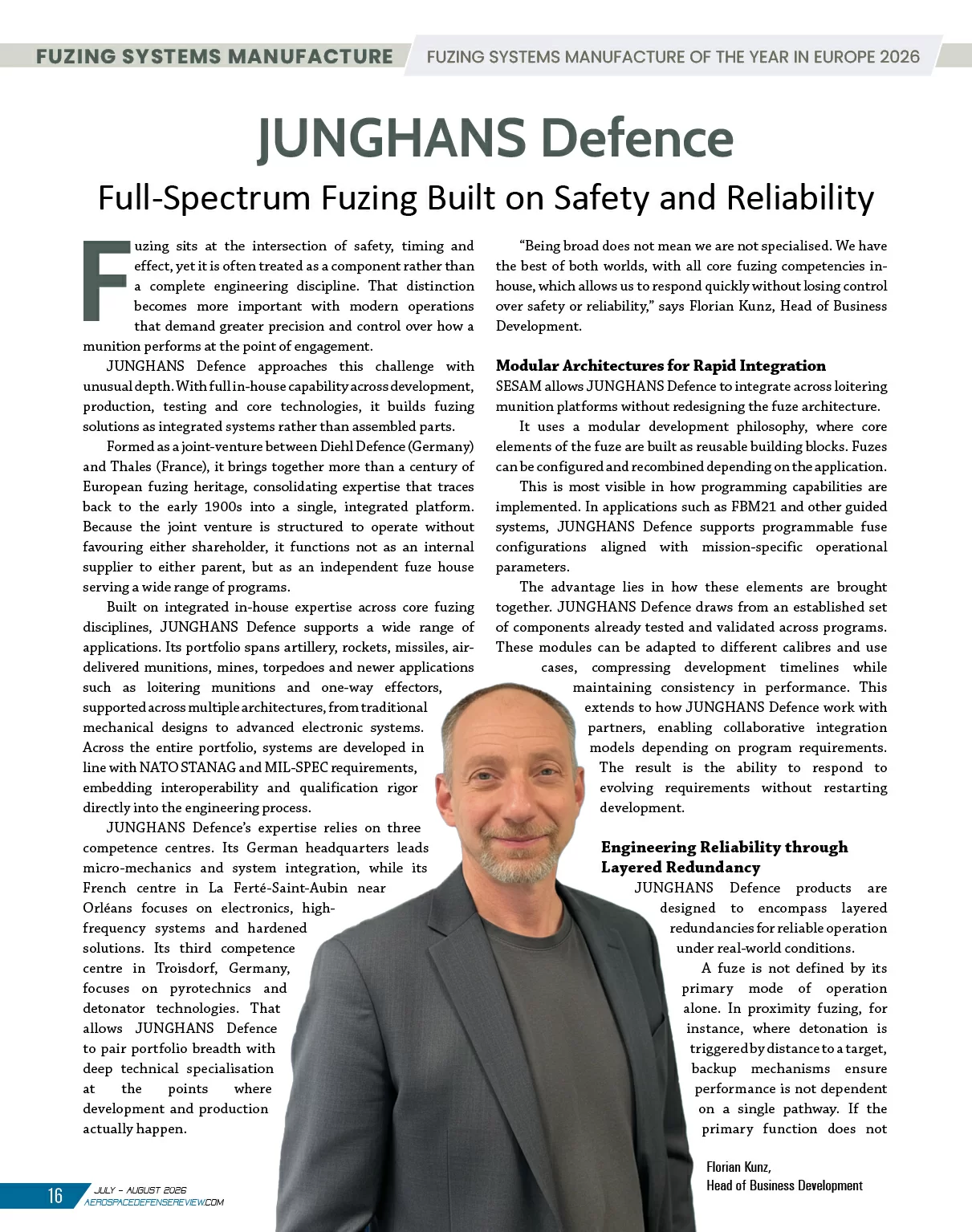
 Florian Kunz, Head of Business Development
JUNGHANS Defence approaches this challenge with unusual depth. With full in-house capability across development, production, testing and core technologies, it builds fuzing solutions as integrated systems rather than assembled parts.
Formed as a joint-venture between Diehl Defence (Germany) and Thales (France), it brings together more than a century of European fuzing heritage, consolidating expertise that traces back to the early 1900s into a single, integrated platform. Because the joint venture is structured to operate without favouring either shareholder, it functions not as an internal supplier to either parent, but as an independent fuze house serving a wide range of programs.
Built on integrated in-house expertise across core fuzing disciplines, JUNGHANS Defence supports a wide range of applications. Its portfolio spans artillery, rockets, missiles, air-delivered munitions, mines, torpedoes and newer applications such as loitering munitions and one-way effectors, supported across multiple architectures, from traditional mechanical designs to advanced electronic systems. Across the entire portfolio, systems are developed in line with NATO STANAG and MIL-SPEC requirements, embedding interoperability and qualification rigor directly into the engineering process.

JUNGHANS Defence’s expertise relies on three competence centres. Its German headquarters leads micro-mechanics and system integration, while its French centre in La Ferté-Saint-Aubin near Orléans focuses on electronics, high-frequency systems and hardened solutions. Its third competence centre in Troisdorf, Germany, focuses on pyrotechnics and detonator technologies. That allows JUNGHANS Defence to pair portfolio breadth with deep technical specialisation at the points where development and production actually happen.
“Being broad does not mean we are not specialised. We have the best of both worlds, with all core fuzing competencies in-house, which allows us to respond quickly without losing control over safety or reliability,” says Florian Kunz, Head of Business Development.
Modular Architectures for Rapid Integration
SESAM allows JUNGHANS Defence to integrate across loitering munition platforms without redesigning the fuze architecture.
It uses a modular development philosophy, where core elements of the fuze are built as reusable building blocks. Fuzes can be configured and recombined depending on the application.
This is most visible in how programming capabilities are implemented. In applications such as FBM21 and other guided systems, JUNGHANS Defence supports programmable fuse configurations aligned with mission-specific operational parameters.
The advantage lies in how these elements are brought together. JUNGHANS Defence draws from an established set of components already tested and validated across programs. These modules can be adapted to different calibres and use cases, compressing development timelines while maintaining consistency in performance. This extends to how JUNGHANS Defence work with partners, enabling collaborative integration models depending on program requirements. The result is the ability to respond to evolving requirements without restarting development.
Engineering Reliability through Layered Redundancy
JUNGHANS Defence products are designed to encompass layered redundancies for reliable operation under real-world conditions.
A fuze is not defined by its primary mode of operation alone. In proximity fuzing, for instance, where detonation is triggered by distance to a target, backup mechanisms ensure performance is not dependent on a single pathway. If the primary function does not activate as expected, an impact-based fallback provides an additional layer of assurance.
Making this redundancy particularly effective is the deliberate separation of technologies. JUNGHANS Defence splits primary and backup functions across mechanical and electronic architectures. If an electronic system is compromised due to power loss or interference, a mechanically driven backup remains unaffected, reducing the risk of simultaneous failure across functions. In high-volume and high-cadence applications, a further layer is added through self-destruct functions, which activate if neither the primary nor backup mechanisms trigger, minimising the risk of unexploded ordnance while preserving operational intent.
-
Being broad does not mean we are not specialised. We have the best of both worlds, with all core fuzing competencies in-house, which allows us to respond quickly without losing control over safety or reliability.
A firm distinction is maintained between functional reliability and safety. Overall functional reliability is engineered to reach approximately 98 percent under real-world conditions.
Safety is treated as an absolute design requirement. Modular safe-and-arm devices are maintained across different munition classes, enabling faster development cycles while drawing on proven internal building blocks. This approach carries through into manufacturing, where safety-critical functions are assessed during production rather than only at final inspection. Each unit is validated for functional performance before delivery, reinforcing consistency over time and supporting the reliability standards expected in operational environments.
“Safety is non-negotiable. In over a decade, we have not recorded a single safety-relevant incident with our fuzes in the field,” adds Kunz.
Purpose-Built for a Changing Battlefield
JUNGHANS Defence is developing its fuzing system for a more contested battlespace. These systems have to endure higher mechanical stress, resist heavier electronic interference and perform across mission profiles that are becoming harder to predict.
It is extending its capabilities into high-G environments, stronger resistance to electronic countermeasures and navigation approaches that move beyond sole reliance on satellite-based systems. That includes terrain-based and optical guidance methods designed for GPS-denied conditions.
A concrete example of this direction is SESAM, a modular electronic safe-and-arm device developed specifically for loitering munitions and one-way effectors. In a category where safety and standardisation have often lagged behind a rapid adoption pace, SESAM was designed to align with established requirements while remaining cost-sensitive and achievable within compressed timelines.
The development cycle ran to approximately two years, with market readiness reached in 2026. Demand has been strong from the outset with multiple launch programs underway and first serial deliveries planned before year-end. Application in programs such as TDW's Lion Strike warhead offers a publicly available reference point for how the system is being integrated into emerging platforms.
At the same time, JUNGHANS Defence does not treat technological progression as a one-directional shift toward electronics. Certain applications continue to favour mechanical or hybrid architectures, particularly where resistance to interference, robustness under extreme conditions or production depth remain decisive factors. Maintaining expertise across all three architectural approaches allows JUNGHANS Defence to match technology to function.
Mechanical precision remains central to JUNGHANS Defence’s engineering approach, alongside continued advances in electronic and programmable fuzing systems. Built on long-standing expertise rooted in the Black Forest region, the company continues to combine precision engineering with evolving operational requirements, which is why Aerospace and Defense Review Europe recognises it as Fuzing Systems Manufacturer of the Year for 2026.
Engineering Precision and Control in Modern Fuzing Systems
Modern defence programs no longer evaluate fuzing systems as passive triggering mechanisms. They are expected to function as embedded decision layers within complex munitions, influencing accuracy, safety and mission adaptability under highly variable conditions. The shift toward precision-led operations has exposed a set of pressures that separate capable manufacturers from those that cannot sustain program-level demands.
At the centre of this shift is the expectation that fuzing must support configurable mission behaviour without compromising safety assurance. Programmable architectures are becoming more and more associated with air-delivered munitions, guided artillery and missile systems, where engagement results are determined by in-flight or pre-launch configurability. This necessitates the use of modular design techniques that enable quick adaptation across various munition types while allowing the reuse of proven components. Here, systems that depend on disjointed development chains suffer because integration gaps cause delays and inconsistencies that compromise dependability.
Reliability itself has become a more complex benchmark. Achieving high functional success rates in controlled situations is no longer enough; systems now need to show consistent performance in a variety of operating contexts, electronic interference and stressful environments. Manufacturers with full-cycle validation capabilities, from early-stage development to production-level verification, are emphasised. One of the key indicators of long-term system integrity is now continuous in-process testing.
Safety is still unavoidable, although its interpretation has changed. Modern safety frameworks need to consider handling, transport, and failure scenarios in live situations in addition to preventing premature detonation. Multi-layered safety and arming mechanisms, combined with redundancy strategies such as backup detonation modes and controlled self-neutralisation, now play a critical role in reducing unintended effects. Integrating these mechanisms without compromising performance is a vital factor in supplier selection.
Supplier ecosystem fragmentation is another source of pressure. Defence programs frequently involve several vendors in the fields of electronics, mechanics, and energetic materials, which can lead to coordination issues that impact system coherence and timeliness. A more straightforward route to program execution is provided by manufacturers who internalize these competencies while retaining flexibility for cooperative integration. This balance between vertical capability and partnership readiness has become essential in large-scale procurement decisions.
Against this backdrop, Junghans Defence presents a model that aligns closely with these emerging expectations. Its approach is built on complete in-house coverage of fuzing technologies, spanning mechanical, electromechanical and fully electronic systems, supported by integrated capabilities in power sources and pyrotechnics. This breadth maintains consistency in design and validation processes while configuring solutions across a range of ammunition types.
And with the modular architecture, proven components are rapidly reassembled into new configurations to support changing mission requirements without requiring lengthy development cycles. While unified integration permits end-to-end control over safety, testing, and production, the structure of specialized competence centers guarantees depth within each technical domain. This results in high reliability supported by continuous in-process verification and comprehensive environmental and functional testing conducted entirely in-house.
The company’s work in programmable fuzing, including applications in guided artillery and emerging munition types, reflects a focus on adaptability and precision. At the same time, layered safety strategies incorporating redundant functions and self-destruct mechanisms demonstrate a commitment to controlled outcomes even in failure scenarios. Its independence within the defence ecosystem further positions it as a neutral partner capable of supporting diverse program requirements without alignment constraints. For defence executives prioritising precision, safety assurance and integration efficiency, Junghans Defence stands as a credible benchmark for fuzing system manufacture in Europe.
...Read more
Fuzing Systems Manufacturing Companies in Europe Info
Q1
What Do Fuzing Systems Manufacturers Contribute to Modern Defense Programs?
A munition is only as effective as the technology that determines when and how it functions. Fuzing Systems Manufacturers develop the safety, arming and initiation systems that control a munition’s behavior from launch to target impact. These technologies are used in artillery, mortars, rockets, missiles and other defense applications. Reliable fuzing systems help ensure safe handling, transportation and storage while supporting mission performance when the munition is deployed.
Q2
How Does JUNGHANS Defence Stand Out Among Fuzing Systems Manufacturers?
When mission success depends on precision and reliability, fuze technology becomes a critical part of the equation. JUNGHANS Defence has established itself as a specialist in the development and production of mechanical and electronic fuzing systems as well as safety and arming devices. Based in Germany, the company supports defense organizations and munitions manufacturers with technologies used in artillery ammunition, mortars, infantry grenades, rockets, missiles and torpedoes. Its long-standing focus on fuze engineering has allowed it to develop deep expertise in one of the most complex areas of ammunition technology.
Q3
What Should Buyers Evaluate When Comparing Fuzing Technologies?
Technical performance is important, but it is not the only factor to consider. Buyers assessing Fuzing Systems Manufacturers should look at safety features, environmental durability, compatibility with existing ammunition platforms and the strength of manufacturing quality controls. A fuze that is not properly aligned with program requirements can lead to integration issues, testing setbacks and additional costs. The most effective solutions deliver a balance of reliability, safety and operational performance while meeting the demands of the intended environment.
Q4
Why Are Electronic and Proximity Fuzes Receiving Increased Attention?
As modern threats continue to evolve, defense forces need systems that can respond with greater speed and accuracy. This has led many Fuzing Systems Manufacturers to focus on electronic and proximity fuze technologies that help improve performance in demanding operational environments. Interest has grown particularly in air defense and counter-drone applications, where precise timing can have a major impact on effectiveness. These advancements are giving defense organizations new ways to improve capability and adaptability while making the most of existing weapon systems.
Q5
How Do Fuzing Systems Manufacturers Support Reliability Throughout a Munition’s Lifecycle?
Reliability begins well before a munition enters service. Fuzing Systems Manufacturers must develop products capable of withstanding transportation, storage, handling and challenging environmental conditions while maintaining consistent performance. Thorough testing, detailed documentation and rigorous quality assurance processes all contribute to that goal. Because even minor fuze issues can affect overall system performance, disciplined engineering and validation remain essential throughout the product lifecycle.
Q6
What Recent Work Highlights JUNGHANS Defence’s Capabilities?
Industry partnerships often provide insight into how technologies are being applied to current defense needs. JUNGHANS Defence recently entered a strategic collaboration with Nammo to support the development of advanced 30mm ammunition equipped with proximity fuze technology. The initiative is aimed at improving effectiveness in air-defense and counter-drone applications. It highlights how Fuzing Systems Manufacturers continue to advance fuze technology and ammunition design to address emerging operational requirements while maintaining a strong focus on safety and reliability.
| Share this Article: |

Company
JUNGHANS Defence
Management
Florian Kunz, Head of Business Development
Description
JUNGHANS Defence, a joint venture between the DIEHL and THALES groups, is a leading supplier in the field of ammunition fuzes and Safety & Arming Devices (SAD), focusing on the development, design, manufacture and testing of mechanical and electronic fuzing systems.