THANK YOU FOR SUBSCRIBING

Aerospace and Defense Review Weekly Brief
Be first to read the latest tech news, Industry Leader's Insights, and CIO interviews of medium and large enterprises exclusively from Aerospace and Defense Review


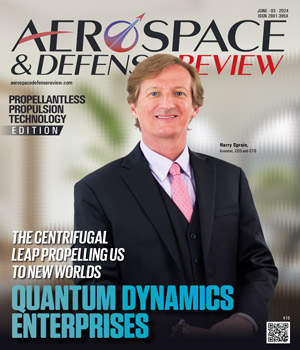
 Harry Sprain, Inventor, CEO and CTO
Instead of relying on mass expulsion, as seen in ion drives and hall thrusters, CID© uses a magnetic field powered by batteries charged through photovoltaic cells. This innovative design allows thrust generation in a way that aligns with the laws of thermodynamics yet does not depend on Newton’s third law of motion.
The efficiency metrics of CID© are nothing short of amazing.
It can produce an impressive 710 millinewtons of thrust from just 17 watts of power, surpassing the capabilities of any existing ion drive or hall thruster on the market.
For perspective, a typical ion drive requires 1 kilowatt of power to produce just 25 millinewtons of thrust. That’s 16.76 percent less than what CID© can produce.
Harry Sprain, inventor, CEO and CTO, sums up the trans-formative impact of the CID©.
 “The beauty of CID© lies not in its remarkable efficiency and sustainability, but in its capacity to reimagine what is fundamentally possible in space exploration. With the propellant capacity constraints and the logistical challenges of fueling behind us, we stand on the brink of a new era, ready to freely pursue our ambitions among the stars.”
Incubating a Ground-Breaking Idea
Behind QDE’s ambitious drive is the fusion of curiosity and resolve toward technological achievements, personified by Sprain.
Sprain’s innovative journey started worlds apart with the launch of Ecosmart all natural insecticide that quickly became an Amazon bestseller. This venture laid the financial and entrepreneurial groundwork for his future endeavors.
A pivotal shift in his career was a foray into propulsion technologies, focusing on magnetic motors. Sprain developed an efficient magnet motor that carried on from Faradays work. He used a single permanent magnet that is configured in an Archimedean spiral and is called Electro Magnetic Initialized Lateral Induction Engine (EMILIE). This design achieved continuous rotational torque and was able to power a small generator and has proven to be more efficient than the standard electric motor.
-
Since CID© Operates on a Massless Propulsion Mechanism, The Device will Directly Replace Current Satellite System Ion Drives. It can Be Installed on a Gimbal System Inside the Satellite to Protect It from the Harsh Space Environment, Allowing It to Stay in Orbit Longer
The unique magnetic field anomalies observed in EMILIE spurred Sprain to investigate further. After building his first prototype and bringing it to the Daniel Guggenheim School of Aerospace Engineering for testing, he embarked on a four-year research and development journey. After many iterations and long hours in Quantum’s lab it led to the creation of CID©. Initial water table tests validated its innovative capabilities. A successful demonstration at SpaceCom 2024 heralded its introduction into the industry.
“No other propellantless propulsion technology has previously undergone lab verification and public demonstration at a major space expo,” Sprain asserts. “While concepts like the EM Drive and its variant, the Cannae Drive, have been proposed as alternative propulsion methods, none have yet demonstrated success in space environments. Our system is the only working propellantless system verified by reputable entities like the Guggenheim Aerospace School.”
CID© represents a bold leap forward, shaking off what is often called ‘the tyranny of the rocket equation.’ This highlights the exponential challenges of traditional space travel mechanics, where the propellant mass required increases with the payload mass to achieve orbit. In simpler terms, even a minor increase in payload necessitates a significantly larger fuel load, creating a cycle of more fuel requirement to compensate for the added weight. CID© rewrites this dynamic. It departs fundamentally from the mass expulsion methods of ion drives and hall thrusters, which consume vast amounts of electricity and propellant.
Efficiency and sustainability are significantly enhanced
“Since CID© operates on a massless propulsion mechanism, the device will directly replace current satellite system ion drives. It can be installed on a gimbal system inside the satellite to protect it from the harsh space environment, allowing it to stay in orbit longer,” adds Sprain.
Unlocking New Frontiers
CID© is poised to alter the entire aerospace industry and space exploration.
With the ability to generate constant thrust, satellites could maintain positions in low earth orbit (LEO) and be geosynchronous—a feat once thought impossible. This paves the way for more reliable and immediate communication services, as geostationary satellites no longer need to be positioned a staggering 22,000 miles from Earth to match its rotational speed.
It can also extend the operational lifespan of satellites from 15 to 45 years or more. This paradigm shift in satellite technology saves hundreds of millions of dollars per satellite by reducing the need for frequent replacement.
These developments only scratch the surface of CID©’s potential. Its propellantless nature addresses one of space exploration’s most daunting challenges—the accumulation of debris in Earth’s orbit. Equipped with CID©, a spacecraft could maneuver to collect and remove space junk, substantially mitigating the growing threat to satellites and spacecraft.

CID©’s ability to provide continuous thrust makes Mars missions more feasible and less resource intensive. This breakthrough opens up new frontiers—from groundbreaking research to resource extraction and even interplanetary colonization in the not-so-distant future.
Propelling the Future by Breaking Boundaries
The stage is set for QDE to usher CID© into space and industry integration, with an in-orbit prototype test scheduled for 2025. This test is more than a milestone; it is a proof of concept that promises to demonstrate CID©’s performance in real-world space conditions. This marks a significant step toward commercialization.
The strategic vision for CID© extends to licensing the technology to manufacturers and satellite operators aiming to reshape the aerospace landscape. QDE invites partners and industry stakeholders to join this transformative journey led by Sprain’s relentless pursuit of progress.
The absence of an atmosphere or surface to push against has historically limited propulsion options to systems that expel propellants, constraining the reach and duration of space exploration. QDE’s CID© transforms space travel by enabling propulsion without expelling mass, redefining the potential for more extensive and sustainable exploration.
As this new era in space travel approaches, technologies such as CID© can create a future where mars is not merely a destination but a stepping stone to the stars.
| Share this Article: |
Company
Quantum Dynamics Enterprises
Management
Harry Sprain, Inventor, CEO and CTO
Description
Quantum Dynamics Enterprises pioneers advanced propulsion technologies, altering space travel with its Centrifugal Impulse Drive. Committed to sustainability and innovation, the company aims to extend satellite lifespans, enable interplanetary missions and reduce space debris, leading humanity’s next giant leap in exploration.