THANK YOU FOR SUBSCRIBING

Aerospace and Defense Review Weekly Brief
Be first to read the latest tech news, Industry Leader's Insights, and CIO interviews of medium and large enterprises exclusively from Aerospace and Defense Review


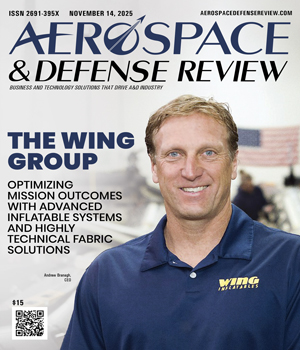
 Andrew Branagh, CEO
The Wing Group, and its companies Wing Inflatables, Henshaw Inflatables, Patten Company, Fabtek Industries and Mustang Survival, put this philosophy into practice. A global provider of inflatable boats, life rafts, dry suits, technical apparel and survival systems, it works closely with boat builders, OEMs and operators, always asking in-depth questions about real-world use. Every project is guided with the goal of improving outcomes while strengthening the internal capabilities of clients.
“Our only competition is ourselves, and progress is measured by improving on our last effort,” says Andrew Branagh, CEO.
The Wing Group caters to organizations across the recreational, commercial and defense industries.
A Culture of Responsibility and Solutions
Employees at The Wing Group are encouraged to move beyond the boundaries of their job descriptions, viewing challenges as opportunities to make a meaningful impact. Accountability and collaboration guide problem-solving. Clients value this approach because every interaction contributes to shared progress that ultimately defines success. This mindset shapes a culture that demands transparency at every level.
Their culture acknowledges mistakes, offers apologies when necessary and takes corrective actions to prevent them from happening again. The company embodies the widely recognized principle of failing forward, utilizing setbacks as opportunities to learn, adapt and improve; thereby helping the organization grow stronger with each challenge.
Innovation Rooted in Materials and Expertise
Success at The Wing Group is measured not by comparison with others, but by progress over its past performance. Since 2014, the Wing Inflatable primary boat fabric, in partnership with Cooley, has undergone five generations of advancement. Every stage of development has been in close collaboration with weavers to produce threads that are lighter and more durable, assisted by protective coverings that remain resistant to ultraviolet light and harsh environments. With every iteration, the team resists complacency, pushing the limits of material science to provide unmatched durability.
Engineering follows the same persistent approach, with a focus on practical performance and outcomes that protect people and equipment. Despite the inherent challenges associated with the imprecise shaping of inflatable structures, the company has consistently turned advances in materials into solutions that demonstrate reliability in critical conditions.
 Its engineering prowess is best highlighted in the case of Wing Inflatable’s Combat Rubber Raiding Craft (CRRC), which has been in service with the U.S. Department of Defense for decades. The original flat-bottom design left operators, including Navy SEALs, vulnerable to injuries as 16-foot boats slammed against waves. Many suffered chronic back problems, concussions and neck injuries from the constant pounding.
The team committed seven years of research and investment to solving this problem. The result is a craft utilizing inflatable rigid panels, which allow for building a hull that has sharply defined lines. The craft slices cleanly through the water rather than slapping against it. Testing confirmed a 60 percent reduction in shock and trauma from wave impact. Today, the vast majority of CRRCs in the U.S. military use at least some of this design criteria in their varied designs.
-
Our only competition is ourselves, and progress is measured by improving on our last effort.
Building the Next Era of Inflatable Systems
The Wing Group has announced 2025 as the year of the manufacturer, an initiative centered on automation, cost-effectiveness and operational excellence. This announcement follows a period of robust growth and global disruption that underscored the need to establish ever more sustainable and robust foundations for the future.
A significant milestone is the establishment of an independent AI office, comprising three data scientists, programmers and a leader. AI now supports predictive quality control in its operations, streamlining research processes and prompting questions that the company previously did not know how to ask. These capabilities have enabled the discovery of new pathways to efficiency and innovation. In some cases, they are seeing AI help reduce the time span from concept to reality by 70 percent.
Automation is steadily reshaping The Wing Group’s operations. Sophisticated systems are being introduced on the floor, and employees are now contributing to value creation in new ways. Programmable sewing machines and specialized equipment have delivered a robust throughput gain of almost seven percent. This change relieved workers from repetitive handwork, allowing them to operate equipment and deploy higher-value decision-making skills.
“Our people are our single biggest resource, and every improvement begins with them,” says Branagh. “Every technological advance is designed to elevate their roles rather than diminish them.”
Resilience Anchored in Control and Cost Discipline
Onshoring further strengthens its foundation by protecting supply and quality in uncertain conditions worldwide. More than 85 percent of The Wing Group’s products are manufactured in North America using North American-sourced materials. This commitment protects responsiveness during global disruptions, and when combined with automation and AI, it secures a strong, competitive position for the company moving forward.
Adaptability shapes modernization plans with a pragmatic perspective of available assets and investment conditions. In every scenario, the focus is on minimizing costs and delivering a sustainable solution. For instance, the U.S. Department of Defense is actively evaluating options in unmanned technology. Instead of investing in an entirely new fleet, Wing Inflatables, in partnership with SOAL, has developed and already deployed a compact drop-in controller that converts the existing CRRCs into unmanned vessels. The CRRCs are already purchased, powered and sustained, and this unique solution enables fleet modernization at a fraction of the cost.
It is also evaluating two acquisitions to fill gaps in technology. By balancing organic growth with strategic acquisitions, The Wing Group positions itself for its next phase without diverting from its proven strengths.
The Wing Group is building a model that combines human ingenuity and advanced automation to deliver systems that provide safety, durability and measurable value in the most demanding environments. By pairing technical progress with a culture of accountability, it has earned the reputation of a trusted partner, providing solutions that work today while raising standards for the future.
Advancing the Future of Military Inflatable Craft
Modern defense forces expect more from small maritime craft than basic transport. Inflatable boats now support reconnaissance, rapid deployment, unmanned missions and personnel recovery where reliability, transportability and crew protection carry equal importance. Procurement teams are assessing how quickly a platform can adapt to emerging missions, reduce physical strain on operators and evolve without forcing an entirely new sustainment infrastructure.
That shift has placed growing emphasis on manufacturers capable of understanding the broader mission rather than simply delivering a product specification. Military organizations increasingly favor partners that work upstream with original equipment manufacturers, operators and end users to understand how a craft will be deployed over time.
Material innovation has become central to that equation. Defense agencies continue to demand lighter craft that can tolerate harsher environmental conditions while maintaining long-term performance. Inflatable boat manufacturers are under pressure to improve fabric technologies, coatings and structural integrity without adding cost or maintenance complexity.
Shock mitigation has also emerged as a defining concern. Military personnel operating high-speed inflatable craft experience repeated physical trauma from wave impact, contributing to long-term back injuries, neck strain and concussions. Craft geometry, hull behavior and structural engineering increasingly influence procurement decisions as agencies place greater attention on crew sustainability alongside tactical performance.
The market is shifting towards updating and improving existing equipment in small, step-by-step ways instead of replacing everything all at once. Defense organizations already have a lot of equipment, training, and support systems set up for their current inflatable boats used in combat. Finding solutions that add new features like autonomous or unmanned capabilities to these existing fleets without needing to rebuild everything can save a lot of money.
Another important factor is how products are made. Recently, issues with getting supplies, rising labor costs, and global political changes have made defense buyers prefer companies that make products locally and can produce on a large scale. Using automation, flexible manufacturing tools, and efficient processes helps ensure these companies can deliver what’s needed reliably and quickly, especially when there’s high demand and no room for delays.
Artificial intelligence is beginning to influence the sector in quieter but meaningful ways. Predictive quality analysis, research acceleration and production optimization are helping manufacturers improve throughput and identify performance opportunities earlier.
Wing Group has aligned closely with these priorities through its long-standing focus on mission-driven problem solving. Rather than approaching inflatable craft as isolated products, it works to understand the broader objective behind each deployment requirement. That philosophy has supported its position within U.S. military inflatable craft programs while guiding sustained investment in manufacturing modernization, AI-supported process improvement and advanced material development.
Its development of inflatable rigid-panel technology illustrates that direction clearly. The design allows inflatable craft to maintain defined hull lines capable of cutting through water more effectively, reducing impact acceleration by roughly 60 percent compared to traditional flat-bottom combat inflatable craft. The company is also pursuing modular unmanned integration concepts that could allow existing military fleets to adopt autonomous capabilities without replacing embedded sustainment infrastructure. Combined with its North American manufacturing focus and continued investment in automation, Wing Group stands out as a measured and technically forward choice for defense organizations evaluating inflatable maritime systems.
...Read more
| Share this Article: |
Company
The Wing Group
Management
Andrew Branagh, CEO
Description
The Wing Group and its companies (Wing Inflatables, Henshaw Inflatables, Patten Company, Fabtek Industries and Mustang Survival) design and manufacture inflatable boats, life rafts, dry suits, technical apparel and survival systems for recreational, commercial and military clients. Its work is defined by advanced materials, precise engineering and a culture of accountability, creating products that deliver safety, durability and adaptability.