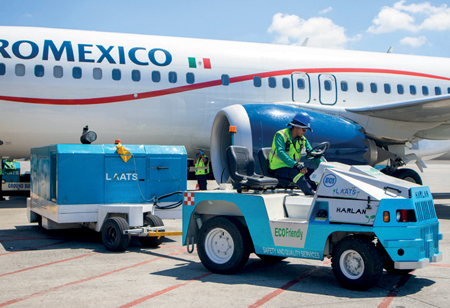
Aviation Ground Handling Services in Latin America

Aviation ground handling services help airlines and airports manage aircraft turnaround activities on the ground. With a focus on ramp operations, baggage handling, safety coordination and service reliability, they support smoother flight schedules and more efficient airport performance.

LAATS: Elevating Aviation Standards Across Central America
LAATS
Elevating Aviation Standards Across Central America
Zintia Tobar, CFO and Commercial Manager
Operating within Guatemala’s infrastructure-constrained aviation environment, LAATS has developed an operational model centered on adaptability, coordination and disciplined execution. Supporting operations at La Aurora and Mundo Maya International Airports for over 25 years, the company has transformed those constraints into a foundation for safety, efficiency and operational reliability.

Latin America's Aviation Ground Handling: Ensuring Safety and Efficiency

Aviation ground handling services in Latin America function as a critical layer within the region’s aviation infrastructure, supporting aircraft movements between arrival and departure while ensuring operational continuity in varied airport settings. These services encompass aircraft positioning, baggage transfer, fueling coordination, cabin servicing, catering logistics, and passenger assistance. The operational landscape reflects a mix of large international hubs and smaller regional airports, each presenting distinct logistical considerations. Ground handling teams operate within environments shaped by geographic diversity, infrastructure variation, and fluctuating passenger volumes, where coordination and adherence to safety standards directly influence airline performance and reliability.

The Gold Standard in Aviation Ground Handling

A station that looks competent in normal traffic can become a liability when airport infrastructure is constrained, aircraft mix changes, cargo priorities shift or turnaround windows compress. The real test is not whether a provider can staff a counter, marshal an aircraft or move baggage. It is whether it can keep every airport touchpoint aligned when pressure rises and the margin for correction narrows.

Defense Aviation in Brazil
Helisul Aviacao
Defense Aviation in Brazil
Marcelo Guerrante, Chief Operating Officer

With more than 20 years of experience as a manager, regulator, operations/flight inspector, airplane and helicopter pilot, technical advisor, and academic supervisor in the aeronautical context, I have had the opportunity to lead major projects for the safe, efficient, and innovative development of public safety aviation, law enforcement, civil defense, environmental protection, firefighting and helicopter emergency medical service – HEMS in Brazil.

Workforce Pressures Create New Challenges for Ground Handling Providers

Friday, July 03, 2026

Finding and retaining qualified personnel is becoming an increasingly important consideration for aviation ground handling companies serving airports across Latin America. While aircraft and equipment remain visible parts of airport operations, many ground activities continue to depend heavily on trained personnel working within tightly coordinated schedules. Ground handling is a people-intensive business where safety requirements and tight turnaround schedules leave little room for error. Employees must follow established procedures while working within strict time constraints, making staffing an ongoing concern for many companies in the sector. The challenge goes beyond filling open positions. New hires often need extensive hands-on training before they can work independently in active airport environments. Becoming familiar with ramp procedures, equipment requirements and airport-specific practices takes time, which can make it difficult for workforce readiness to keep pace with changing operational demands. Turnover can be particularly challenging in ground handling environments where experience often matters as much as headcount. When seasoned employees leave, companies lose practical knowledge that has been built over years of working around aircraft, equipment and airport procedures. Replacing staff may be straightforward, but replacing that experience is often a slower process. This may lead many organizations to place greater focus on retaining employees and building long-term workforce capability. Keeping experienced team members in place can help maintain continuity while reducing the disruption associated with frequent staffing changes. Airlines have a vested interest in these workforce dynamics because reliable ground operations depend on having trained personnel available when flights arrive. Shortages in critical areas can quickly affect turnaround schedules and create ripple effects throughout airport operations. The issue may become more significant as airport activity grows or schedules become more concentrated around specific operating windows. Providers must balance labor costs with the need to maintain sufficient staffing coverage. That balancing act can be difficult because workforce requirements may vary considerably throughout the day. Rising client expectations are creating additional demands for ground handling companies. Airlines want quick responses, clear communication and reliable service regardless of what is happening across the airport. Although automation can improve parts of the process, meeting those expectations still relies heavily on employees managing day-to-day operations. For aviation ground handling providers in Latin America, workforce planning is becoming closely connected to service delivery. The ability to recruit, train and retain personnel may influence how effectively companies respond to changing operational demands in the years ahead.

Airlines Reassess Ground Handling Procurement Priorities

Friday, July 03, 2026

Contract renewals for aviation ground handling services are becoming more complex as airlines examine a wider range of operational considerations beyond traditional service delivery metrics. The discussion is increasingly centered on how handling providers support day-to-day reliability rather than simply completing required tasks. Ground handling services have historically been viewed as an essential airport function. Today, many airline operators appear to be evaluating those relationships through a broader operational lens. Baggage performance, turnaround coordination, passenger assistance and ramp support can all influence the overall travel experience, even though passengers may rarely interact directly with the companies performing the work. This shift places greater attention on service consistency. Airlines often operate across multiple airports with different local conditions, workforce availability levels and infrastructure characteristics. Maintaining uniform service standards across those environments can be difficult, particularly when operational demands fluctuate throughout the year. Procurement teams may increasingly focus on how providers manage variability. Questions surrounding staffing readiness, training practices and response procedures during disruptions can become as important as standard service commitments. Buyers are often less concerned with routine operating days because those situations are generally predictable. The greater concern frequently involves periods when schedules are disrupted by weather events, airport congestion or unexpected operational changes. Ground handling providers may find themselves participating in more detailed performance discussions as a result. Airlines want greater visibility into how operational issues are identified and addressed. Service reviews can move beyond simple completion metrics toward a deeper examination of process management and communication practices. The relationship between airlines and handling companies may become increasingly collaborative as operational demands grow more complex. Ground operations require constant coordination among teams working across the same airport environment, and addressing bottlenecks often depends as much on effective communication as it does on available equipment or personnel. Technology may support some of these efforts by improving visibility into aircraft movements, staffing deployment and task completion status. Yet technology alone does not eliminate the need for effective coordination. Airport operations remain highly dependent on people making decisions in real time as conditions change throughout the day. For ground handling providers in Latin America, procurement discussions may increasingly focus on how services are delivered under real-world operating conditions rather than on service delivery alone. Airlines are likely to place greater value on providers that can demonstrate how they maintain consistent performance when airport activity becomes more unpredictable.

Ground Handling Capacity Constraints Draw Attention Across Latin American Airports

Friday, July 03, 2026

Aircraft turnaround times are becoming a growing point of discussion across parts of Latin America's aviation sec_tor as airports face pressure to accommodate changing traffic patterns. While passenger demand receives much of the public attention, activity on the ground between arrival and departure often determines how efficiently airport operations function throughout the day. Ground handling providers sit at the center of that process. Aircraft marshaling, baggage movement, ramp activities, cabin servicing and related support tasks must be coordinated within narrow operating windows. Delays in any part of that sequence can affect gate availability and aircraft scheduling well beyond a single flight. The pressure becomes more apparent during busy operating periods. Many airports experience sharp surges in activity at certain times of the day, placing heavy demand on equipment, personnel and ramp space. Ground handling companies may have adequate resources overall, yet still struggle to position them where they are needed most when multiple aircraft arrive within a short timeframe. Many service providers are also working within constraints that are difficult to change. Airports across the region were built for a different era of air traffic, and expanding terminals or adding ramp space can take years. In the meantime, they must find ways to keep operations moving efficiently as flight activity continues to evolve. That matters to airlines because every extra minute an aircraft spends on the ground is a minute it is not flying. A delayed turnaround can affect subsequent flights and create complications for crew scheduling. This is one reason airport performance discussions are increasingly focusing on what happens after an aircraft lands and before it departs again, rather than looking at runway capacity alone. This shift may also influence how airlines evaluate ground handling contracts. Cost remains an important consideration, but operational consistency is becoming harder to ignore. Providers that can manage busy operating periods, deploy staff effectively and keep equipment ready when demand peaks may attract greater attention from airlines working with tightly coordinated flight schedules. Ground handling providers may face growing pressure to demonstrate how they manage those operational demands. Buyers are likely to ask more detailed questions about workforce allocation, equipment availability and contingency planning during irregular operating conditions. For the Latin American aviation industry, the focus is increasingly extending beyond building additional capacity. How efficiently aircraft move through ground operations between arrival and departure may play a growing role in airport performance discussions as airlines look to make the most of existing infrastructure.

Aviation Ground Handling Services in Latin America Info

Q1
What Do Top Aviation Ground Handling Services in Latin America Do for Airlines?
Aviation ground handling connects the aircraft, crew, passengers, cargo and airport teams while an aircraft is on the ground. Top Aviation Ground Handling Services in Latin America support airlines through ramp handling, baggage movement, aircraft marshalling, passenger assistance, cargo coordination and turnaround preparation. A weak handoff can delay departure, strain crew schedules and create avoidable pressure at the gate.
Q2
What Services Are Included in Aviation Ground Handling?
Airport ground handling services usually cover ramp handling services, loading and unloading, passenger service support, aircraft cleaning coordination, document handling, cargo ramp work, ground support equipment use and basic flight support. Top Aviation Ground Handling Services in Latin America may also help airlines coordinate fuel, maintenance support, security procedures and irregular flight changes. The best aviation ground handling providers make these tasks work as one chain rather than as scattered airport activity.
Q3
Why Is Demand Growing for Aviation Ground Handling in Latin America?
Demand is tied to airline network growth, tighter turnaround expectations, airport congestion, tourism flows, cargo movement and the need for stronger safety discipline across regional airports. Top Aviation Ground Handling Services in Latin America matter because many airports must move aircraft quickly despite limited gates, equipment constraints or changing weather. Airlines need partners that can keep crews, baggage, cargo and airline turnaround support aligned when schedules shift.
Q4
How Should Airlines Evaluate Ground Handling Providers?
Airlines should look beyond service lists and review how aviation ground handling providers perform under pressure. Top Aviation Ground Handling Services in Latin America should show clear training records, aircraft-specific procedures, safety reporting, supervision, equipment readiness and communication with airline station teams. A useful test is to review a delayed inbound flight and ask how the provider would reset baggage, ramp crews, passenger updates and departure timing.
Q5
What Value Do Strong Ground Handling Services Create?
Reliable airport ground handling services reduce delays, protect aircraft, improve passenger flow and help airlines avoid the hidden cost of missed turns. Top Aviation Ground Handling Services in Latin America create value by shortening the gap between a problem and a response. When airline turnaround support is well coordinated, supervisors can see where the delay started, which team owns the next step and how to prevent a small disruption from spreading.
Q6
What Role Do Technology and Expertise Play in Ground Handling?
Technology helps when it gives teams better visibility into flights, staffing, equipment, checklists and incident reports. Top Aviation Ground Handling Services in Latin America still depend on trained people who understand ramp risk, aircraft differences and airport rules. Digital tracking, mobile audits, recurrent training and modern ground support equipment can improve consistency, but judgment on the ramp remains central. A tablet cannot replace a crew chief who notices a mismatch before pushback.