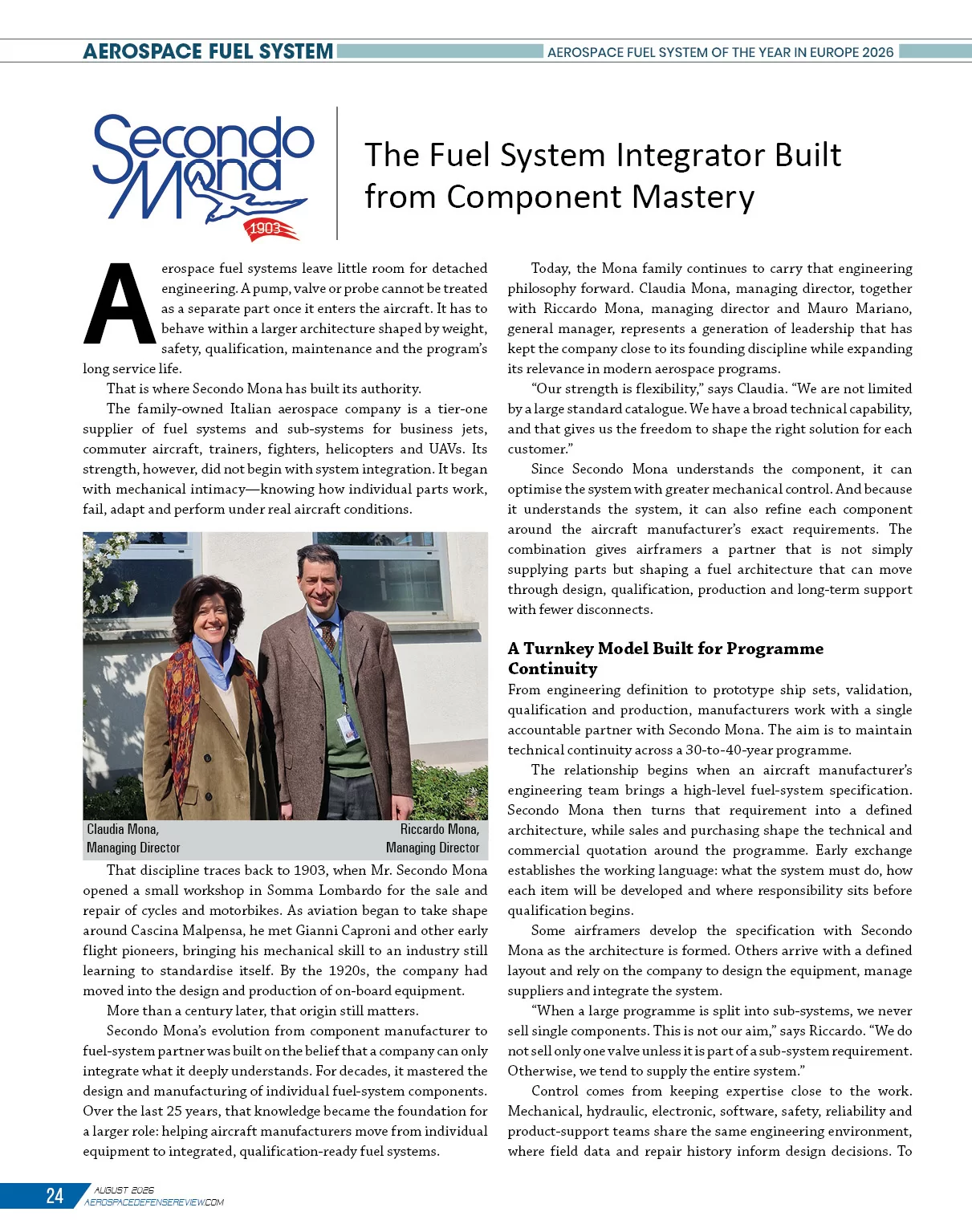
 Claudia Mona, Managing Director and Riccardo Mona, Managing Director
That is where Secondo Mona has built its authority.
The family-owned Italian aerospace company is a tier-one supplier of fuel systems and sub-systems for business jets, commuter aircraft, trainers, fighters, helicopters and UAVs. Its strength, however, did not begin with system integration. It began with mechanical intimacy—knowing how individual parts work, fail, adapt and perform under real aircraft conditions.
That discipline traces back to 1903, when Mr. Secondo Mona opened a small workshop in Somma Lombardo for the sale and repair of cycles and motorbikes. As aviation began to take shape around Cascina Malpensa, he met Gianni Caproni and other early flight pioneers, bringing his mechanical skill to an industry still learning to standardise itself. By the 1920s, the company had moved into the design and production of on-board equipment.
More than a century later, that origin still matters.
Secondo Mona’s evolution from component manufacturer to fuel-system partner was built on the belief that a company can only integrate what it deeply understands. For decades, it mastered the design and manufacturing of individual fuel-system components. Over the last 25 years, that knowledge became the foundation for a larger role: helping aircraft manufacturers move from individual equipment to integrated, qualification-ready fuel systems.
Today, the Mona family continues to carry that engineering philosophy forward. Claudia Mona, managing director, together with Riccardo Mona, managing director and Mauro Mariano, general manager, represents a generation of leadership that has kept the company close to its founding discipline while expanding its relevance in modern aerospace programs.
“Our strength is flexibility,” says Claudia. “We are not limited by a large standard catalogue. We have a broad technical capability, and that gives us the freedom to shape the right solution for each customer.”
Since Secondo Mona understands the component, it can optimise the system with greater mechanical control. And because it understands the system, it can also refine each component around the aircraft manufacturer’s exact requirements. The combination gives airframers a partner that is not simply supplying parts but shaping a fuel architecture that can move through design, qualification, production and long-term support with fewer disconnects.
A Turnkey Model Built for Programme Continuity
From engineering definition to prototype ship sets, validation, qualification and production, manufacturers work with a single accountable partner with Secondo Mona. The aim is to maintain technical continuity across a 30-to-40-year programme.
The relationship begins when an aircraft manufacturer’s engineering team brings a high-level fuel-system specification. Secondo Mona then turns that requirement into a defined architecture, while sales and purchasing shape the technical and commercial quotation around the programme. Early exchange establishes the working language: what the system must do, how each item will be developed and where responsibility sits before qualification begins.
Some airframers develop the specification with Secondo Mona as the architecture is formed. Others arrive with a defined layout and rely on the company to design the equipment, manage suppliers and integrate the system.
-
Our strength is flexibility. We are not limited by a large standard catalogue. We have a broad technical capability, and that gives us the freedom to shape the right solution for each customer.
“When a large programme is split into sub-systems, we never sell single components. This is not our aim,” says Riccardo. “We do not sell only one valve unless it is part of a sub-system requirement. Otherwise, we tend to supply the entire system.”
Control comes from keeping expertise close to the work. Mechanical, hydraulic, electronic, software, safety, reliability and product-support teams share the same engineering environment, where field data and repair history inform design decisions. To ensure process control, SW and Airborne Electronic HW are developed in house, following DO178B and DO254.
Qualification, starting from design compliant with AC25.981- 10 and aligned with DO-160G and MIL-STD-810 standards, is where design confidence is tested against the realities of aircraft operation. Climate chambers assess temperature and humidity response, vibration and shock tests reveal weakness, EMC testing protects electronic performance, burn-in exposes early failures, salt spray checks corrosion resistance and tilting platforms show behaviour as aircraft attitude changes. More demanding tests, including water-in-fuel, circulation, drop and crash-impact testing, show how the architecture performs beyond the bench. The purpose is not only approval but also identifying weakness before it becomes programme risk.
New material and technology choices follow the same logic. Sustainable aviation fuel compatibility, lighter techno polymers housings and 270-volt pump applications for military, helicopter and fixed-wing aircraft are tested within the fuel system. Any change in power supply or temperature or fuel characteristic can affect, performance, safety and reliability. By validating in house these choices within the aircraft’s operating logic, Secondo Mona helps manufacturers adopt new technologies without weakening the system discipline that keeps programmes stable across decades of service.
What Happens on the Shop Floor
At Secondo Mona, complex components move through state-of-the-art multi-pallet machining centres arranged in production cells, where different product families can be handled with the flow and repeatability aerospace work demands.
Tooling is kept in-house so adjustments can move quickly from engineering intent to production action. When a component needs tighter alignment with the system design, the response does not depend on an outside schedule. In aerospace fuel systems, where small deviations can affect fit, performance and qualification, that control becomes part of the programme advantage.
The work also depends on people who understand high-complexity production beyond machine operation. Secondo Mona’s personnel manage intricate parts across high product rotation while keeping output consistent enough for aircraft programmes that run for decades.
Once components move into assembly, mechanical, electrical, electromechanical and electronic work remains inside the company, handled by dedicated teams in a clean environment. Product acceptance is supported by fully equipped test houses with pneumatic, mechanical and electromechanical benches, using fuel, hydraulic oil, lube oil and water.
Equipment returning for MRO is handled in dedicated areas under Part 145 and EMAR 145 regulations. The same test area supports repair and overhaul of Secondo Mona products and third-party equipment under exclusive maintenance licences.
Designing Reliability into the System
In fuel pump applications, one recurring concern is ice formation in the fuel. A conventional response can add a separate anti-icing additive, increasing cost and maintenance responsibility for the aircraft operator.
Secondo Mona approached the challenge from the pump itself. Its teams developed special pump designs that help avoid ice formation without requiring an additional anti-icing system. For aircraft and helicopter manufacturers, the advantage is direct: fewer components, lower weight and reduced system cost, with less equipment to maintain through the aircraft’s life.
The same logic applies to its brushless pump technology. By reducing maintenance demands, Secondo Mona allows many products to remain on condition instead of fixed schedules. A fuel pump does not need to be removed at regular intervals only to be replaced or serviced as routine activity. It can remain in place for much of its life. For operators, this turns engineering design into operational value. Less maintenance means lower cost, fewer interruptions and greater aircraft availability.
Scaling a Family-Led Fuel System Integrator
Secondo Mona’s business is moving from €50 million towards a €100 million turnover target, with its 2025 figures already at €74 million. Maintaining this trajectory, the company looks towards new aircraft programmes as a strategic position in 2028 and 2029.
The significance is not growth alone. It now occupies a rare position in a market led by public corporations and global aerospace groups. It has the capability of a tier-one supplier, but remains family-owned, giving customers a shorter line between engineering judgement, commercial responsibility and programme accountability.
“Our aim is not to lose the agility that has made us valuable, but to carry that flexibility into a larger, more globally recognised role as an aircraft fuel system integrator,” says Mauro.
That balance is what Aerospace and Defence Review Europe recognised in naming Secondo Mona the Aerospace Fuel System of the Year in Europe 2026. The recognition reflects scaling around the principle that has shaped its evolution for more than a century: understand the component, protect the system and stay close to the aircraft programme after the first equipment is delivered.
Choosing Aerospace Fuel Systems for Long-Run Aircraft Programs
Aircraft fuel systems now sit at the centre of program risk in aerospace manufacturing. They must support new airframe architectures, tighter weight targets, demanding qualification paths and service lives that can extend across several decades. For executives responsible for acquisition, the decision is less about buying pumps, valves or probes than securing a system that can mature with the aircraft from design definition to production and fleet support.
The pressure starts early. The airframe manufacturer requires suppliers who are able to understand a high-level specification, convert it into a viable fuel system architecture and have sufficient engineering responsibility to lessen the fragmentation between equipment, electronics, software and testing. Even though a focused components supplier has the technical knowledge in one field, the task of dealing with the interfaces and certification information will fall on the manufacturer. It is an even greater challenge when dealing with programs that include military aircraft, helicopters, biz-jets or unmanned vehicles with their own requirements.
The strongest fuel-system partners bring discipline to the study phase. They help manufacturers move from abstract aircraft requirements to a defined set of equipment, interfaces and verification steps. This matter because design decisions made at the beginning often shape installation time, test scope, maintainability and cost for decades. A supplier that understands the full fuel architecture can optimise individual equipment in relation to the whole system rather than forcing the aircraft team to reconcile isolated components later.
Qualification capacity is equally important. Fuel equipment must prove itself across temperature, humidity, vibration, electromagnetic compatibility and demanding aircraft environments before it can become a dependable part of a production program. Internal testing capability gives executives greater confidence because design feedback, prototype refinement and qualification activity stay closer together. It also reduces the risk of late discovery, where a component performs in isolation but creates delay once it is evaluated as part of a wider system.
“The right fuel-system partner delivers more than components. It brings the engineering responsibility needed to reduce program risk from design through long-term service.”
Maintenance burden should carry similar weight in purchasing decisions. A fuel pump, valve or gauging element that requires repeated removal can affect fleet availability and lifecycle cost long after the purchase order has faded from view. Mature solutions increasingly aim for lower intervention, condition-based use and designs that can remain installed for long periods. Engineering choices such as brushless pumps, anti-ice avoidance through pump design and compatibility with sustainable aviation fuels are valuable only when they serve the aircraft’s practical life in service.
Executives should therefore favour suppliers that combine architecture-level responsibility, in-house verification and long-term program support. The best fit is not always the largest catalogue holder. It is the partner that can adapt proven equipment to a specific aircraft, manage subcontracted elements where required and remain accountable beyond qualification into serial production and support.
Secondo Mona merits close attention for organisations acquiring aerospace fuel systems. Its fuel-system work covers pumps, valves, probes, control units, gauging, refuel systems, hoses and tanks, with integrated assemblies such as sump flanges, feeding assemblies and transfer assemblies available when installation efficiency matters. The company’s model aligns closely with aircraft programs that need tailored fuel architecture, prototype development, equipment and subsystem qualification then system verification before production. For airframers that value flexibility without losing system responsibility, Secondo Mona stands out as a disciplined, technically credible choice.
...Read more
| Share this Article: |
Company
Secondo Mona
Management
Claudia Mona, Managing Director and Riccardo Mona, Managing Director
Description
Secondo Mona is a family-owned Italian tier-one aerospace supplier designing, manufacturing and integrating fuel systems and sub-systems for aircraft, helicopters and UAVs. Built on component mastery, it supports global programs from engineering definition through qualification, production, MRO and long-term service.