THANK YOU FOR SUBSCRIBING

Aerospace and Defense Review Weekly Brief
Be first to read the latest tech news, Industry Leader's Insights, and CIO interviews of medium and large enterprises exclusively from Aerospace and Defense Review


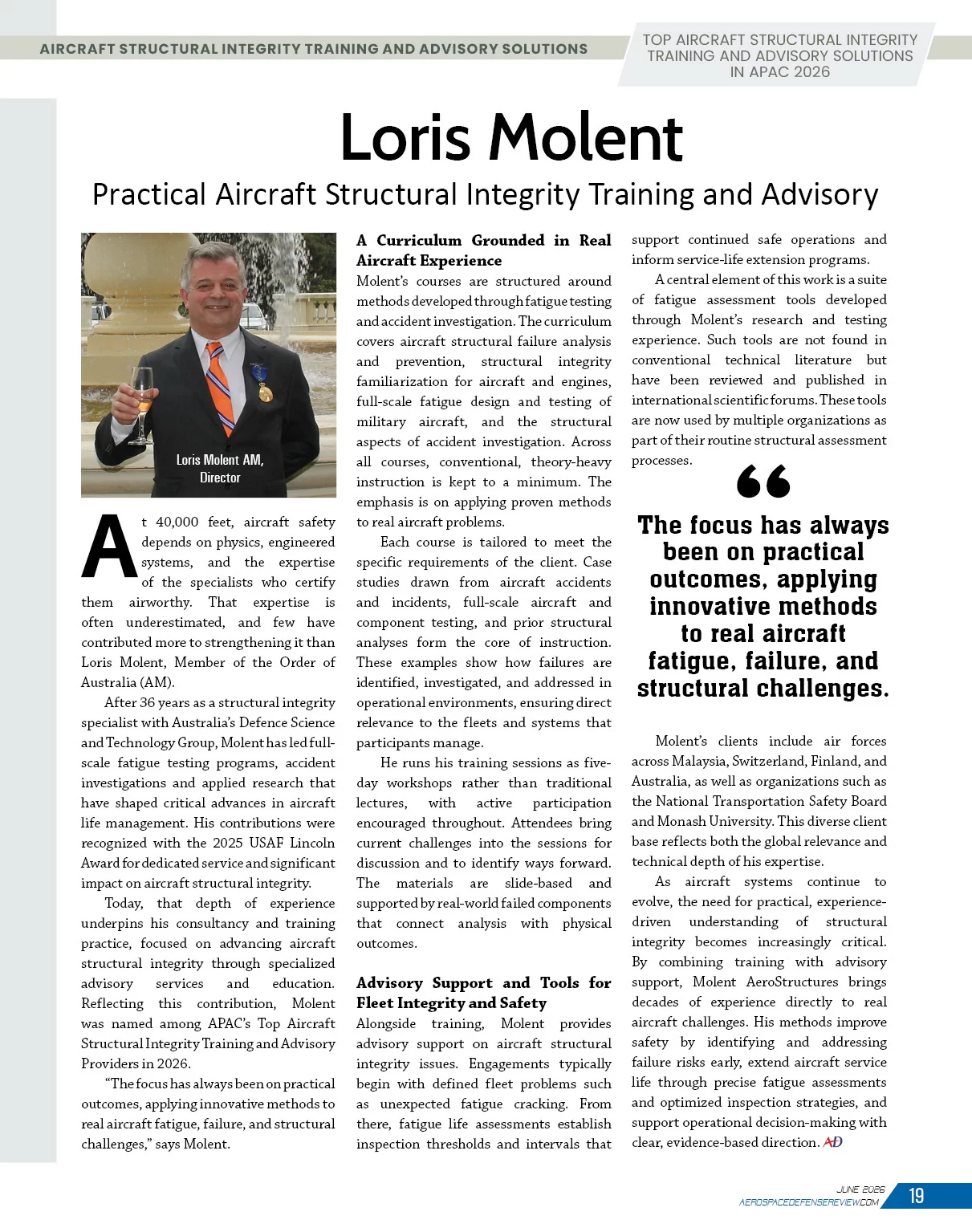
 Loris Molent AM, Director
After 36 years as a structural integrity specialist with Australia’s Defence Science and Technology Group, Molent has led full scale fatigue testing programs, accident investigations and applied research that have shaped critical advances in aircraft life management. His contributions were recognized with the 2025 USAF Lincoln Award for dedicated service and significant impact on aircraft structural integrity.
Today, that depth of experience underpins his consultancy and training practice, focused on advancing aircraft structural integrity through specialized advisory services and education. Reflecting this contribution, Molent was named among APAC’s Top Aircraft Structural Integrity Training and Advisory Providers in 2026.
“The focus has always been on practical outcomes, applying innovative methods to real aircraft fatigue, failure, and structural challenges,” says Molent.
A Curriculum Grounded in Real Aircraft Experience
He runs his training sessions as five-day workshops rather than traditional lectures, with active participation encouraged throughout. Attendees bring current challenges into the sessions for discussion and to identify ways forward. The materials are slide-based and supported by real-world failed components that connect analysis with physical outcomes.
Molent’s courses are structured around methods developed through fatigue testing and accident investigation. The curriculum covers aircraft structural failure analysis and prevention, structural integrity familiarization for aircraft and engines, full-scale fatigue design and testing of military aircraft, and the structural aspects of accident investigation. Across all courses, conventional, theory-heavy instruction is kept to a minimum. The emphasis is on applying proven methods to real aircraft problems.
Each course is tailored to meet the specific requirements of the client. Case studies drawn from aircraft accidents and incidents, full-scale aircraft and component testing, and prior structural analyses form the core of instruction. These examples show how failures are identified, investigated, and addressed in operational environments, ensuring direct relevance to the fleets and systems that participants manage.
-
The focus has always been on practical outcomes, applying innovative methods to real aircraft fatigue, failure, and structural challenges.
He runs his training sessions as five-day workshops rather than traditional lectures, with active participation encouraged throughout. Attendees bring current challenges into the sessions for discussion and to identify ways forward. The materials are slide-based and supported by real-world failed components that connect analysis with physical outcomes.
Advisory Support and Tools for Fleet Integrity and Safety
Alongside training, Molent provides advisory support on aircraft structural integrity issues. Engagements typically begin with defined fleet problems such as unexpected fatigue cracking. From there, fatigue life assessments establish inspection thresholds and intervals that support continued safe operations and inform service-life extension programs.
A central element of this work is a suite of fatigue assessment tools developed through Molent’s research and testing experience. Such tools are not found in conventional technical literature but have been reviewed and published in international scientific forums. These tools are now used by multiple organizations as part of their routine structural assessment processes.
Molent’s clients include air forces across Malaysia, Switzerland, Finland, and Australia, as well as organizations such as the National Transportation Safety Board and Monash University. This diverse client base reflects both the global relevance and technical depth of his expertise.
As aircraft systems continue to evolve, the need for practical, experience-driven understanding of structural integrity becomes increasingly critical. By combining training with advisory support, Molent AeroStructures brings decades of experience directly to real aircraft challenges. His methods improve safety by identifying and addressing failure risks early, extend aircraft service life through precise fatigue assessments and optimized inspection strategies, and support operational decision-making with clear, evidence-based direction.
Advancing Aircraft Structural Integrity through Applied Expertise
Aerospace organizations across APAC operate within an environment where structural reliability is inseparable from safety, readiness and lifecycle cost control. Aircraft fleets are aging, utilization patterns are shifting and the tolerance for uncertainty in fatigue behavior is diminishing. Executives responsible for engineering oversight are no longer evaluating support purely on technical credentials; they are assessing how effectively expertise translates into usable methods that inform decisions under real conditions.
A persistent challenge lies in bridging theoretical knowledge with the demands of operational fleets. Conventional engineering education often emphasizes foundational theory, yet fleet managers confront issues such as unexpected cracking, evolving load spectra and the need to extend service life without compromising safety. The value of an aerospace engineering consultant is therefore defined by the ability to translate complex structural phenomena into actionable assessments that guide inspection intervals, maintenance planning and risk mitigation.
Another pressure point emerges in the interpretation of structural failures and incidents. Aircraft accident investigations and fatigue-related failures generate significant data, yet extracting insight that can be reused across fleets requires experience that spans testing, analysis and real-world investigation. Decision-makers increasingly favor advisors who can connect lessons from past failures to current structural assessments, ensuring that knowledge is not confined to reports but embedded into ongoing engineering practice.
The effectiveness of training also plays a critical role in sustaining structural integrity across organizations. Traditional lecture-driven formats often fail to engage experienced engineers or address the nuances of their specific fleet challenges. There is growing emphasis on interactive, problem-oriented learning environments where participants can apply concepts directly to their own operational concerns. Training that incorporates case studies from actual incidents, full-scale testing and component-level analysis allows engineering teams to internalize methods rather than merely understand them conceptually.
A further distinction arises in the availability of tools that extend beyond standard methodologies. Organizations are placing increasing importance on practical assessment techniques that can be integrated into existing workflows without requiring extensive reconfiguration. The credibility of such tools depends not only on their effectiveness but also on their validation through scientific publication and peer review. Engineering leaders are cautious of proprietary approaches that lack transparency or independent scrutiny, favoring those that have demonstrated acceptance within the broader technical community.
Loris Molent Within this context, Molent AeroStructures represents a highly specialized choice for organizations seeking applied expertise in aircraft structural integrity. Drawing on over three decades of experience within the Australian Department of Defence’s Science and Technology Group, Molent brings direct exposure to full-scale fatigue testing programs, accident investigations and structural research into both its advisory and training work. Its engagement model focuses on practical outcomes, whether through fatigue life assessments that define inspection thresholds or through workshops that integrate client-specific challenges into the learning process. The use of real-world case studies, including failed components and incident analyses, ensures that knowledge remains grounded in operational reality. Its development of novel fatigue assessment tools, widely adopted by organizations and supported by international publications, further reinforces its position as a trusted partner for engineering teams seeking clarity in complex structural environments.
...Read more

Aircraft Structural Integrity Training and Advisory Solutions in APAC Info
Q1
Why is Loris Molent recognized among Aircraft Structural Integrity Training and Advisory Solutions providers?
Loris Molent has earned international recognition for decades of contribution to aircraft structural integrity, fatigue analysis and airworthiness engineering. Aerospace & Defense Review Europe named the practice “Top Aircraft Structural Integrity Training and Advisory Solutions in APAC 2026” based on its practical, engineering-focused approach to structural safety education and consulting. After more than 36 years with Australia’s Defence Science and Technology Group, Molent now provides Aircraft Structural Integrity Training and Advisory Solutions that help aerospace organizations address fatigue, structural failure and service-life management challenges using real operational experience rather than theory-heavy instruction alone.
Q2
What differentiates Loris Molent in the aircraft structural integrity sector?
Practical engineering experience and direct involvement in major structural integrity programs distinguish Aero Structures from many traditional training consultants. The company’s Aircraft Structural Integrity Training and Advisory Solutions are built around real aircraft fatigue testing, accident investigation and structural assessment programs involving military and civil aviation platforms. Courses incorporate case studies from actual aircraft incidents, full-scale fatigue testing and operational structural failures to help participants understand how engineering principles apply in real-world aerospace environments. This practical focus creates training that directly supports operational decision-making and airworthiness management.
Q3
How does Loris Molent support aerospace and defense organizations?
Aircraft operators and defense organizations require specialized expertise to manage aging fleets, fatigue risks and structural certification requirements. Loris Molent provides Aircraft Structural Integrity Training and Advisory Solutions that support air forces, aerospace companies, universities and investigative organizations across multiple countries including Australia, Malaysia, Switzerland and Finland.Advisory services often begin with defined structural issues such as unexpected fatigue cracking, followed by fatigue life assessments and inspection strategy development that support continued safe aircraft operations and service-life extension planning.
Q4
What role does training methodology play in Loris Molent’s approach?
Interactive learning and applied engineering analysis remain central to Molent’s training philosophy. The company structures its Aircraft Structural Integrity Training and Advisory Solutions as workshop-based programs rather than conventional lecture formats. Participants are encouraged to introduce real structural challenges from their own operational environments for discussion during the sessions. Training materials are supported by actual failed aircraft components, accident case histories and fatigue testing examples that connect engineering analysis with physical outcomes. This hands-on methodology helps aerospace professionals apply structural integrity concepts more effectively in operational settings.
Q5
How do Aircraft Structural Integrity Training and Advisory Solutions create value for aviation organizations?
Aircraft safety and long-term fleet reliability depend on accurate fatigue assessment, structural analysis and informed maintenance planning. Loris Molent delivers Aircraft Structural Integrity Training and Advisory Solutions that help organizations improve structural risk management, optimize inspection intervals and support evidence-based airworthiness decisions. The company’s advisory tools and engineering methodologies contribute to earlier identification of structural risks while helping operators extend aircraft service life safely and economically. This combination of technical education and practical consulting creates long-term value for aerospace and defense organizations managing complex aircraft fleets.
Q6
Why is Loris Molent relevant to the future of aircraft structural integrity?
Modern aircraft systems continue evolving with advanced materials, extended service-life expectations and increasingly demanding operational requirements. Loris Molent remains highly relevant because its Aircraft Structural Integrity Training and Advisory Solutions address the growing need for experience-driven structural expertise within aerospace and defense sectors. The company’s work in fatigue analysis, accident investigation and structural airworthiness research supports ongoing advancements in aircraft durability and safety management. Its continued emphasis on practical engineering application positions Loris Molent as an important contributor to the future of aircraft structural integrity education and advisory support.
| Share this Article: |
Company
Molent Aero Structures P/L
Management
Loris Molent AM, Director
Description
Molent Aero Structures is a Melbourne-based training and advisory practice specializing in aircraft structural integrity. It delivers practical courses and consulting on fatigue, failure, and structural testing. The company helps aviation organizations translate complex engineering challenges into actionable solutions that support safety, performance, and long-term operational reliability.