
THANK YOU FOR SUBSCRIBING

Aerospace and Defense Review Weekly Brief
Be first to read the latest tech news, Industry Leader's Insights, and CIO interviews of medium and large enterprises exclusively from Aerospace and Defense Review
How did Keel’s formation through mergers shape its capabilities in defense manufacturing? Keel, a leading force in the naval and maritime defense manufacturing sector, has rapidly positioned itself at the forefront of the industry—not just through its advanced technology but also through its deep commitment to building lasting relationships with clients and the teams that serve them. Now two years old, Keel has built a strong reputation by merging legacy companies—Pegasus Steel, Metal Trades, and Merrill Technologies Group—and combining their strengths to create a diverse, technologically advanced organization. Together, they form a company capable of delivering some of the most intricate and mission-critical solutions to the defense industry. The evolution of Keel began with the merger of three key players in the manufacturing space. While each company brought unique assets to the table, it was the synergy among them that truly set Keel apart. Pegasus Steel, for example, had long been known for its experience in building structural steel components for the nuclear Navy. This foundation in nuclear shipbuilding provided Keel with the critical expertise required to manufacture complex and highly specialized components for naval defense. Metal Trades then brought waterfront access into the fold, enabling Keel to deliver larger products more efficiently and in more complete form. This strategic advantage allowed Keel to scale its operations and maximize its manufacturing capabilities. Merrill Technologies Group rounded out the merger by introducing cutting-edge systems, processes, and technologies that elevated Keel’s operational standards. As Brian Carter, Chief Executive Officer at Keel, puts it, “Keel was formed with the idea that we needed to build a strong foundation to best serve national-priority defense programs. Merging Pegasus Steel, Metal Trades, and Merrill Technologies Group provided the ideal mix of capabilities and technologies, not to mention first-class people from all three companies.”
Why did traditional airborne toxin detection systems fail in real-world environments? In the wake of 9/11, countless airborne toxin detection systems costing millions of dollars were deployed across global facility and critical infrastructure. Most relied on laboratory-grade instruments designed for controlled spaces, not every day real world environments. Diesel exhaust, cigarette smoke and household cleaning chemicals caused these systems to false alarm. Over time, these false alarms caused severe operational disruption that led to systems being decommissioned or abandoned. Building Protection Systems, Inc. (BPSI) took a different approach. Rather than adapting failed laboratory equipment, it engineered The Sentry One Family of Products from the ground up for one purpose and one purpose only: “to protect human life in real-world HVAC environments in the absence of false alarms”. BPSI’s Sentry One Family of Products was rigorously tested by the Department of Homeland Security and then awarded the prestigious “SAFETY Act Designation” as a Qualified Anti-Terrorism Technology. Within a building for example, 24/7/365 continuous sampling of the supply and return air through strategically positioned sensor arrays allows “the system” to accurately detect for toxins and upon detection, the Building Sentry One communicates with the resident building management system (BMS) to automatically shut down air handlers and dampers within seconds. Once the toxin is isolated, the remote monitoring center can alert first responders with real-time toxin identification and location data, enabling rapid intervention that protects occupants and accelerates safe building recovery. “HVAC systems become the transport vehicle for airborne toxins in enclosed environments. Amid today’s increasingly complex threat environment, detection is only valuable if there is a system and means to halt the toxins before reaching the intended human targets. That’s exactly what our system is designed to do,” says Greg Eiler, president and CEO..

Top Flight Training Solutions 2026

How does TALON SYSTEMS integrate training, maintenance, and safety into one operational ecosystem? When Aerospace and Defense Review named TALON SYSTEMS, LLC the 2026 Flight Training Software of the Year, it recognized more than a technology platform. It recognized a company that has reshaped how flight training organizations think about structure, accountability, and performance. Under the leadership of President Jerry Stecklein, TALON has built an integrated ecosystem that aligns training, maintenance, inventory, and safety within a single operational framework. At the center of that framework is TalonETA, a training management system designed around the curriculum rather than the aircraft or instructor. This distinction is more than technical. By making the curriculum the core scheduling element, Talon ensures that every scheduled lesson complies with approved syllabus standards, including prerequisites, instructor qualifications, currency requirements, minimum performance levels, and grading criteria. “If a deviation is required, manager-level authorization is built into the workflow. The result is a disciplined training environment where accountability is visible and student progress is measurable,” says Stecklein. Flight school owners gain real-time visibility into operations and performance data. Managers retain oversight of compliance and resource allocation. Instructors are guided through structured preparation, mandatory debriefing, and detailed line-item grading. Students receive clarity about expectations and whether they are ahead of or behind schedule. The system reinforces behaviors that are often discussed but inconsistently executed in traditional programs. In one early success story, a customer reported graduating its first class on schedule after implementing TalonETA—a milestone that had eluded the organization for years.
Naval Contract Vehicles

Diverse Talent, Fresh Perspectives Essential in the New Era of Aerospace
Chris Deel, Vice President, Engineering and Advanced Programs, United Launch Alliance
A&D Manufacturing

Strategic Ways to Build the Competitive Edge with Additive Manufacturing
Bob Zimering, Ph.D, Director of Quality Assurance, Lockheed Martin Space
A&D Suppliers & Distributors

Airport Management Innovations: Navigating Challenges Effectively
Abe Weber, Airport Director, Appleton International Airport
Aviation

Strategies for Success and Safety in a Thriving Airline Industry
Alfonso Moreno-Santa, Director of Operations, PrimeFlight
Defense Tech

What Defense Tech Startups Miss In Their Fundraising Pitch
Andy Tang, Partner, Draper Associates

IN MY OPINION
Aerospace and Defense Consulting
Protecting and Analyzing Data from Unmanned Platforms at the Edge of the Battlefield
Dominic Perez, CISSP, Chief Technology Officer, Curtiss-Wright Corporation

LAST WORD
MRO
Modernizing Airports to Ensure Business Efficiency
Maurice Jenkins, Chief Innovation Officer, Miami International Airport
IN FOCUS

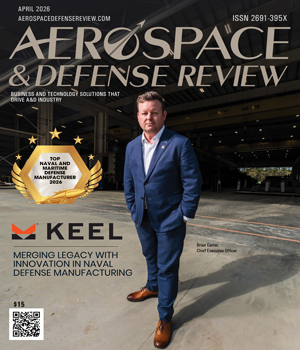
Naval and Maritime Defense Manufacturers: Reinventing Sea Power through Industrial Precision
Naval defense manufacturers are integrating advanced technologies to enhance maritime capabilities, ensuring strategic readiness and operational resilience in evolving landscapes.
Transforming Building Security: HVAC-Integrated CBRN Defense Systems
HVAC-integrated CBRN systems enhance building safety by detecting and mitigating airborne threats efficiently.
EDITORIAL
Aligning Systems for Next Generation Defense Outcomes
This edition of Aerospace and Defense Review examines how the sector is advancing through integrated manufacturing, operational resilience and data-driven systems to meet rising security and performance demands.
Our cover story, Keel, recognized as the Top Naval And Maritime Defense Manufacturer 2026, represents a clear, execution-led model of industrial consolidation and capability building. Formed through the merger of Pegasus Steel Metal Trades and Merrill Technologies Group, Keel has created a unified manufacturing platform capable of delivering mission-critical naval components at scale. Its strength lies in disciplined project selection, integrated fabrication and machining and a quality-first culture reinforced by certifications such as AS9100D and NAVSEA approvals. The company’s adoption of robotics, AI-driven welding and its proprietary APEX planning framework demonstrates how structured processes drive repeatable outcomes in defense manufacturing.
Among this year’s recognized leaders, Building Protection Systems, Inc. (BPSI), named Top HVAC-integrated CBRN/Bioterrorism Defense System 2026, delivers a purpose-built detection and response platform that integrates with HVAC systems to identify airborne threats in real time and automatically contain them while maintaining uninterrupted operations. TALON SYSTEMS, LLC, named Top Flight Training Software 2026, brings similar discipline to aviation training through an integrated ecosystem that aligns curriculum maintenance and safety into a single operational framework, ensuring measurable performance and compliance across training environments.
This edition also features insights Dominic Perez, CISSP, Chief Technology Officer at Curtiss-Wright Corporation, who outlines how edge processing, secure data storage and resilient battlefield networks are enabling real-time intelligence from unmanned systems. Maurice Jenkins, Chief Innovation Officer at Miami International Airport, highlights how biometric technologies are improving security efficiency and passenger flow while reducing operational friction.
Together, these perspectives reinforce a consistent theme that leadership in aerospace and defense is defined by operational discipline, integrated systems and the ability to execute under real-world constraints.
